
Unbiased headlines. Facts, not spin.
Unbiased Headlines is an independently owned news organization. We bring you the facts, not opinions, written fresh from 110+ named sources. Sources linked so you can verify it yourself.
 energy
Major Story (8/10)
Energy Department Presses Refiners for More Diesel as Pump Price Holds at $6.32 a Gallon
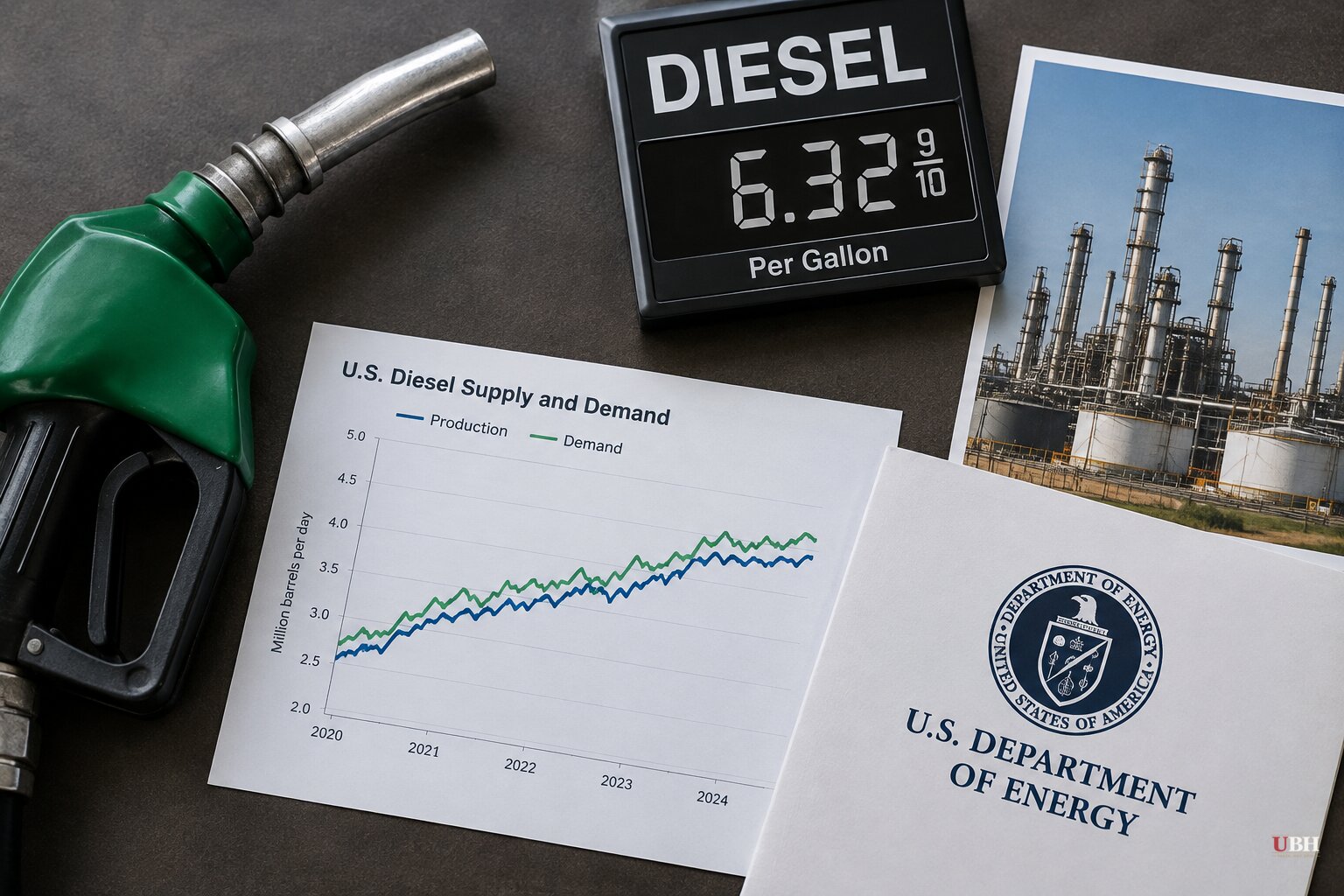
The Trump administration is asking refiners at home and abroad to squeeze out more diesel. There is not much left to squeeze.
Two senior Department of Energy officials said on Oct. 20 that talks are underway with U.S. and foreign refiners. Energy Secretary Chris Wright, speaking in Houston, said "we're in discussions to get every refinery that can run back up and running." He also hedged: "the talks are progressing but it's a difficult challenge. I'm not saying everything will come to pass."
The numbers
AAA puts the national average for diesel at $6.32 a gallon as of Oct. 20. That is down slightly from the all-time high of $6.53 set Sept. 22, and well above the $3.62 a gallon of a year ago. Before the war with Iran began, the national average was $3.76, according to CNN's figures.
Mike Sommers, CEO of the American Petroleum Institute, told reporters in Titusville, Pennsylvania, that U.S. refinery utilization has reached 95-100%. He said some operators, encouraged by the price spike, have postponed scheduled maintenance to keep running.
That leaves little room for domestic output to rise. The administration has also asked Europe to release diesel stockpiles, but the release has fallen short of the 50 million barrels Washington requested. The International Energy Agency has separately agreed to release more than 20 million barrels of diesel.
Why diesel is worse than gasoline
Fewer ships have been moving through the Strait of Hormuz, which has tightened every oil product. Diesel has taken an extra hit. Ukrainian strikes have knocked many Russian refineries offline, and Moscow imposed a diesel export ban earlier this year. Russia is normally the world's second-largest diesel exporter after the U.S. China has also cut back exports, according to NPR's reporting. Morgan Stanley is forecasting that the global fuel market will stay tight through mid-2027.
What the administration has tried
The list is long:
- $8 billion for farmers. President Trump announced the Harvest Fuel Relief program Monday night, Oct. 19, at a rally in Kansas. USDA will pay for it from Commodity Credit Corporation funds. It follows the $12 billion Farmer Bridge Assistance program announced last December, so the two programs total $20 billion in taxpayer-funded farm aid.
- Dyed diesel on highways. Earlier this month Trump signed an executive order letting drivers use tax-exempt red-dyed diesel on roads through the end of the year, with no IRS penalty. The normal penalty is $1,000 or $10 a gallon, whichever is higher. The fuel is exempt from the 24.4-cent federal tax on commercial diesel.
- Russian diesel. Trump announced a deal this month easing sanctions to allow Russian diesel sales to the U.S. and world markets. Late last week he waived new sanctions that were due to take effect. Lawmakers from both parties pushed back.
- Other options. The administration has also floated using the Defense Production Act and cooperating with India.
USDA Secretary Brooke Rollins said the farm payout "will help bring certainty to our farmers during this harvest so they can continue to feed our nation." USDA says payment rates for major commodity crops will come in November. Farmers do not need crop insurance to qualify.
The farm math and the politics
USDA's September forecast has net farm income falling 2.6% this year while production costs rise 4.5%. Fuel and oil expenses alone are projected to jump nearly 30%. Gregg Ibendahl, a Kansas State University agricultural economist, said the typical Kansas farm spent about $31,000 on diesel last year, a bill that could double.
The politics are plain. Trump announced the payout while campaigning for Republican Sen. Roger Marshall, who polls show in a tight race with Democrat Adam Hamilton. Kansas has not elected a Democrat to the Senate since 1932.
Douglas Holtz-Eakin, president of the center-right American Action Forum, said the administration's moves look and feel "panicky because they're panicked." "They can't move the price of diesel in the next 14 days," he said.
Bob McNally, a former energy adviser to George W. Bush and founder of Rapidan Energy Group, said "there are no silver bullets here." He also said the administration is "looking under more rocks than most."
Gbenga Ajilore, chief economist at the Center on Budget and Policy Priorities and a former USDA official, offered a sharper criticism. He said farmers would benefit more from a resolution to the Iran war, which would likely lower energy prices, and from an end to the administration's tariffs. "He imposes policies that harm farmers, then spends taxpayer money to offset the damage his policies create," Ajilore said of the president.
What comes next
No refiner has publicly committed to new output. USDA's commodity-specific payment rates are due in November. Wright has not said which idled refineries could come back, or when, and the European stockpile release remains short of the 50 million barrels Washington asked for.
With utilization already at 95-100%, the most direct path to lower diesel prices depends on supply routes the administration does not control: Hormuz shipping and Russian refinery output.
Sources used for this briefing
8 links from 8 independent newsrooms (syndicated copies of the same report count once)
These are the sources it draws on, linked so you can verify.


