
Unbiased headlines. Facts, not spin.
Unbiased Headlines is an independently owned news organization. We bring you the facts, not opinions, written fresh from 110+ named sources. Sources linked so you can verify it yourself.
 energy
Major Story (7/10)
Phoenix Tailings to Build $375 Million Rare Earth Plant in Rochester, With Full Output Not Due Until 2028
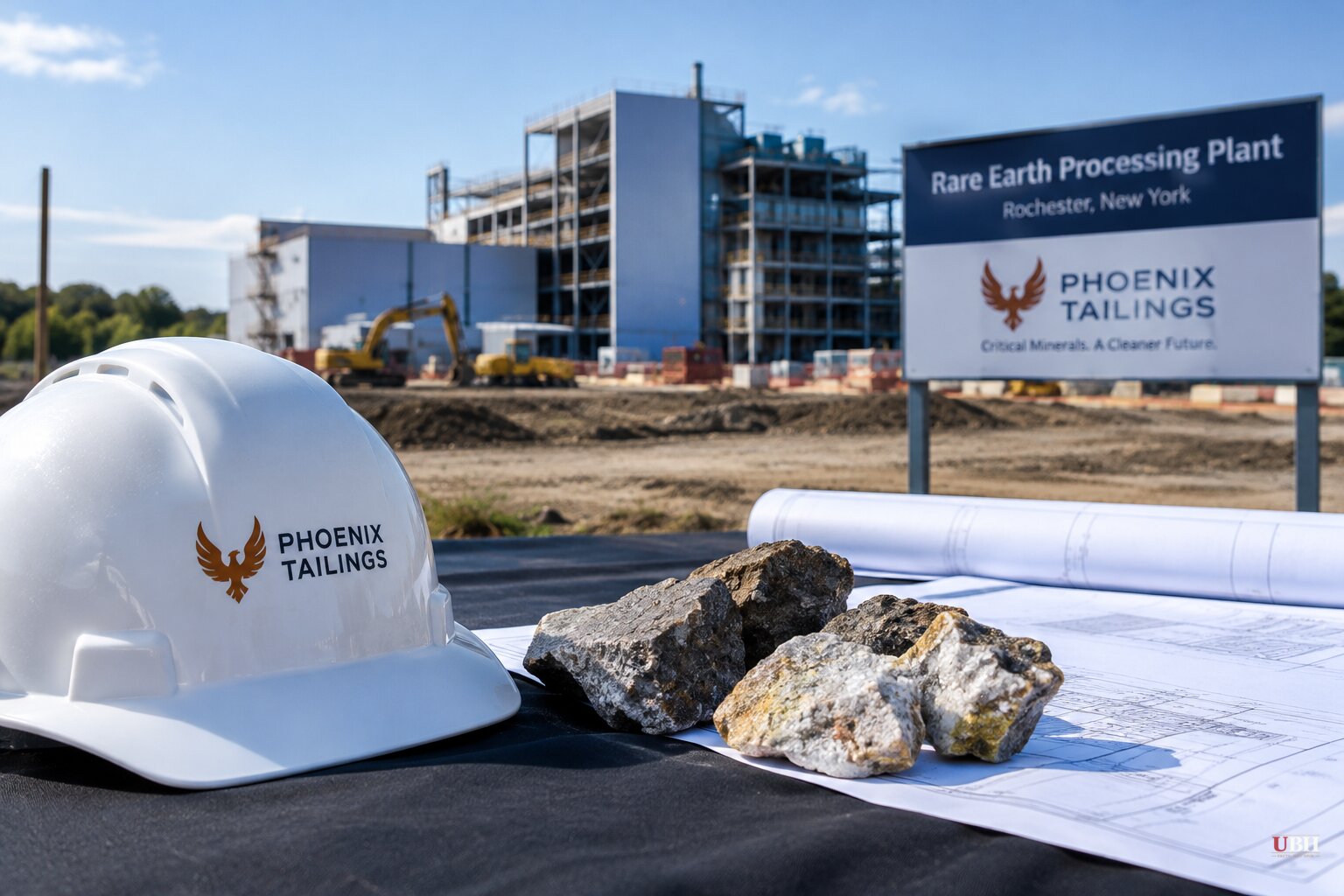
Phoenix Tailings said Tuesday, Oct. 20, that it will build a $375 million rare earth processing plant at Eastman Business Park in Rochester, New York. Gov. Kathy Hochul announced the project and the state's $3 million in performance-based tax credits.
The 500,000-square-foot facility, called Freedom Separation, is designed to process more than 18,000 tons of mined and recycled rare earth feedstock a year. At full capacity it would produce more than 4,400 tons annually of separated rare earth oxides.
Some operations are slated to start next year. Full production is expected in 2028.
The money behind it
Rochester is one piece of Phoenix Tailings' $1.2 billion Freedom project, a separation and metallization platform meant to fill the gap in U.S. midstream rare earth processing. The company says the broader effort will create more than 500 jobs across New York, Massachusetts and New Hampshire. Hochul said the Rochester plant alone will create at least 90.
The Department of War's Office of Strategic Capital has issued a $500 million conditional loan commitment to the Freedom project. Reuters reported that the Pentagon made that commitment months ago, and that it covers long-term debt financing. The commitment is conditional, and neither the company nor the state has announced a closing date.
It is a loan, not a grant. Taxpayers are on the hook if it goes bad.
The state's contribution is far smaller: $3 million in tax credits, tied to performance, against a $375 million plant.
Sen. Chuck Schumer, a Democrat, backed the project. "This is critical for reducing our reliance on foreign processors and protecting our national security," he said.
Why rare earths
Rare earths go into products ranging from electric vehicles to fighter jets. Reuters reported that the United States is pouring billions into new rare earth plants to loosen China's grip on the minerals, and that most of that capacity will not come online until 2027 or later.
CEO Nick Myers framed the project in supply-chain terms. "America and its allies cannot build the next generation of advanced manufacturing on a rare earth supply chain they do not control," he said in a statement.
Phoenix Tailings was cofounded in 2019 by Tomás Villalón Jr., Michelle Chao, Nick Myers and Anthony Balladon. The company says its proprietary electrochemical process extracts rare earth metals from mining waste, generates no toxins and is carbon-free when powered by renewable energy. Those are the company's own claims.
The cost of decoupling
The rare earth push is one front in a wider effort to cut reliance on Chinese technology. Under President Donald Trump, the U.S. has restricted domestic use of Chinese drones, mobile robots and other critical electronics. U.S. officials cite protecting sensitive consumer and government data and encouraging domestic manufacturing.
The transition is not painless. Ben Armstrong, executive director of MIT's Industrial Performance Center, said American digital life rests on foreign-made components. "We just don't know how to make them in the US," he said. "So, there will be a learning curve, and during that learning curve process, the price will be high."
Armstrong and other experts warn the curbs may hinder American companies' ability to keep up with Chinese rivals. Decades of outsourcing have left U.S. manufacturers ill-equipped to meet demand, which means higher costs and longer waits for companies, universities and consumers.
Rajat Bhageria, who founded San Francisco robotics startup Chef Robotics seven years ago, is already adjusting. His robot arms are assembled in the U.S., but the utensil components attached to the ends of the arms are all made in China. Those parts are not covered by the current bans.
"For a while of course, it was like, 'Hey, let's find the best components, and let's find them at the cheapest price,'" Bhageria said. Now investors and customers ask why he is still using foreign-made parts. He worries about "the next shoe to drop," possibly fixed robot arms.
Europe is doing the same
The U.S. is not alone. On Oct. 9, the European Commission approved a second list of 46 Strategic Projects under its Critical Raw Materials Act, bringing the total to 106 including those approved in 2025. The new projects span 16 member states and cover extraction, processing and recycling. Four of them are rare earth projects supporting the permanent magnet supply chain.
The EU's 2030 benchmarks call for domestic extraction equal to at least 10% of annual consumption of strategic raw materials, processing equal to at least 40% and recycling equal to at least 25%.
What comes next
The Rochester plant is scheduled to begin partial operations next year and reach full production in 2028. Whether the $500 million Office of Strategic Capital commitment moves from conditional to final is the next financial marker, and no timeline for that has been announced.
Until then, the plants being announced remain plans, while the supply chains they are meant to replace are still running through China.
Sources used for this briefing
5 links from 5 independent newsrooms (syndicated copies of the same report count once)
These are the sources it draws on, linked so you can verify.


