
Unbiased headlines. Facts, not spin.
Unbiased Headlines is an independently owned news organization. We bring you the facts, not opinions, written fresh from 110+ named sources. Sources linked so you can verify it yourself.
 energy
Major Story (8/10)
Event date: October 16, 2026 ·
China's September Rare Earth Magnet Exports to EU Rose 20.5%, While Shipments to Japan Fell Nearly 20%
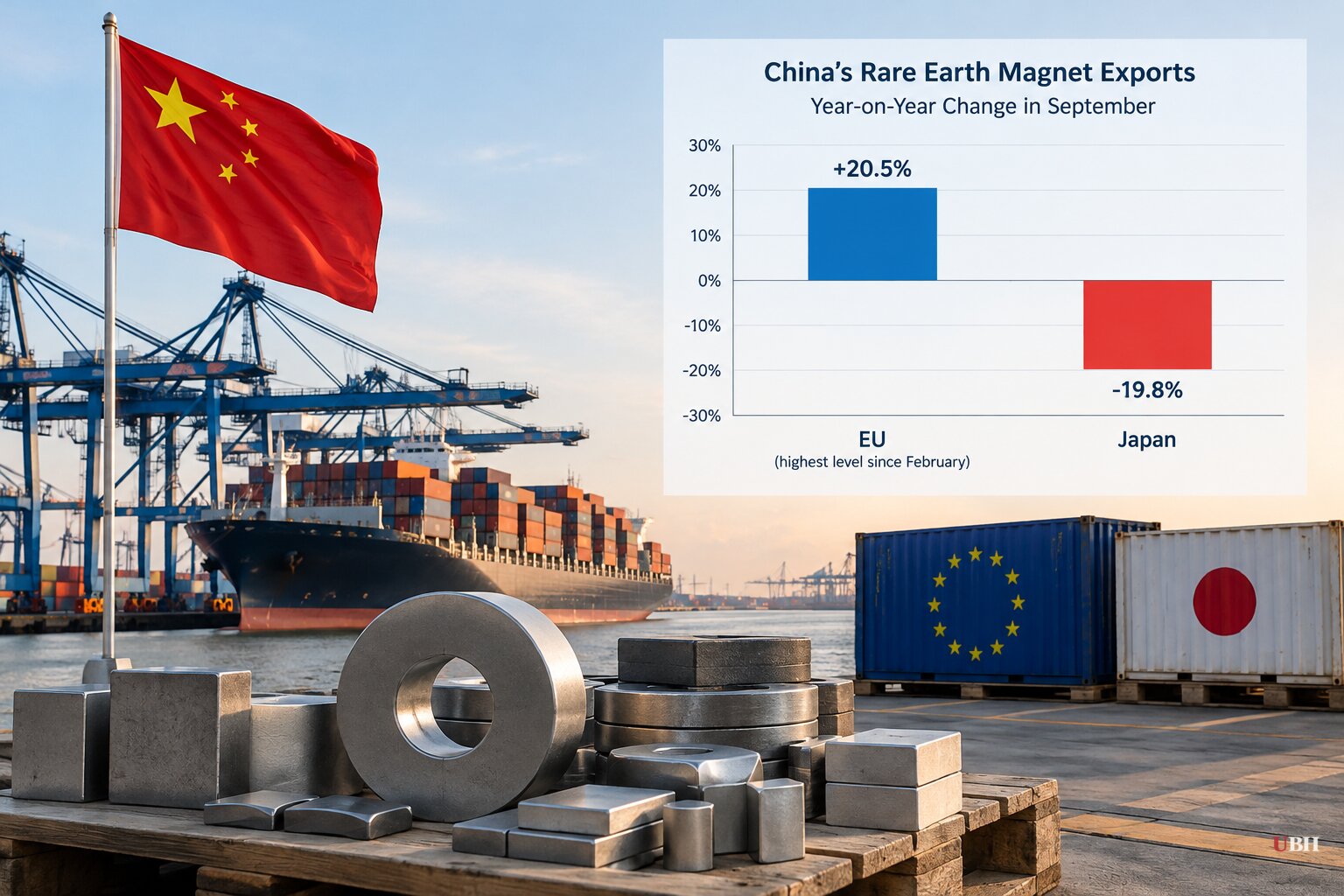
With the Jan. 1, 2027 Pentagon ban on Chinese-origin rare earths in U.S. weapons systems approaching, new Chinese customs data shows Beijing is rationing access by customer.
China's General Administration of Customs released September figures, according to SCMP reporting dated Oct. 20. Rare earth permanent magnet shipments to the European Union rose 20.5% from August to 2,454 tonnes, the highest since February. August had seen a 4.9% decline.
Shipments to Japan fell nearly 20% amid diplomatic tensions between Beijing and Tokyo, according to the SCMP's reading of the same data. The SCMP's headline also reports that exports to the U.S. rebounded in September.
Brussels got a green channel. Tokyo did not.
The EU rebound came ahead of trade talks between Beijing and Brussels that helped ease concerns about a potential trade war. After those talks, China pledged to "continue to facilitate" export licence approvals for rare earths and permanent magnets headed to the bloc through a "green channel." The two sides also reached an understanding to cap Chinese hybrid car shipments to the EU over the next four years.
Japan is getting the opposite treatment. After Tokyo indicated it would not stay neutral in a Taiwan conflict, Beijing sharply restricted exports of heavy rare earths including dysprosium and terbium, according to OilPrice.com's reporting.
Once Japanese inventories ran down, Shin-Etsu Chemical, the world's largest magnet producer outside China, stopped accepting new orders for some dysprosium-containing magnets, Reuters reported. TDK said sourcing rare earths had become "extremely difficult" and that it was redesigning products to use less of them.
That is the template. Chinese export licensing has become a lever Beijing adjusts country by country.
The U.S. truce is short
The late-September summit between Xi Jinping and President Trump extended the U.S.-China trade truce by only two months, according to VOA. Rare earths remained a key unresolved issue in the talks.
Anders Corr, writing in a commentary in The Epoch Times, says Beijing cut rare earth exports before that summit and treats its control of the sector as leverage over trade, semiconductors and Taiwan. Corr's argument is an opinion, not a finding. His point is that the leverage works only while the democracies lack alternatives.
The January deadline versus the factory floor
In July, Trump signed an executive order, "Securing America's Defense Supply Chains and Ensuring Domestic Acquisition of Critical Materials." It gives industry until the start of 2027 to stop using critical minerals and materials from China, Russia, North Korea and Iran.
Industry says that is not achievable. Melissa Sanderson, co-chair of the Critical Minerals Institute, said the Defense Department cannot simply bar those sources in January because no substitutes exist. "No one has the production capacity at this time to fill the pipe of that supply chain as it currently exists," she said.
Ethan Plotkin, CEO of GDCA Inc. and chair of the National Defense Industrial Association's Supply Chain Network Committee, called the timeline aggressive. "If you're going to put a restriction on a non-compliant source, industry has to have enough time to qualify an alternative source," he said. "Otherwise, the supply chain is going to suffer."
Both experts say the government should put more money into the effort. They also want a dedicated federal mining agency.
What Washington says it is building
The administration's spending is real. A Sept. 27 Wall Street Journal report, citing White House officials, put the number of initiated projects at 180. Center for Strategic and International Studies data shows U.S. government non-equity investment in rare earth and magnet projects reached $7.6 billion between 2025 and June.
In February, Washington launched a stockpile initiative modeled on the Strategic Petroleum Reserve. It aims for a 60-day emergency supply of minerals such as gallium and cobalt.
On Oct. 16, Trump announced a large mineral exploration effort in Greenland aimed at loosening China's hold on rare earths, according to the Daily Wire's news rundown. A Greenland deal was signed Sept. 25.
The timelines are contested. White House trade adviser Peter Navarro said on Sept. 25 that the U.S. could be self-sufficient in rare earth magnets, with enough left over to export, within six to 18 months. Analysts generally estimate five to 10 years.
Chia-Wei Jui of the Taiwan-based China Technical Consultants Inc. Foundation questioned Navarro's timeline but told VOA the U.S. is "absolutely moving in the right direction." He said Japan cut its dependence on Chinese rare earths from 92% in 2010 to below 60% today.
Chips are exposed too
The problem is not confined to defense. A Semiconductor Industry Association report found about half of the semiconductor supply categories it analyzed carry "high" or "medium" vulnerability. It named rare earth production, dominated by China and Russia, as a primary concern. Disruption risks, the report said, "compound as they move upstream."
The OilPrice.com analysis, citing the IMF, says rare earth magnets account for about 70% of U.S. value added at risk in a severe rare earth disruption. A cutoff would put military and civilian buyers in the same thin domestic market.
What to watch
Two dates matter. The trade truce extension runs only two months from the late-September summit. The Pentagon ban takes effect Jan. 1, 2027. Defense manufacturers have warned that a new supply chain won't be ready in time. The deadline remains in place.
Sources used for this briefing
7 links from 7 independent newsrooms (syndicated copies of the same report count once)
These are the sources it draws on, linked so you can verify.


