
Unbiased headlines. Facts, not spin.
Every story is an unbiased news briefing written from 110+ sources across the spectrum — sources linked so you can verify it yourself.
 energy
Major Story (7/10)
June 17, 2026 at 03:17 PM
energy
Major Story (7/10)
June 17, 2026 at 03:17 PM
El Niño Is Strengthening Toward Historic Levels. U.S. Food Prices and Global Health Systems Are Already in the Crosshairs.
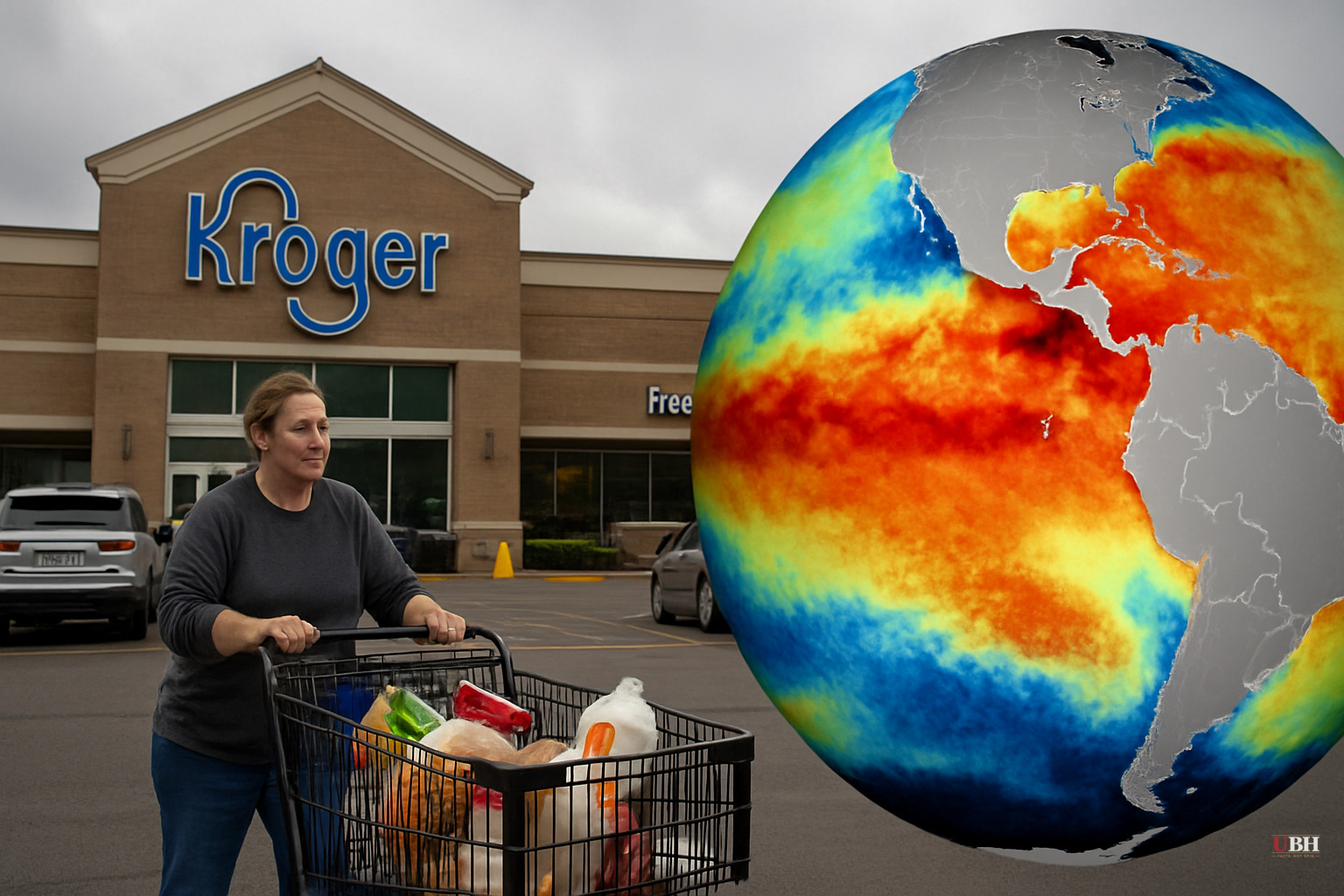
NOAA officially confirmed El Niño's formation on June 11 and flagged a 63% probability of a historically large event, moving the story from meteorological confirmation to concrete downstream risk. The pattern exists, it is strengthening, and the cost estimate is climbing.
What the Data Actually Says
NOAA's June 11 diagnostic update, reported by the Associated Press via PBS News, puts the probability of this El Niño ranking among the largest on record since 1950 at 63%. NOAA separately estimates an 82% chance the pattern was developing between May and July, with a 96% chance of persistence through winter, according to Newsweek's reporting.
Newsweek notes that what distinguishes a "super" El Niño — an informal but useful term — is sea surface temperature anomalies exceeding +2.0°C above average. Weak events stay below +1.0°C. The scale of warming determines how far and how severely the atmospheric disruption spreads.
Clark University climate scientist Abby Frazier, quoted by the Associated Press, described the dynamic plainly: the warm, deep Pacific waters bring "a lot of extra heat to the surface, fueling a lot of extreme events for a lot of places around the world." In the Pacific specifically, she said, "it can get dire very quickly."
The Food Supply Threat Is Concrete
The U.S. imports heavily from nations that sit squarely in El Niño's disruption zones. Newsweek reports that fresh fruits and vegetables are the most exposed category, with overall U.S. food prices already projected to rise 3.4% in 2026 and grocery inflation tracking at 2.9%. A severe El Niño that hammers harvests in Central and South America — key suppliers — would pile onto those existing pressures.
That is a measurable economic risk, not climate alarmism. Supply chain bottlenecks from extreme weather in producing countries translate directly to store shelves. That mechanism is straightforward and has played out in prior El Niño years.
The strongest fair pushback here is worth stating directly: El Niño forecasts carry real uncertainty, and the 1997-98 event — the benchmark everyone is comparing this one to — did not uniformly devastate every affected region. Some areas received beneficial rainfall. The U.S. domestic agricultural sector, depending on the season and the specific weather outcomes, could see offsetting effects. Forecasters are working from probabilistic models, not certainties, and Newsweek's own reporting is careful to frame these as projected risks, not locked-in outcomes.
A 63% probability of a historically large event is a serious number. You would not ignore a 63% chance of a major storm making landfall. Dismissing this as routine climate-cycle noise would be a mistake.
Health System Exposure Across the Americas
Direct Relief, a humanitarian organization, catalogued six specific extreme-weather health threats facing the Americas tied to the 2026 El Niño pattern. Their reporting highlights that the combination of flooding, drought, and heat stress in vulnerable regions creates conditions for disease outbreaks — waterborne illness, vector-borne disease spread, and malnutrition — that overwhelm health infrastructure that is already thin in many parts of Central America, the Caribbean, and northern South America.
This is the exposure that tends to get underreported in U.S. domestic coverage. The human cost of a strong El Niño is not primarily felt in American grocery prices. It concentrates in nations that lack the infrastructure buffers the U.S. has. That matters both on humanitarian grounds and practically: migration pressure from climate-stressed regions in the Americas has consistently created downstream border and policy consequences for the United States.
The Atlantic Hurricane Trade-Off
One measurable near-term benefit for the U.S. mainland: El Niño tends to suppress Atlantic hurricane activity. Frazier confirmed to the Associated Press that the U.S. East and Gulf coasts may get a relative break this hurricane season as a result. That is a genuine offset.
The downside is that Pacific hurricane activity increases under El Niño conditions, putting Hawaii and Pacific island territories at elevated risk.
The UN's Warning, and How to Read It
United Nations Secretary-General António Guterres called El Niño "an urgent climate warning" and said it would "pour fuel on the fire of a warming world," according to the Associated Press via PBS. That framing — linking a natural climate cycle to fossil fuel emissions — is the politically charged layer of this story that Guterres and some climate scientists are pushing.
The factual distinction matters: El Niño is a natural oscillation that has existed for millennia. The claim being made by scientists like Frazier and by Guterres is that background warming from fossil fuel emissions amplifies the extremes on top of the natural cycle. That is a claim with scientific support, but it is a separate scientific argument from the existence and strength of this particular El Niño event, and conflating the two obscures what is actually known versus what is modeled.
What Comes Next
The specific number to watch is whether sea surface temperature anomalies are tracking toward or past the +2.0°C threshold that would push this event into the informal "super" category that Newsweek describes. If that threshold is crossed, the food supply and health risk projections shift from contingent to likely. NOAA's own data already shows the equatorial subsurface temperature index increased for the sixth consecutive month, pointing to widespread, significantly above-average subsurface temperatures across the equatorial Pacific — a signal that the pattern is not weakening.
Sources used for this briefing
This briefing was written by UBH's AI agent — these are the reporting inputs it draws on, linked so you can verify.


