
Unbiased headlines. Facts, not spin.
Unbiased Headlines is an independently owned news organization. We bring you the facts, not opinions, written fresh from 110+ named sources. Sources linked so you can verify it yourself.
 energy
Notable (6/10)
EIA Projects Record 112.2 Bcf/d of U.S. Gas Output in 2026 as European Prices Near €100 per MWh
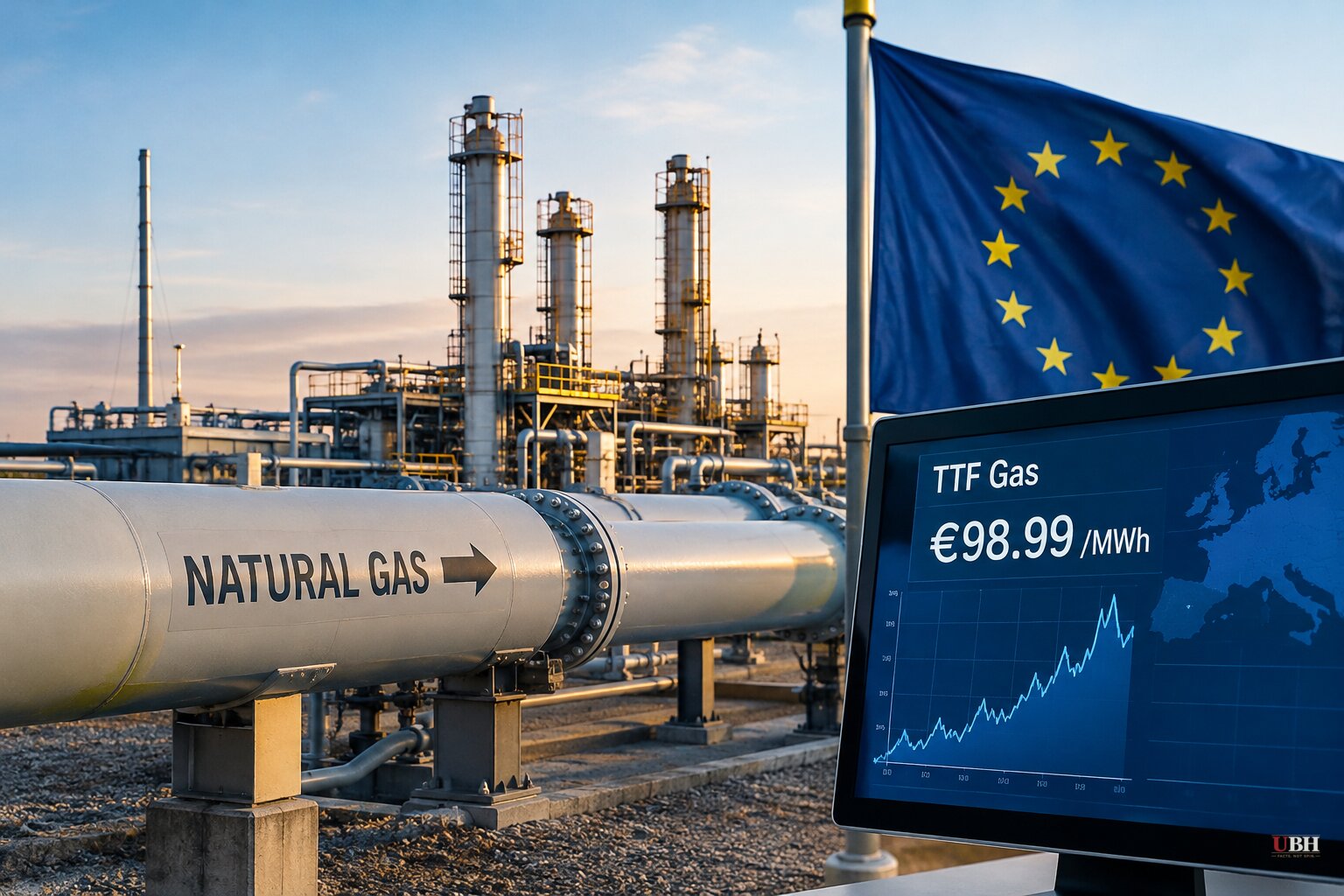
Since the EIA's October Short-Term Energy Outlook put U.S. gas output on course for a second consecutive annual record, the surrounding numbers have kept moving: a $13 billion producer merger, a federal push to revive a dead Northeast pipeline, and a European gas market creeping toward €100 per megawatt-hour.
The production numbers
The EIA projects U.S. dry natural gas production at 112.2 billion cubic feet per day in 2026, up from 107.64 Bcf/d in 2025. It forecasts 116.13 Bcf/d in 2027.
The growth is concentrated in two places. The Permian Basin is producing more associated gas alongside oil. The Haynesville is expanding too, close to Gulf Coast LNG terminals and big industrial users.
Gross withdrawals hit a record 137 Bcf/d in July, the EIA said, driven mainly by the Permian.
Despite the surge, the EIA expects supply to outrun demand. It forecasts the Henry Hub spot price averaging $3.16 per MMBtu in 2027, down 32 cents from 2026. The spot price was $2.76 on Oct. 27, and working gas in storage stood 35 Bcf above the five-year average in the week ended Oct. 16.
Who is buying
U.S. LNG exports averaged 17.4 Bcf/d in the first half of 2026, 23% above the same period in 2025, as new liquefaction capacity came online. For the full year, the EIA expects exports of about 17.6 Bcf/d, against 15.1 Bcf/d in 2025, and 18.6 Bcf/d in 2027.
Total U.S. gas demand is projected to climb from 116.5 Bcf/d in 2025 to 120 Bcf/d in 2026. Data centers are a major reason. Gas-fired generation is being added to feed the AI buildout, and Moody's estimates the U.S. could add more than 30 GW of new capacity for the sector.
The power side is already showing strain. The EIA expects 2026 wholesale electricity prices to average $52 per megawatt-hour across the 11 hubs it tracks, up 11% from 2025. In the PJM region the increase is 41%, the largest of any region.
Europe's side of the ledger
The Iran war and disruption to Qatari LNG have tightened the global spot market. QatarEnergy has signed a long-term LNG purchase agreement with Cheniere Energy to offset reduced exports after attacks on Qatari energy infrastructure and shipping trouble through the Strait of Hormuz.
European benchmark gas reached about €98.99/MWh on Oct. 28, up 42.5% in a month and more than 200% from a year earlier, according to Trading Economics.
Storage is the problem. EU inventories were 74.9% full on Oct. 26, against 82.9% a year earlier and a five-year average of about 89.6%. Germany stood at roughly 61.6%.
The EU regulator ACER estimates the regional conflict has added €18 billion to €33 billion to Europe's gas import bill. U.S. LNG now supplies about 30% of EU gas.
After prices passed €80/MWh, utilities increased coal-fired generation, with forecasts pointing to roughly 25% more coal power in coming months.
Consolidation among producers
EQT has agreed to buy Range Resources in an all-stock deal valued at about $13 billion. The combined company would have a pro-forma enterprise value above $50 billion and output above 9 Bcfe per day.
"North American gas markets have shifted from producer-push to demand-pull, and this deal puts EQT firmly at the heart of that transition," said Lydia Walker, senior research analyst at Wood Mackenzie.
EQT then raised its 2026 production guidance by about 90 Bcfe and trimmed its full-year capital spending guidance by $25 million, citing compression investments that improved existing and new wells and flattened decline rates. Expand Energy guides to 7.4 to 7.6 Bcfe per day in 2026 on capital spending of $2.75 billion to $2.95 billion.
The pattern is more gas for the same or less money.
The pipeline fight
Gas is abundant. Getting it to the Northeast is the hard part. On Oct. 19, Energy Secretary Chris Wright announced the administration will use up to $42 million in Defense Production Act Title III funding to advance the 125-mile Constitution pipeline from Pennsylvania to New York.
Wright said tens of millions of Americans have limited access to low-cost gas "due to a lack of pipeline infrastructure," and that the project would lower electricity and heating costs and reduce blackout risk.
Williams Partners proposed the line in 2012. It won federal approval in 2014, was blocked by then-Gov. Andrew Cuomo, and was scrapped in 2020 after New York rejected its Clean Water Act permit.
New York's current leadership is not on board. Ken Lovett, a senior communications adviser on energy and environment to Gov. Kathy Hochul, called the announcement a "political ploy" to distract from the president's tariffs and the war in Iran, which he said have "driven up home energy costs and gas prices at the pump." He said Hochul is pursuing an "all-of-the-above" strategy. Stop the Constitution Pipeline, a coalition of environmental groups, local advocates and property owners, argues the project is unnecessary.
FERC staff concluded in August that the pipeline would not significantly affect the human environment. Other federal agencies are expected to finish their authorizations by late November.
What comes next
The grid is the other bottleneck. On Oct. 26, the North American Electric Reliability Corporation's board adopted its first reliability standards for large computational loads such as data centers, and will file them with FERC for approval.
Separately, FERC's Oct. 15 draft policy statement would stop requiring air dispersion modeling from applicants for Natural Gas Act projects. Comments are due Nov. 16, 2026.
Whether the gas flowing at record rates can reach customers in the Northeast and in data-center territory before another winter tests Europe's thin storage is still unsettled.
Sources used for this briefing
6 links from 5 independent newsrooms (syndicated copies of the same report count once)
These are the sources it draws on, linked so you can verify.


