
Unbiased headlines. Facts, not spin.
Unbiased Headlines is an independently owned news organization. We bring you the facts, not opinions, written fresh from 110+ named sources. Sources linked so you can verify it yourself.
 energy
Major Story (8/10)
Event date: October 22, 2026 ·
400,000 March Across France as Trump Blames Migration and Macron Says French Citizens Carried Out the Violence
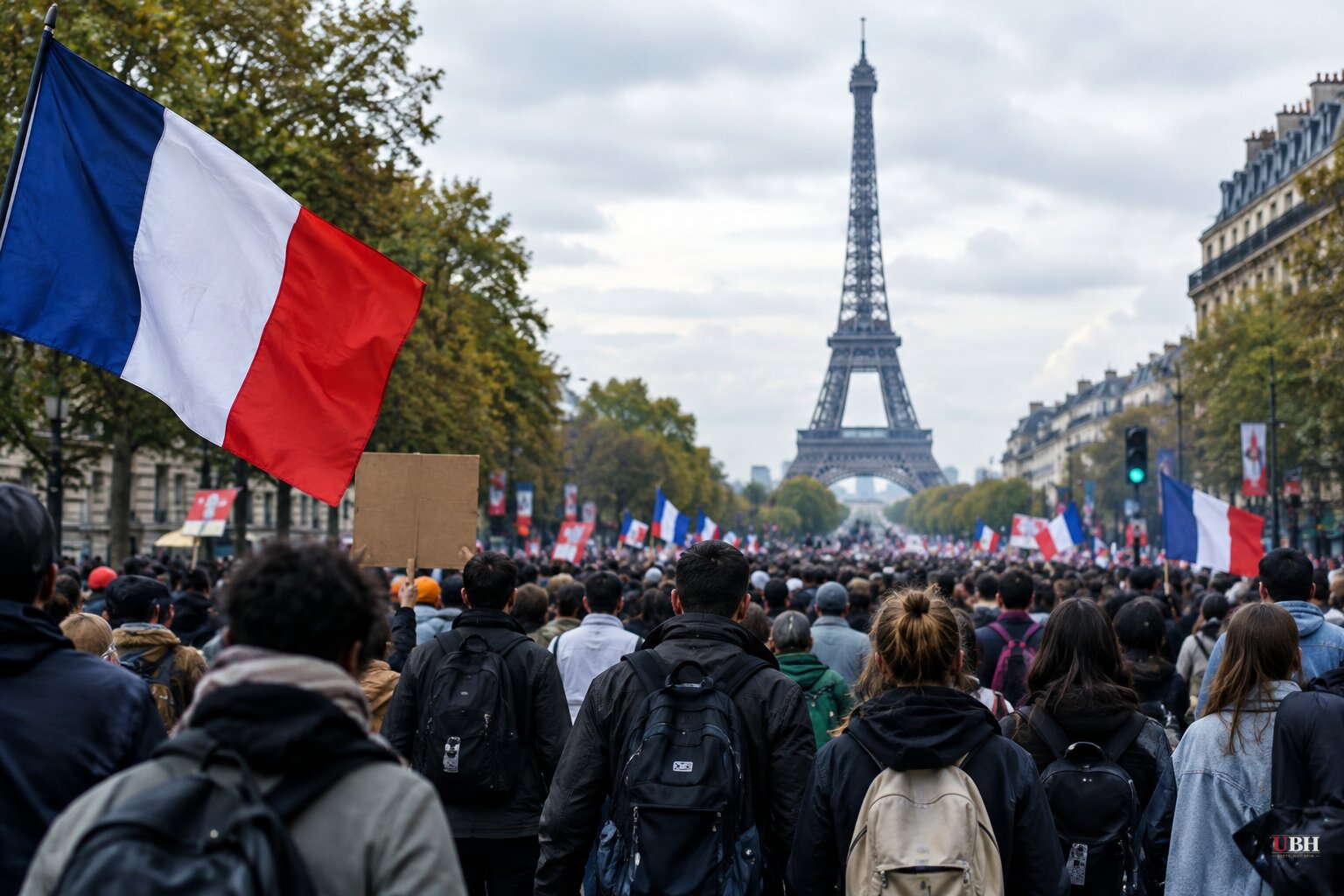
France has spent six weeks watching a protest movement grow from a school grievance into a national confrontation with the government. It is now entangled in a transatlantic argument over what is driving it.
How it started
The movement began in mid-September with high school students demanding better conditions. Piles of wheelie bins stacked against school entrances were an early sign of anger over crumbling classrooms and teacher shortages.
Unions and public-sector workers have since joined. They are calling for more public spending and attacking what they describe as a capitalist society where the rich get richer.
At the latest Saturday march, more than 400,000 people turned out nationwide, according to figures NPR relayed. Government figures put the Paris crowd at more than 100,000. Sophie Binet, secretary general of the CGT union, put the national turnout at about half a million.
More than a thousand people have been arrested during the unrest, according to NPR's count.
Violence and the government response
Earlier clashes in Paris were ugly. Police fired tear gas and water cannons at masked rioters in the Place de la République, who threw fireworks and paving stones at officers. Looting and attacks on public buildings were reported in France and Italy.
The latest weekend was calmer. NPR's Eleanor Beardsley reported that the government deployed heavy security, banned protests in some cities and rerouted marches in others. Marchers were moved away from the Place de la Bastille at the last minute.
The unrest is not confined to France. Demonstrations and clashes have hit Italy, Spain, Portugal, Belgium and Albania, where fighting has convulsed Tirana. Tent encampments over housing costs have sprung up in Madrid and Portugal.
María Silvestre, a sociology professor at the University of Deusto in Spain, attributes it to young Europeans feeling "a strong sense of uncertainty and a lack of control." She says a specific event can then "channel that discontent and drive people into the streets."
The migration argument
President Trump weighed in on Truth Social on Sunday. "France is burning! The immigration of people from an entirely different world, people with hatred in their hearts, has shattered that once great country," he wrote. He urged France to "close your borders."
Vice President JD Vance said "Western liberals imported the third world into France and other countries in the name of diversity and compassion," and that they "ignored fundamental questions of assimilation and compatibility."
The French government rejects that account. President Emmanuel Macron said on Sunday that the "unbridled violence" was carried out by French people. Officials in Paris have dismissed any link between the violence and immigration.
Alberto Alemanno, a professor of EU law at the HEC business school in Paris, says he has received an unprecedented number of calls from right-wing outlets trying to cast the protests as a "pan-European revolt." He calls that narrative misleading and says the demonstrations "have different causes and do not necessarily share political objectives."
The Trump and Vance statements cited no breakdown of who was arrested. Neither did the French officials who rejected the link.
The money problem
Even the French government's critics agree on one point: Paris has little room to maneuver.
Célia Belin, who heads the Paris office of the European Council on Foreign Relations, points to a high deficit and debt-to-GDP ratio and a deadlocked parliament. "Basically the answer is: 'There's no money, there is nothing we can do,'" she said. "And that's a huge problem."
Gordon Sondland, the former U.S. ambassador to the EU, argues in a Fox News op-ed that the cause runs deeper. In his view, too many European economies protect "yesterday's arrangements" through heavy regulation, rigid labor rules and fragmented capital markets. He says executives at European firms' U.S. operations have told him they cannot innovate at home the way they can in America.
Sondland also argues that decades under the American security umbrella let European governments put more money into pensions and social benefits than into defense. That is his argument, not a finding. But it fits with the deficit squeeze Belin describes.
The protesters want the opposite remedy. The unions and students are demanding more public spending, not less.
The political stakes
France holds a presidential election next spring. Macron cannot run again after ten years in office.
Marine Le Pen formally launched her third presidential bid at a two-day National Rally event in Orléans, about 100 miles south of Paris. She used words like "decline," "ruin," "riot" and "chaos" and called for law and order. Polls show her as the frontrunner, according to NPR.
The protesters on the streets come largely from the left, and they despise her. Beardsley described the political center as "largely absent."
France, Italy and Spain all approach pivotal elections, and far-right parties have made gains in Germany. The open question is whether any governing party can answer the students' demands without money. If none can, Le Pen's campaign has a clear opening.
Sources used for this briefing
6 links from 6 independent newsrooms (syndicated copies of the same report count once)
These are the sources it draws on, linked so you can verify.


