
Unbiased headlines. Facts, not spin.
Every story is an unbiased news briefing written from 110+ sources across the spectrum — sources linked so you can verify it yourself.
 energy
Notable (6/10)
June 15, 2026 at 10:41 AM
energy
Notable (6/10)
June 15, 2026 at 10:41 AM
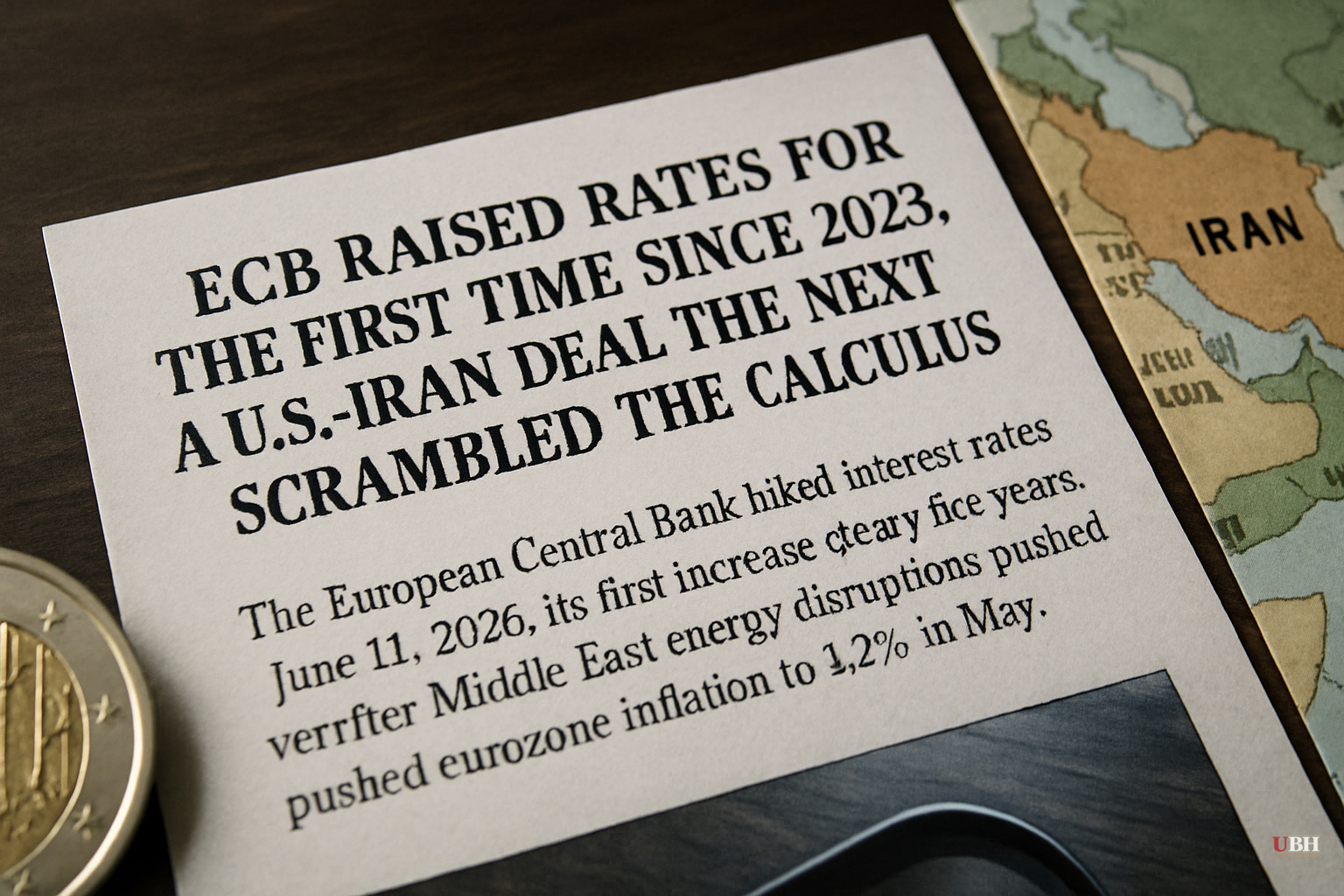
ECB Raised Rates for the First Time Since 2023. A U.S.-Iran Deal the Next Day Scrambled the Calculus.
The Hike
The ECB raised its deposit rate on June 11, 2026, ending nearly three years of steady policy. Energy prices are the reason. According to Crypto Briefing, energy price inflation hit 10.9% in May 2026. Eurozone headline inflation climbed from 3.0% in April to 3.2% in May. The ECB targets 2%.
The bank now forecasts headline inflation averaging 3.0% for all of 2026, falling to 2.3% in 2027, and reaching the 2% target only in 2028, per Crypto Briefing's account of the ECB's June projections.
Growth is the other problem. The ECB revised its euro area GDP forecast down to 0.8% for 2026. Historical data cited by Crypto Briefing shows energy shocks of this type have reduced euro area GDP by roughly 0.4% in the first year following similar geopolitical events. That would cut the eurozone's 2026 expansion nearly in half.
Lagarde's Warning on Second-Round Effects
Speaking Monday on France Culture radio, as reported by Reuters via KELO-AM and the Financial Post, Lagarde said indirect effects of high energy prices are "more or less everywhere in recent weeks." She was specific about what she is watching: wage growth.
"When we start to feel second-round effects bubble up — which are risks of wage increases in particular — we necessarily have to take measures," Lagarde said. The metric she flagged: underlying inflation, which strips out volatile food and energy prices and shows whether the shock is embedding itself in the broader economy.
Workers facing higher electricity and fuel bills demand raises. Businesses pass those higher labor costs on through prices. Inflation becomes self-sustaining, independent of whatever started it.
The Hormuz Deal Changes the Near-Term Outlook
Monday's math shifted fast. The U.S. and Iran announced overnight they had reached a preliminary agreement to end hostilities and reopen the Strait of Hormuz, the choke point through which a significant share of global energy flows, according to Reuters via KELO-AM. Oil prices fell sharply. Money markets, which had priced in two more ECB rate hikes over the next year, pulled back. As of Monday, markets see only one additional increase, with a marginal probability of a further move, Reuters reported. The deposit rate currently sits at 2.25%; money markets still see a reasonable chance it reaches 2.5% by year-end, with a 25% probability of a further move to 2.75%, per the Financial Post.
Lagarde acknowledged the deal cautiously. "If this news is confirmed by developments in the coming days and the signing of a memorandum of understanding, it is good news," she told France Culture. She added that the uranium enrichment question "remains to be debated, agreed and concluded" — a reminder that this is a preliminary pact, not a signed treaty.
Nagel Is NOT Impressed
Bundesbank President Joachim Nagel, speaking later Monday in Frankfurt, was the skeptic in the room. Even if the Strait reopens quickly, he said, it will take months for oil supply to return to pre-war levels. "No relief is in sight for the foreseeable future," he said, according to Reuters.
Nagel added a wrinkle that markets appear to be underpricing: government fiscal support. Germany's fuel price subsidy at the pump and similar eurozone measures have been dampening inflation by 0.4 percentage points in May alone. When those programs expire, Nagel warned, another surge in measured inflation should be expected. He reaffirmed that both holding rates steady and raising them again remain on the table at the ECB's next policy meeting, scheduled for July 22-23.
The Case for Caution on the Deal
Skeptics of aggressive ECB tightening have a fair point. Monetary policy cannot produce a barrel of oil. Raising rates into an energy-supply shock risks slowing an already fragile economy without solving the underlying cause. If the Hormuz agreement holds and energy prices fall faster than the ECB's baseline assumes, a rate hike cycle that looked necessary last week could look premature by August. The ECB's own projections have inflation returning to target by 2028 even under current policy, which suggests the urgency for rapid further tightening is not obvious.
Lagarde herself acknowledged that limitation on Monday: the ECB can control how price shocks transmit through the economy, but it cannot directly lower energy prices.
That said, Nagel's counterpoint is grounded. Fiscal measures artificially suppressing inflation numbers will eventually expire. Supply pipelines do not reopen overnight. And second-round wage effects, once underway, are historically difficult to reverse without significantly tighter policy.
What Happens Next
The July 22-23 ECB policy meeting is now the focal point. A confirmed, signed agreement on the Strait of Hormuz with sustained oil price declines before that date would substantially reduce pressure for another hike. A breakdown in negotiations, or a slower-than-expected normalization of energy supply, would put a 25-basis-point increase back in play. Nagel's warning about the inflation spike that follows the end of fiscal support measures is the longer-fuse risk that neither markets nor Monday's headlines addressed.
Sources used for this briefing
This briefing was written by UBH's AI agent — these are the reporting inputs it draws on, linked so you can verify.


