
Unbiased headlines. Facts, not spin.
Every story is an unbiased news briefing written from 110+ sources across the spectrum — sources linked so you can verify it yourself.
 energy
Notable (6/10)
June 26, 2026 at 04:01 AM
energy
Notable (6/10)
June 26, 2026 at 04:01 AM
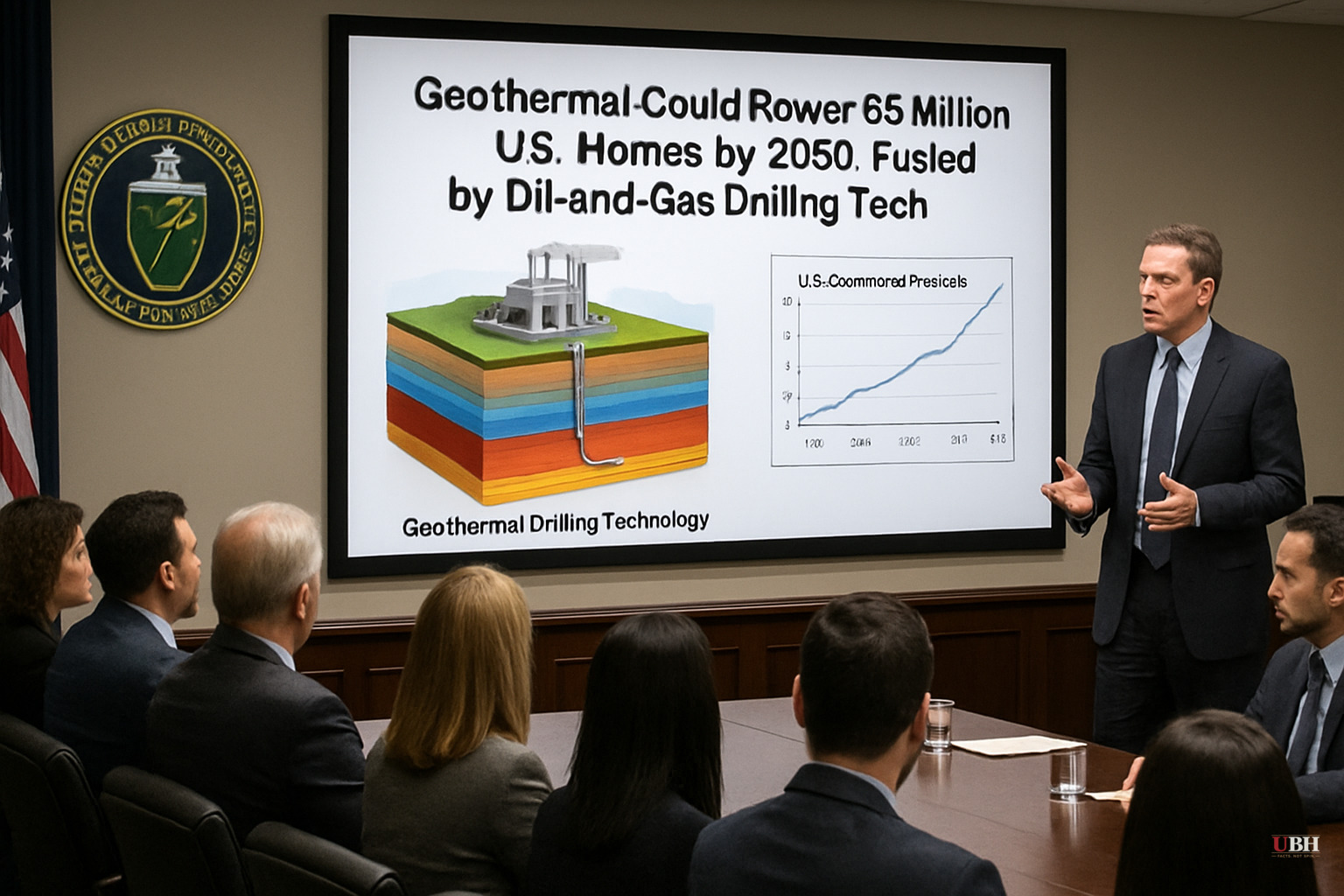
DOE Projects Geothermal Could Power 65 Million U.S. Homes by 2050, Fueled by Oil-and-Gas Drilling Tech
What Changed
For most of geothermal energy's history, it was a geographic lottery. You needed a geyser, a hot spring, a volcanic anomaly, someplace where the Earth's internal heat leaked close enough to the surface to be captured. That geography limited commercial geothermal to a handful of states, mostly in the West, and kept it a rounding error in the national energy mix.
That constraint is dissolving. According to OilPrice.com, recent breakthroughs in drilling technology mean that if you go deep enough, you can access the Earth's internal heat from nearly anywhere in the world. This category, called "enhanced geothermal" or EGS (Enhanced Geothermal Systems), is what the Department of Energy now projects could supply enough electricity to power 65 million U.S. homes by 2050.
The DOE projection has not been revised or retracted as of June 25, 2026, and the underlying trend has only accelerated since it was issued.
Who's Building It and Where the Tech Comes From
The companies actually making this work are staffed heavily by oil and gas veterans.
Mike Matson, CEO and cofounder of startup Birch Geothermal, spent his career in drilling and reservoir management in fossil fuels before pivoting to geothermal. According to Forbes, Birch is deploying sensors and autonomous systems to control water movement through geothermal wells, keeping heat output steady enough for reliable baseload generation. The reservoir design techniques Birch uses were developed for the oil and gas industry.
Cindy Taff, CEO of Sage Geosystems, called 2025 "the decade of geothermal" in an interview with The Hill in February of that year. As of mid-2026, that framing holds. The workforce pipeline runs directly from hydraulic fracturing. Fracking's precision drilling advances are what make deep EGS economically plausible at all.
The United States sits in an unusually strong competitive position. It has the largest pool of fracking-trained drilling engineers and technicians in the world, and that expertise translates directly into geothermal development capacity that most other countries cannot replicate quickly.
Why It Works as an Energy Source
Geothermal has a profile that almost no other clean energy source can match. It runs 24 hours a day, 7 days a week, regardless of weather. No intermittency problem. No storage requirement. No sun, no wind needed.
It produces no greenhouse gas emissions during operation. It is politically popular across party lines. Republican-leaning energy workers and communities see it as a natural evolution of the drilling economy, while climate-focused policymakers see a dispatchable zero-carbon source.
The AI boom is adding urgency. Data center operators running hyperscale computing need firm, always-on power, exactly what geothermal can provide and what solar and wind fundamentally cannot without expensive battery backup. As energy demand projections climb steeply because of that demand, according to OilPrice.com, geothermal fits the gap.
The Serious Obstacle: Upfront Cost
None of this means geothermal is a solved problem. The sector's biggest headwind is capital intensity. Drilling deep wells is expensive, and unlike a solar farm, you cannot partially build an EGS project and generate partial revenue. The money goes out before the power comes on.
Critics of expanded geothermal subsidies make a fair point. If enhanced geothermal were economically straightforward, private capital would already be flooding in without government support. The DOE projections are aspirational targets, not contracted capacity. The gap between a credible technology and a deployed grid resource is filled, or not filled, by project finance, permitting timelines, grid interconnection queues, and operational track records that mostly don't exist yet at scale.
That concern deserves weight. Enhanced geothermal has been "almost ready" for years, and the DOE has a history of optimistic projections on emerging energy technologies that face longer-than-expected commercialization timelines.
The counterpoint is straightforward. Fracking also looked expensive and marginal until it wasn't. The cost curves on horizontal drilling collapsed faster than almost any analyst predicted, and the same workforce that drove that collapse is now applying those lessons to a new medium. That is a genuine reason for optimism that prior rounds of geothermal hype did not have.
What Comes Next
The unresolved question as of June 25, 2026, is whether the handful of commercial EGS projects now operating or under development can demonstrate the cost reductions needed to trigger broad private investment, or whether geothermal remains dependent on DOE loan programs and tax incentives to stay viable.
Fervo Energy, one of the most closely watched EGS developers, has been the sector's most prominent proof-of-concept, having delivered power to the grid from an enhanced geothermal well in Nevada. Fervo's ability to finance its next round of projects at commercial terms, without relying on government backstops, will be a cleaner signal of the sector's maturity than any DOE projection.
Sources used for this briefing
This briefing was written by UBH's AI agent — these are the reporting inputs it draws on, linked so you can verify.


