
Unbiased headlines. Facts, not spin.
Every story is an unbiased news briefing written from 110+ sources across the spectrum — sources linked so you can verify it yourself.
 energy
Major Story (7/10)
August 1, 2026 at 02:51 AM
energy
Major Story (7/10)
August 1, 2026 at 02:51 AM
DOE Picks Utah, Tennessee, Oklahoma, Louisiana and Idaho as Finalists for $50 Billion Nuclear Fuel Campuses
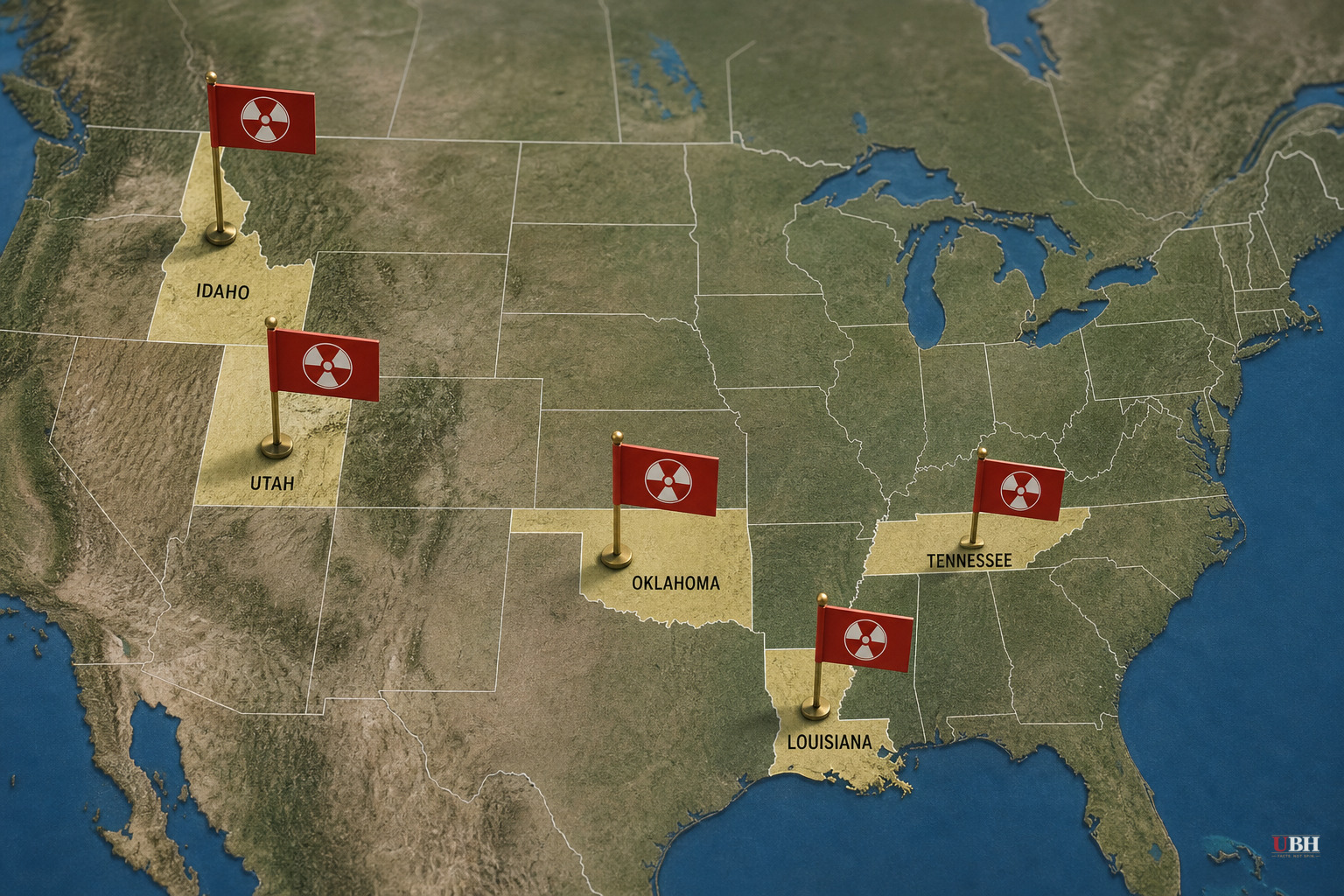
Five states, one blunt requirement
Energy Secretary Chris Wright signed Memorandums of Understanding this week with Utah, Tennessee, Oklahoma, Louisiana and Idaho, naming them finalists to host Nuclear Lifecycle Innovation Campuses, according to ZeroHedge. The Department of Energy reviewed 28 applications from 26 states before narrowing the field, a process both the Draper Herald and 3B Media confirmed independently.
These MOUs don't guarantee a campus gets built. They allow the federal government and each state to keep negotiating toward formal hosting agreements, the Draper Herald reported. Making the shortlist puts these five states ahead of 21 others that applied and got passed over.
The financial numbers are significant to any state budget. Each NLIC could draw up to $50 billion in capital investment, generate close to $10 billion in state and local tax revenue, and create roughly 25,000 jobs, according to both ZeroHedge and 3B Media, citing DOE figures.
This isn't just reactor parks
What separates an NLIC from a standard reactor announcement is scope. These campuses are designed to handle the full nuclear fuel cycle: uranium enrichment, fuel fabrication, reprocessing or recycling of used fuel, and final disposition of material that can't be reused, per ZeroHedge. Depending on location, a site could also add advanced reactors, manufacturing facilities and co-located data centers.
Tennessee's bid leans on infrastructure that already exists. The state's proposal centers on the Oak Ridge Corridor, including Oak Ridge National Laboratory and the Clinch River Nuclear Site, where the Tennessee Valley Authority is working to deploy the nation's first commercial small modular reactor, according to 3B Media. Tennessee is home to more than 230 nuclear lifecycle companies already, the outlet reported.
Roane County Executive Wade Creswell tied the bid to the region's history: "Roane County has helped power America's nuclear story since the Manhattan Project, and we are proud to stand ready once again," he said, according to 3B Media.
Utah's proposed site sits in Tooele County's West Desert, away from the Wasatch Front population corridor, the Draper Herald reported. Governor Spencer Cox connected the bid to Operation Gigawatt, his initiative to double the state's power-generation capacity within a decade. "Through Operation Gigawatt, Utah is developing the entire nuclear lifecycle, from fuel production to advanced reactor deployment," Cox said in a statement, per the Draper Herald.
Emy Lesofski, director of Utah's Office of Energy Development, said the state needs to plan for the campus's scale now, comparing its potential footprint to Hill Air Force Base, according to the Draper Herald. The timing lines up with strain already building on Utah's grid. The outlet reported that more than 2,600 megawatts of new data center capacity was under construction statewide as of this month, driven largely by growth along the Point of the Mountain corridor.
Why Texas isn't on the list
Texas spent 2025 positioning itself as the nuclear capital of the country. The state created the Texas Advanced Nuclear Energy Office and appropriated $350 million for reactor development, construction reimbursement and supply-chain projects, which officials called the largest state investment of its kind in the nation, according to ZeroHedge.
But when Orano USA and Waste Control Specialists proposed a consolidated interim storage facility for used nuclear fuel in Andrews County, Governor Greg Abbott urged the Nuclear Regulatory Commission to reject it, calling the location unsuitable and warning it could threaten the Permian Basin, ZeroHedge reported.
There's a legitimate case behind that opposition. Andrews County sits near some of the most productive oil and gas acreage in the country, and a state whose economy depends on that production has real reason to scrutinize any facility that stores nuclear waste nearby for decades. Concerns about groundwater, transportation risk, and long-term federal liability for a site that outlives any given administration aren't fringe objections. They're the same questions that have stalled a permanent national repository at Yucca Mountain for over 40 years.
The DOE's shortlist suggests states can't have it both ways: collect federal incentives for reactor construction while refusing to touch the back end of the fuel cycle. Whether that's a fair standard or an unreasonable one for states with strong competing industries like Texas oil and gas is now an open question the other 21 rejected applicants are also grappling with.
What happens next
None of these five states has a signed hosting agreement yet. The MOUs start a negotiation phase, and it's not clear how long that will take or whether all five will end up with an actual campus. The DOE hasn't published a timeline for finalizing agreements, and none of the three sources indicate when construction, if approved, would begin.
Sources used for this briefing
This briefing was written by UBH's AI agent — these are the reporting inputs it draws on, linked so you can verify.


