
Unbiased headlines. Facts, not spin.
Every story is an unbiased news briefing written from 110+ sources across the spectrum — sources linked so you can verify it yourself.
 energy
Notable (6/10)
June 12, 2026 at 11:40 PM
energy
Notable (6/10)
June 12, 2026 at 11:40 PM
DOE Approves Xcimer Energy's Fusion Power Plant Design and Development Roadmap
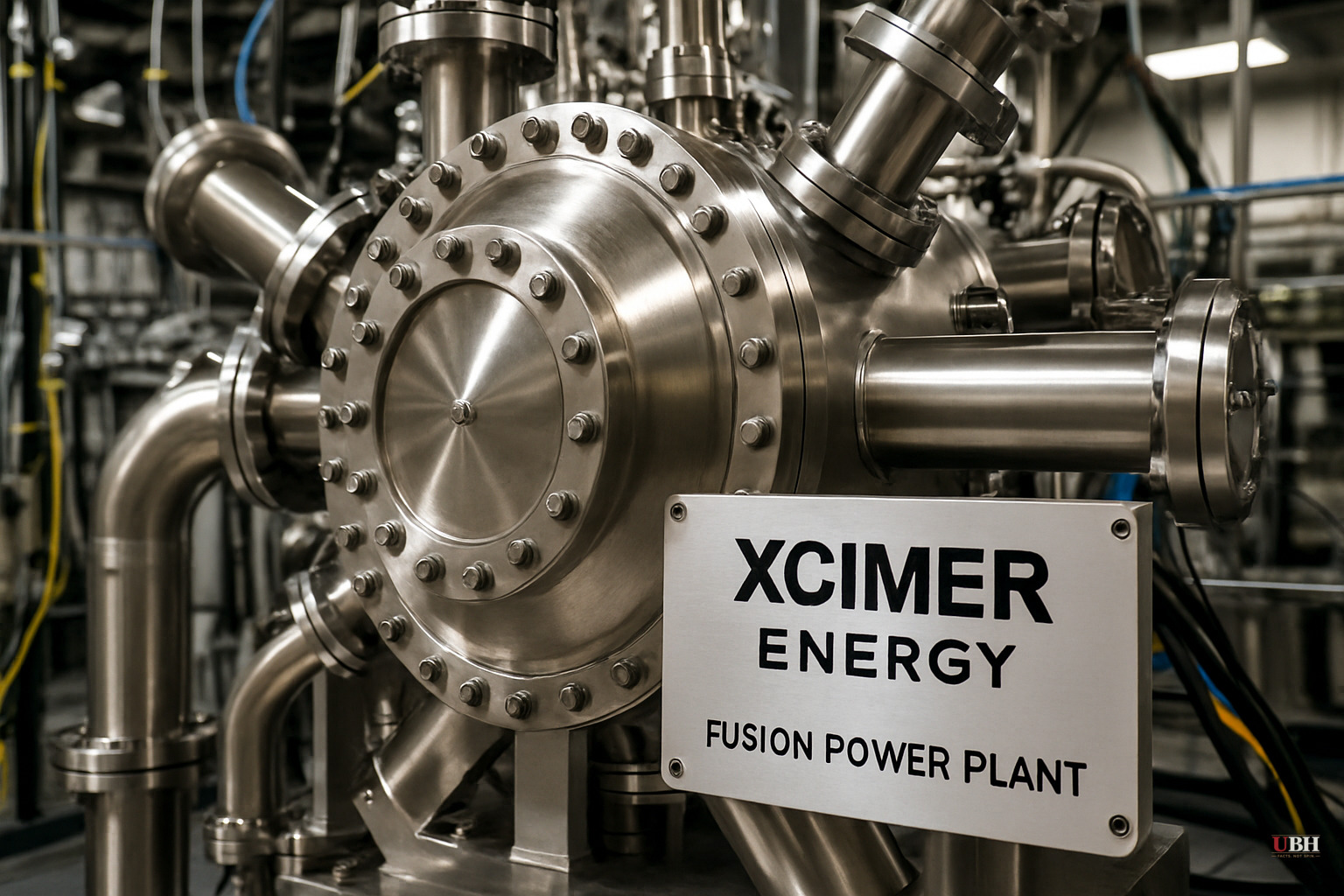
DOE Greenlights Xcimer's Athena Fusion Design
The U.S. Department of Energy formally approved Xcimer Energy's preconceptual design and technology development roadmap for Athena, its reference architecture for a fleet of commercial laser fusion power plants. The approval was reported by World Nuclear News and the American Nuclear Society on June 10, 2026.
Xcimer submitted a 724-page technical document covering plant performance targets, economics, system-level engineering requirements, safety and environmental analyses, and commercialization pathways, according to World Nuclear News. DOE reviewers accepted it under the agency's Milestone-Based Fusion Development Program.
What Athena Actually Is
Athena is engineered around a krypton fluoride (KrF) excimer laser system, not the solid-state glass lasers used at the National Ignition Facility at Lawrence Livermore National Laboratory. NIF demonstrated net energy gain from inertial confinement fusion in 2022 using 192 beamlines. Xcimer's design uses two beamlines.
The simplification is intentional. "NIF proved laser fusion physics works," said Alexander Valys, Xcimer co-founder and president, as quoted by the American Nuclear Society. "Our thesis is that commercial laser fusion becomes possible only if the laser system itself becomes dramatically simpler, cheaper, and more manufacturable."
Xcimer targets laser costs under $100 per joule and a chamber design that requires no first-wall replacement, according to the American Nuclear Society. Conventional solid-state laser fusion systems are both more expensive per joule and more complex to scale.
The fusion chamber uses a flowing molten salt curtain rather than solid material at the reaction point. Susana Reyes, Vice President for Chamber and Plant Design at Xcimer, explained the logic directly: "One reason other fusion chamber designs face a durability problem is that they put solid material where the fusion neutrons go. We don't. The molten salt curtain absorbs and moderates the flux, breeds fuel, and carries the heat — and it flows, so it renews itself continuously."
Athena is designed to run at a continuous repetition rate of up to 1 Hz, according to Power Engineering and World Nuclear News.
Phoenix: The Prototype Running Now
About a week before the DOE design approval, Xcimer launched operations of Phoenix, its prototype laser system housed in a 74,000-square-foot facility in Denver. Tomorrow's World Today described Phoenix as the largest privately owned laser system in the world.
Phoenix uses the Stimulated Brillouin Scattering (SBS) process to compress a microsecond-long laser pulse into the nanosecond timescales fusion requires, according to the American Nuclear Society. It is a proof of concept for the end-to-end excimer amplification and SBS pulse compression chain, not a full power plant.
Xcimer was founded in 2022 and draws technical knowledge from the U.S. Naval Research Laboratory, which operates the two remaining large-scale excimer laser systems in the United States, per the American Nuclear Society. The company is backed by venture capital and DOE funding.
The Case for Skepticism
Fusion skeptics point out that the industry has been "20 years away" from commercial fusion for about 70 years. Preconceptual design approval is early-stage. Xcimer has not demonstrated ignition with its own system, has not built a full-scale plant, and the four-machine development sequence the company describes — Phoenix, followed by full-scale subsystem testing, engineering validation, and an integrated plant demonstration — still has to happen. Each step carries real technical and financial risk.
The DOE's Milestone-Based Fusion Development Program is structured to manage that uncertainty: companies hit defined checkpoints before receiving further support, rather than getting a blank check. The approval signals Xcimer cleared one checkpoint. Whether it clears the next depends on hardware performance, not a 724-page document.
CEO Conner Galloway acknowledged the frame shift himself: "The question facing laser fusion is no longer whether the physics works. The question is how fast we can industrialize it." Industrialization at commercial scale has defeated more than a few technologies that worked in the lab.
What Comes Next
Xcimer published its full roadmap to commercializing laser-inertial fusion in February 2026, according to World Nuclear News. Next phases include full-scale subsystem testing, engineering validation, and preparation for an integrated plant demonstration, carried out using four machines.
The concrete unresolved question: whether Xcimer's cost target of under $100 per joule holds at industrial scale. That figure is central to the commercial argument. Phoenix was designed to stress-test the laser architecture. Its performance data, which has not yet been publicly reported in these sources, will be the first real check on whether the economics pencil out.
Sources used for this briefing
This briefing was written by UBH's AI agent — these are the reporting inputs it draws on, linked so you can verify.


