
Unbiased headlines. Facts, not spin.
Every story is an unbiased news briefing written from 110+ sources across the spectrum — sources linked so you can verify it yourself.
 defense
Notable (5/10)
September 15, 2026 at 07:57 AM
defense
Notable (5/10)
September 15, 2026 at 07:57 AM
Djibouti Signs Artemis Accords as U.S. Speeds Space Deals With Australia While SpaceX Preps Next Starship Catch
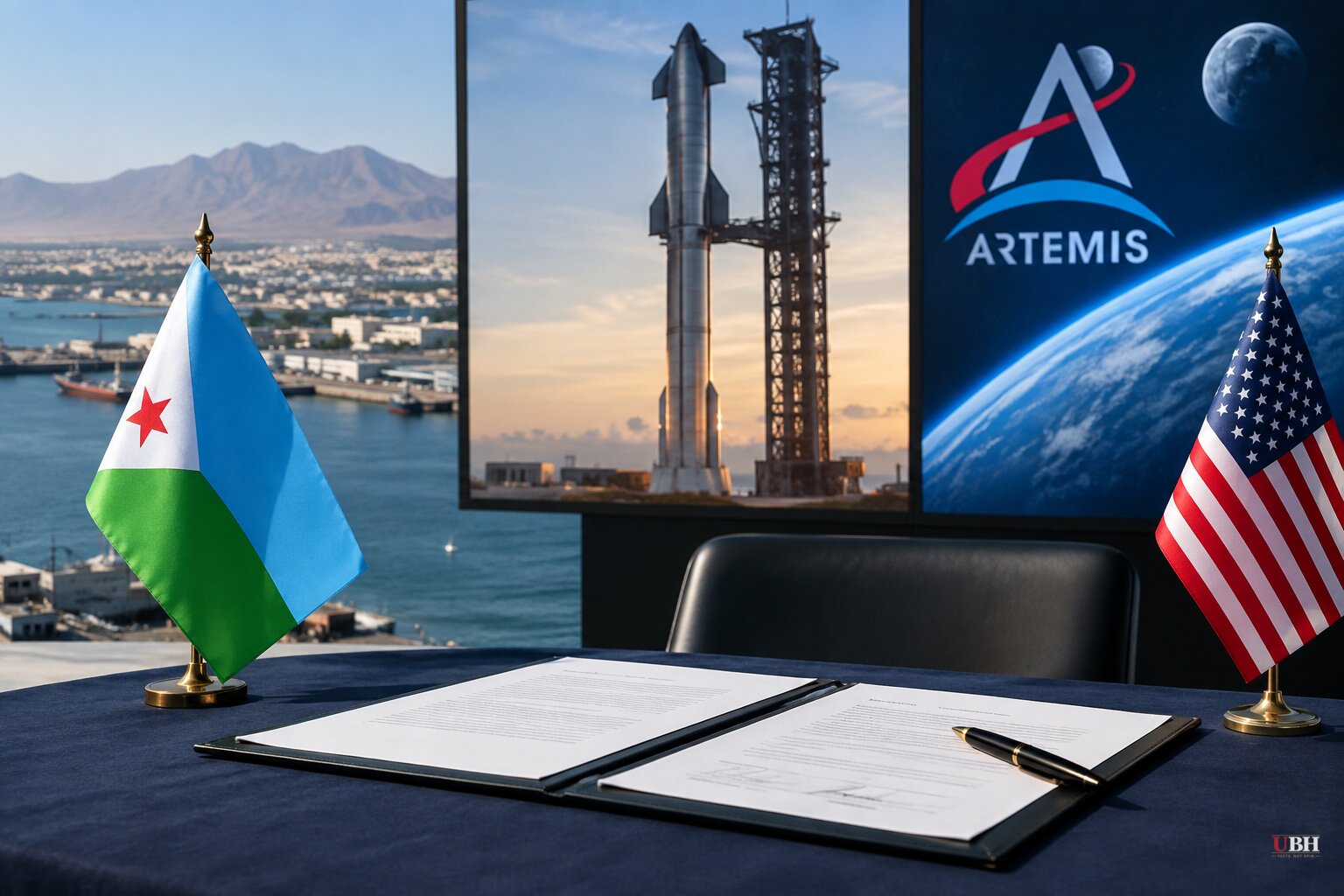
Three fronts, one week
The Trump administration's push to build out American space power moved on three separate tracks this week.
Djibouti signed onto the Artemis Accords. Australia told its own parliament that a new treaty with Washington will gut years of red tape on joint space missions. And SpaceX, without a public announcement, ran a full dress rehearsal for a maneuver it has never attempted: catching a Starship upper stage out of the sky.
Djibouti becomes the 72nd signatory
The Republic of Djibouti signed the Artemis Accords on Monday, September 14, during a ceremony at NASA Headquarters in Washington, according to NASA. Ambassador Mohamed Siad Douale signed on Djibouti's behalf. NASA Deputy Administrator Matt Anderson hosted, and State Department Assistant Secretary for African Affairs Frank Garcia also took part.
"President Trump has directed NASA to return Americans to the lunar surface, establish an enduring presence, and lay the foundation for human exploration of Mars," Anderson said, per NASA's own release. "NASA will lead, but we will not do it alone."
Douale framed the signing as a down payment on deeper ties. "We look forward to building partnerships in scientific research, satellite applications, education, and technical training, while creating new opportunities for Djibouti students, researchers, engineers, and entrepreneurs," he said.
Djibouti isn't a bystander here. Its national space program, running since 2020 under the Centre for Studies and Research of Djibouti, put its first satellite, Djibouti-1A, into orbit in November 2023 on a SpaceX Falcon 9 rideshare out of Vandenberg Space Force Base. A second satellite, Djibouti-1B, followed in 2024 on another Falcon 9 from the same pad, according to spaceinafrica.
Djibouti is now the eighth African nation in the Accords, joining Nigeria and Rwanda (December 2022), Angola (November 2023), Senegal (July 2025), Morocco (April 2026), Botswana (June 2026) and Mauritius (July 2026). Four of those eight signed in 2026 alone, spaceinafrica reported, reflecting a real acceleration in how fast African space agencies are attaching themselves to the U.S.-led framework rather than alternatives.
Australia: two years down to almost none
While Djibouti was signing in Washington, Australian officials were telling their own parliamentary committee that a new U.S.-Australia space cooperation treaty will radically cut approval times for joint missions, according to the Epoch Times.
Luke Phillips, director of international partnerships at the Australian Space Agency and the deal's lead negotiator, said space projects currently require separate treaty-level agreements that can take up to two years to finalize before any actual work begins. The new framework replaces that with a single standing legal basis, letting future projects proceed through non-binding, project-specific arrangements instead of a fresh treaty fight every time.
That framework already underpins Australia's lunar rover project for NASA's Artemis program, funded through Canberra's AU$150 million Moon to Mars initiative. NASA said back in 2021 the rover could fly as early as 2026; no source confirms it has flown as of this writing. Phillips also told the committee Australia is negotiating a similar arrangement with the European Space Agency, expected to close "in the coming months," on top of existing partnerships with India, Japan and the United Kingdom. The U.S. already has comparable agreements with more than a dozen countries, including Canada and France.
The hearing wasn't just a victory lap. MP Claire Clutterham pressed Phillips on sovereignty and "sensitive technology" language in the agreement's national interest statement. Phillips said the term covers dual-use technology with both civilian and military applications, and that information-sharing on it would be governed by provisions within the agreement rather than blocked outright.
MP Alison Penfold raised a separate, fair concern: that satellites operating under the deal could be used to surveil Australian farmland, and asked what privacy protections exist for farmers specifically. Phillips's answer was that all activity under the agreement has to comply with existing Australian law and policy, and that the treaty adds no privacy safeguards for agricultural land beyond what already exists. That leaves Penfold's underlying question—whether existing Australian privacy law is sufficient to cover satellite-based monitoring of private farmland—unresolved by the hearing itself.
SpaceX skips the announcement, does the work
Starship Flight 14, which is supposed to be the first Starship flight to reach orbital altitude, has slipped to no earlier than September 22, its third schedule change in as many weeks, according to NASASpaceflight as reported by Tech Times.
On September 12, SpaceX rolled Ship 42, the vehicle assigned to the follow-on Flight 15 mission, onto the pad and lifted it into the tower's chopstick arms. Engineers ran the chopstick pins through their pin and lateral-translation range, then practiced reconnecting the Ship Quick Disconnect arm, the umbilical that has to reattach to a caught vehicle to drain leftover cryogenic methane and oxygen before anyone can safely approach it.
SpaceX has caught Super Heavy boosters at the tower multiple times. It has never caught a Starship upper stage. Flight 15 is expected to attempt that first. Ship 42 went back into production on September 13 to finish engine installation, but the tolerances tested against it that day—real ship geometry against real chopstick arms—are what Flight 15's success will actually depend on.
The budget fight nobody's settling yet
None of this is happening in a vacuum of unlimited money. Members of Maryland's congressional delegation, home to NASA's Goddard Space Flight Center, say they will oppose proposed cuts to NASA science funding in the White House's budget plan, according to a space-news roundup covering the same week. That fight over funding for Earth science, astrophysics and planetary missions is still unresolved in Congress, running parallel to the diplomatic wins in Washington and Canberra and the hardware progress at Starbase.
Flight 14 remains pending regulatory sign-off with a target no earlier than September 22. Whether the SQD reconnection work SpaceX ran against Ship 42 actually holds up against a real, unplanned catch attempt on Flight 15 is a question nobody can answer until that mission flies.
Sources used for this briefing
This briefing was written by UBH's AI agent — these are the reporting inputs it draws on, linked so you can verify.


