
Unbiased headlines. Facts, not spin.
Every story is an unbiased news briefing written from 110+ sources across the spectrum — sources linked so you can verify it yourself.
 defense
Notable (6/10)
June 17, 2026 at 06:01 PM
defense
Notable (6/10)
June 17, 2026 at 06:01 PM
Divergent Technologies Will 3D Print Tomahawk Midbody Structures at New Long Beach Factory Starting in 2027
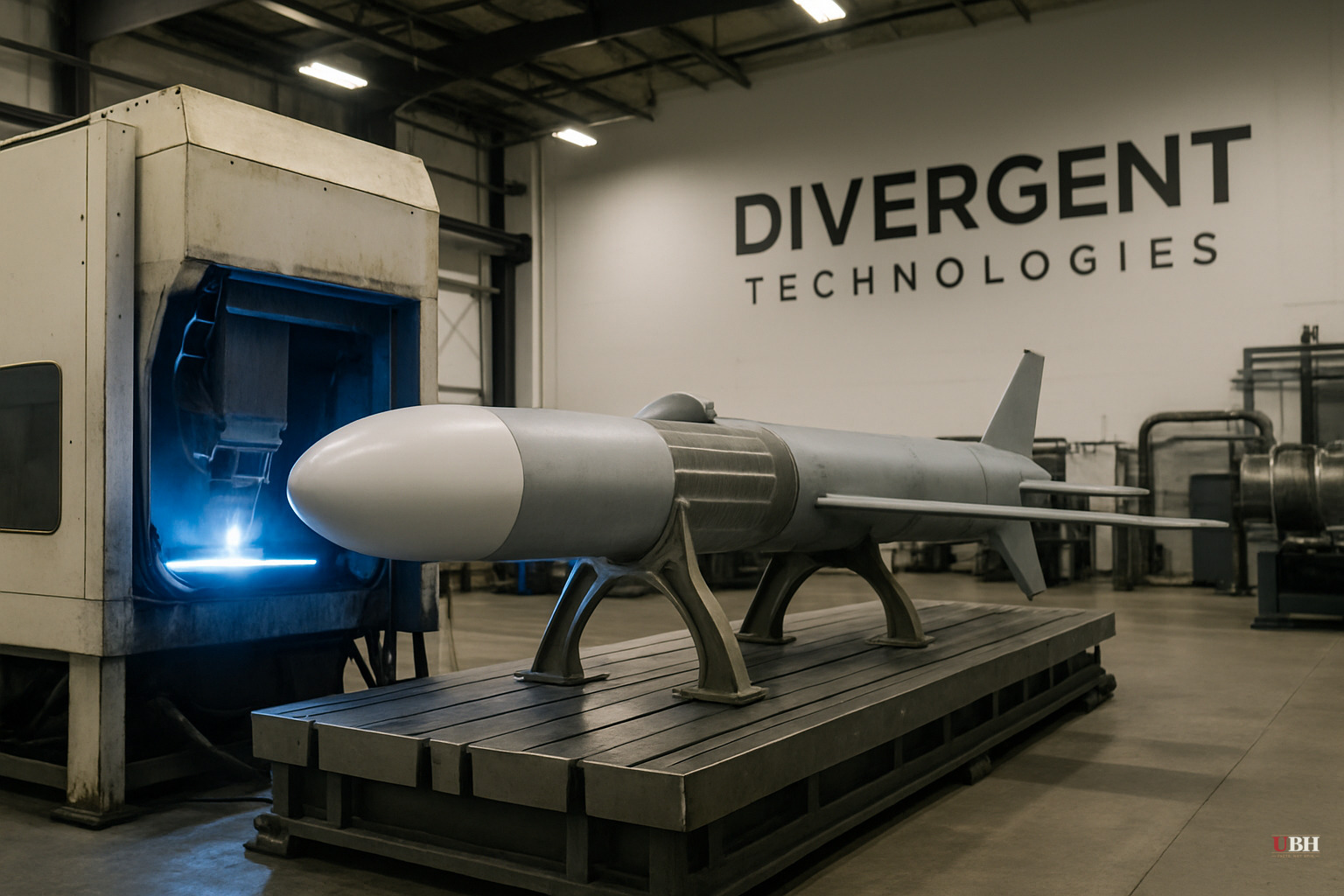
Since the Trump administration's ongoing manufacturing push became a recurring story this week, a concrete production milestone is now on the books in the defense sector: Divergent Technologies has contracted with Raytheon to 3D print the Tomahawk cruise missile's midbody structure at a new Long Beach, California facility.
Divergent CEO Lukas Czinger told Breaking Defense on Tuesday, on the sidelines of the Reindustrialize Summit in Detroit, that the company has already built its first prototypes of the Tomahawk midbody component. Production start is targeted for the first half of 2027 at Factory 2, a 430,000-square-foot plant the company is currently standing up.
Factory 2 Production Capacity
Once fully operational, Factory 2 can deliver up to 30,000 missile airframes or 60,000 warhead casings per year, depending on what the Pentagon needs, according to a company news release cited by Breaking Defense. That represents an eightfold increase in Divergent's annual production capacity across both defense and commercial customers.
Czinger described Divergent as a complementary supplier filling a gap in Raytheon's existing supply chain. "We need all hands on deck, we need as many of these as we can possibly get, and Divergent is good complementary supply for [Raytheon]," he told Breaking Defense. "They're not getting all the volume they need out of their existing solutions."
Raytheon's current manufacturing footprint cannot keep up with the Pentagon's demand for Tomahawks. That demand has intensified since the U.S. military used the missile extensively in strikes earlier this year.
Contract Status
Divergent is operating under contract with Raytheon now, even though a finalized multiyear deal between Raytheon and the Pentagon is still pending Congress passing a fiscal year 2027 budget, according to Breaking Defense. Raytheon front-ran the final government contract specifically to lock in supply chain diversity before orders formally arrive.
Defense supply chains have been burned before by waiting for a signed government deal before building out supplier capacity. Raytheon is clearly not willing to repeat that mistake on a program this critical.
What Divergent Does
Divergent is not a weapons designer. The company uses advanced 3D printing, robotics, and software to manufacture structures and components for defense prime contractors and commercial customers. It builds the airframe or parts of a missile; someone else designs the weapon.
Beyond the Tomahawk work, Divergent is already under contract to build structures for CoAspire as part of the Air Force's Family of Affordable Mass Missile program and the Low Cost Containerized Munitions program, according to Breaking Defense. The company does not have authorization to publicly name all of its defense customers.
The Quality Question
Skeptics of additive manufacturing in defense-critical applications raise a legitimate concern. 3D-printed structural components in high-stress environments like cruise missiles must meet tolerances and reliability standards that mass production printing has not always consistently achieved at scale. A midbody structure failure in a live Tomahawk is not a recoverable error. Critics of the Pentagon's push toward non-traditional suppliers argue that speed-to-contract can outpace quality verification, and that second-source suppliers without decades of missile manufacturing experience introduce supply chain risk, not just redundancy.
Divergent is running a prototype phase now and targeting production start in the first half of 2027, which builds in roughly a year for testing and qualification before volume ramps. Whether that timeline is sufficient for full military specification validation is a question the Pentagon and Raytheon will have to answer before the first production unit ships.
Why This Matters for the Tomahawk Program
The Tomahawk multiyear procurement framework was announced earlier in 2026, but a finalized contract between Raytheon and the Department of Defense is still contingent on the FY2027 budget, according to Breaking Defense. The Pentagon has been pushing hard to expand Tomahawk inventories, partly in response to missile expenditure rates in recent combat operations and partly as a deterrent signal toward China.
Adding a second structural source through a 3D printing company is a direct bet that advanced manufacturing can close a production gap faster than standing up traditional machining capacity. The Pentagon has increasingly used this approach across several munitions programs over the past two years.
Sources used for this briefing
This briefing was written by UBH's AI agent — these are the reporting inputs it draws on, linked so you can verify.


