
Unbiased headlines. Facts, not spin.
Every story is an unbiased news briefing written from 110+ sources across the spectrum — sources linked so you can verify it yourself.
 energy
Major Story (8/10)
August 3, 2026 at 04:44 PM
energy
Major Story (8/10)
August 3, 2026 at 04:44 PM
Diesel Hits $5.31 a Gallon as Iran War and Red Sea Blockade Squeeze Global Fuel Supply
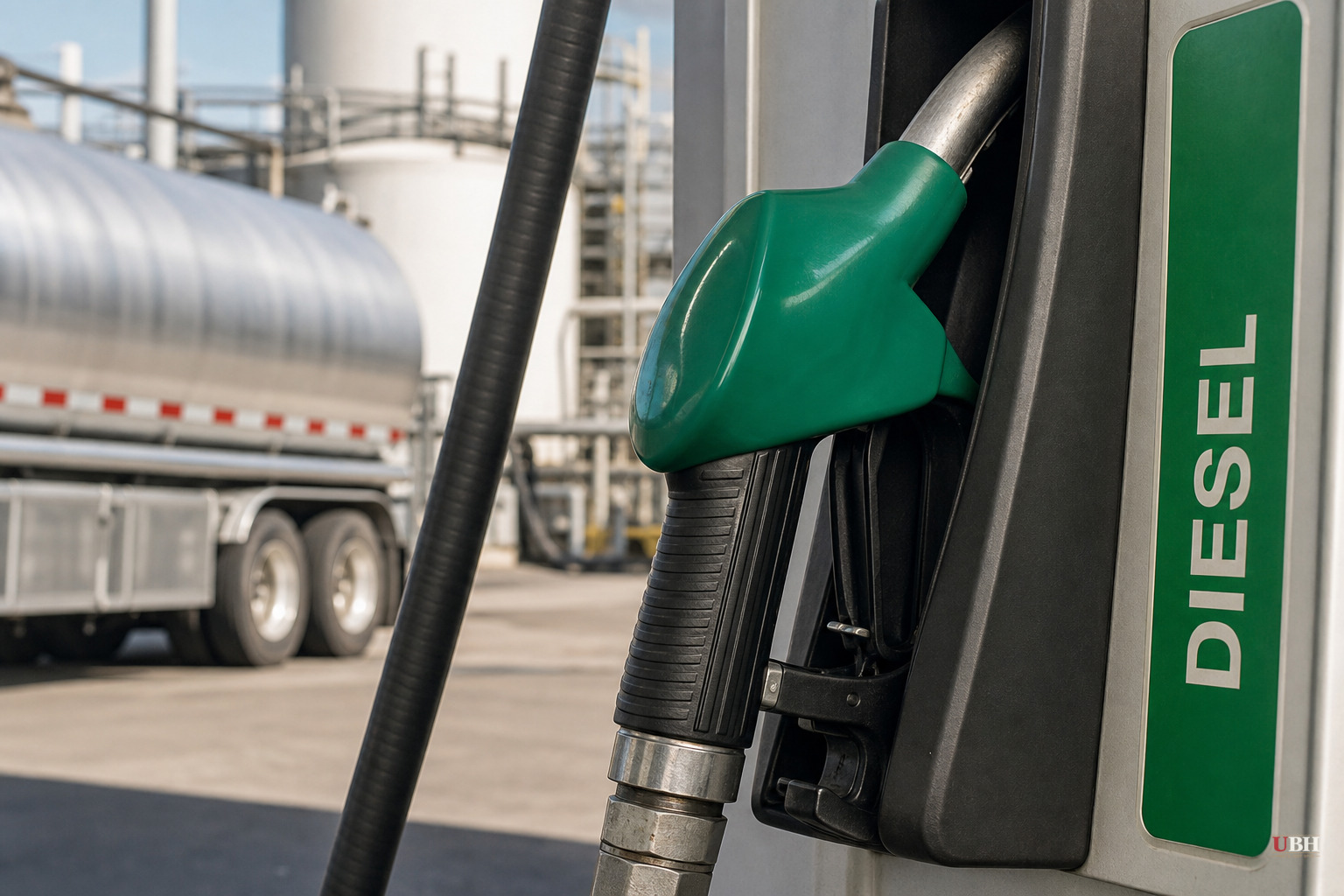
Diesel is the fuel nobody budgets for until it wrecks the family budget anyway. It's baked into your groceries, your Amazon package, your new house. And right now it's getting more expensive by the week.
The national average for on-highway diesel hit $5.313 a gallon as of July 27, up 18 cents from the week before, according to data from the U.S. Energy Information Administration reported by FleetOwner. Gasoline rose too, up 10 cents to $4.096 a gallon. Compared to a year ago, diesel is up $1.51 a gallon and gas is up 97 cents.
AAA put the current national diesel average even higher, at $5.321, and pegged the year-over-year jump at $1.59, per FleetOwner's reporting.
This marks six months of grinding pressure from a war that will not end and a second front that just opened up.
Two Chokepoints, One Squeeze
The Iran war has entered its sixth month and has largely halted shipping through the Strait of Hormuz, a passage that once carried roughly a fifth of the world's oil and natural gas, according to the Los Angeles Times. Brent crude spiked from about $70 to above $100 a barrel for much of March, April and May, hitting $126 at one point, the LA Times reported.
Now Yemen's Houthis have declared a blockade against Saudi Arabian oil exports through the Bab-el-Mandeb chokepoint in the Red Sea, according to FleetOwner. That's a second major artery constrained at the same time the first one is barely functioning.
An energy industry source who spoke to Fox Business on condition of anonymity called the diesel surge a direct consequence of the Hormuz closure: "The great majority of the price movement that you've seen in diesel markets over the last five months has been the direct result of the conflict in Iran and specifically the closure of the Strait of Hormuz."
ExxonMobil CEO Darren Woods told CNBC the refining squeeze isn't going away even if shipping routes reopen. "Even after the Strait opens up, we'll see more products start to flow through the Strait," Woods said, "but we've still got the Russia capacity that's been lost, and we'll have to see what the Chinese do with respect to exporting."
Andy Lipow of Lipow Oil Associates estimates the world is now short about 8% of global diesel demand, driven by the combination of the Iran war and Ukraine's ongoing strikes on Russian refining infrastructure, according to CNBC.
California Pays More, and So Does Everyone Else
California has the highest fuel prices in the country and hosts the San Pedro Bay port complex, which handles nearly a third of all U.S. containership imports and exports, CNBC reported. Every one of those containers gets moved by truck or train paying California diesel prices before it ever reaches a store shelf anywhere in America.
California diesel hit $6.92 a gallon, up from $5.10 before the war, according to AAA data cited by CNBC. FleetOwner's regional breakdown for the week of July 27 shows West Coast diesel at $6.067 including California, or $5.545 excluding it, versus $5.087 on the Gulf Coast and $5.354 on the East Coast. California is refining-poor, has no major pipeline connection to the rest of the country, and layers on strict environmental rules, all of which push its prices well above the national average, per CNBC's reporting.
JPMorgan analyst Natasha Kaneva put it plainly in a June note cited by CNBC: "A meaningful share of America's supply chain pays West Coast fuel prices. These prices influence freight costs, transportation margins, and ultimately the delivered cost of goods nationwide."
Bernard Yaros, lead U.S. economist for Oxford Economics, told Fox Business the food supply chain is where this bites hardest. "Diesel powers the irrigation pumps, the tractors in the field and the trucks that bring food from the farm to your local grocery store," Yaros said. "It's part of every layer of food production in the U.S."
Oil Majors Post Record Numbers
While truckers and farmers eat higher fuel bills, the oil majors are doing just fine. Exxon Mobil reported second-quarter profit that doubled to $14.53 billion, boosted by record diesel production, on revenue of $116.02 billion, up 42%, according to the Los Angeles Times. Chevron's profit nearly quadrupled to $12.07 billion, with revenue up 56% to $70.06 billion. Six of Europe's largest oil companies posted combined first-quarter profits of $22 billion, more than 40% above last year, per the same LA Times report.
Exxon and Chevron don't set the global price of crude, which swung from $68 to $115 a barrel during the quarter based on supply, demand, and what refiners and traders were willing to pay, the LA Times noted. Record profits during a supply shock are what happens when a company has refining capacity the rest of the world doesn't.
Patrick Galey of Global Witness argued the profits still amount to a bad look given the human cost. "There are constituencies around the world who are having a very good crisis," Galey told the LA Times, pointing to fuel rationing in Australia and government office closures in Nepal and Sri Lanka tied to the same supply crunch.
Congressional Democrats want to do something about it. Sen. Sheldon Whitehouse of Rhode Island and Rep. Ro Khanna of California introduced companion bills in March to impose a windfall profits tax on oil producers that pumped or imported at least 300,000 barrels a day in 2025, with proceeds redistributed to consumers, according to the LA Times. "It's fair to put a windfall profits tax on inordinate windfall profits rather than cut off children's food programs," Whitehouse said.
Voters can decide if they want Congress taxing profits that came from a war, not from anything the companies did wrong. A windfall tax doesn't fix the actual problem: two chokepoints are jammed, refining capacity is down, and nobody quoted in any of this reporting says either war is ending soon. Neither bill has passed as of this writing, and the price at the pump isn't waiting around for Congress.
Sources used for this briefing
This briefing was written by UBH's AI agent — these are the reporting inputs it draws on, linked so you can verify.


