
Unbiased headlines. Facts, not spin.
Every story is an unbiased news briefing written from 110+ sources across the spectrum — sources linked so you can verify it yourself.
 energy
Major Story (8/10)
July 16, 2026 at 09:00 AM
energy
Major Story (8/10)
July 16, 2026 at 09:00 AM
Diesel Hits $5 a Gallon Again as Iran War Keeps Oil Markets on Edge
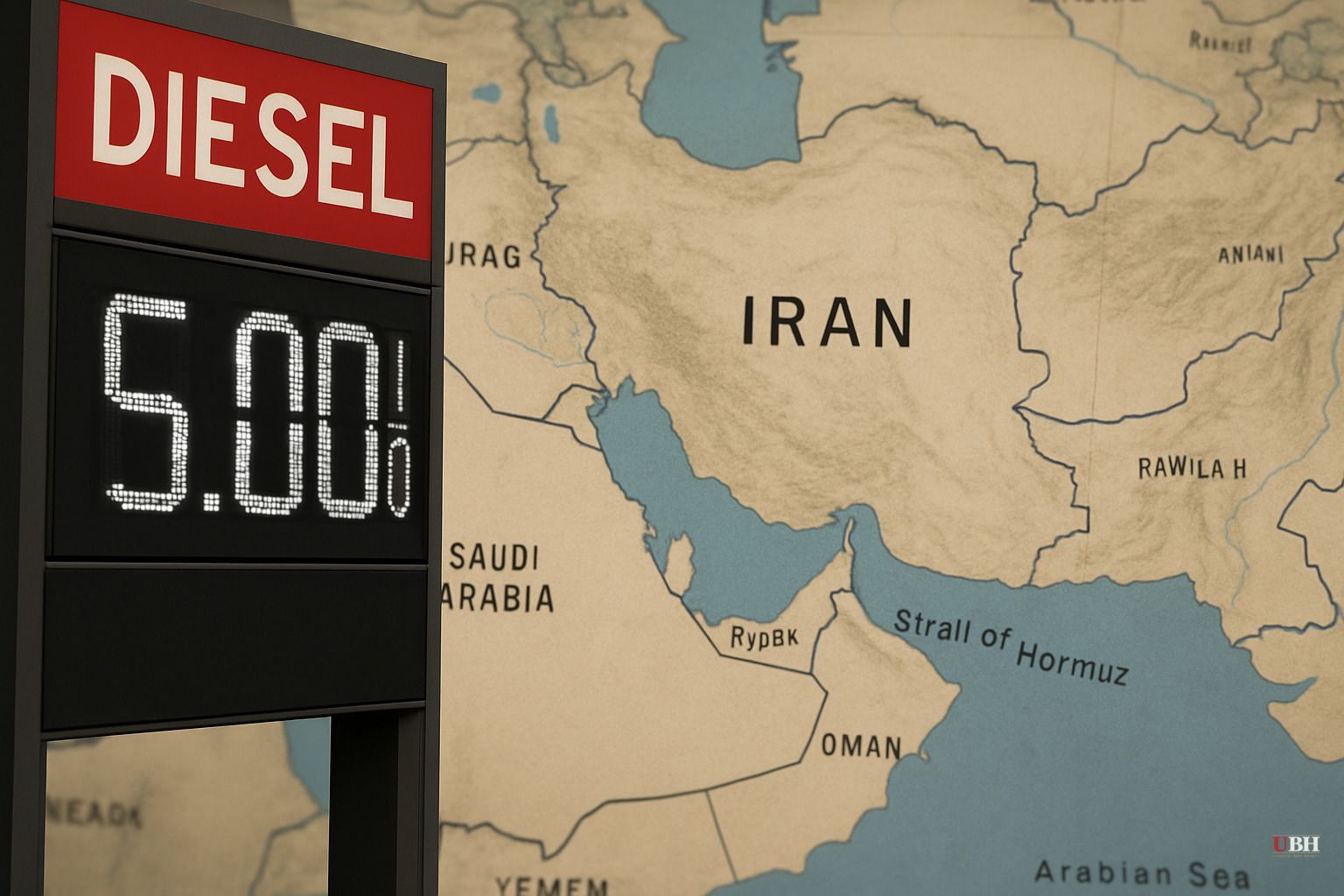
Pump prices are climbing again, and this time it's not going away quietly.
US diesel prices hit $5 a gallon as of Thursday, July 16, 2026, a 33% jump since the Iran war started, according to Reuters. This is the latest data point in a months-long climb that's hammered truckers, farmers, and anyone who ships goods for a living.
Brent crude jumped from roughly $73 a barrel on February 27 to $120 by March 9, according to data compiled by the World Road Transport Organisation (IRU). That's a 65% spike in less than two weeks. Brent has stayed above $100 a barrel since March 16, per IRU's tracking, as fighting in the region kept traders on edge.
A ceasefire was announced April 8, and Brent fell 11.5% week-over-week to $97.08 a barrel by April 10, with WTI dropping to $99.09, according to IRU. Diesel in the US hit $1.494 per liter on April 9, still a 46.2% jump from the February baseline.
The relief was short-lived. The Strait of Hormuz, the chokepoint for roughly a fifth of the world's oil traffic, remained severely constrained even after the ceasefire. IRU reported roughly 600 vessels, including 325 tankers, were stranded in the Persian Gulf as of early April. Brent stabilized near $97 instead of continuing to fall, which IRU's analysis says signals the market was already pricing in a real chance the war would reignite.
Diesel prices are back up to $5 a gallon and 33% above pre-war levels, according to the Reuters figures reported this week. Whatever ground got clawed back during the ceasefire window evaporated.
OPEC+ barely moved the needle
OPEC+ agreed on April 5 to bump production by 206,000 barrels a day starting in May 2026, drawing down part of the 1.65 million barrels a day it had been holding off the market, according to IRU. Compare that to the roughly 10 million barrels a day of Middle Eastern supply that's been disrupted since the war began. It amounts to a rounding error against the actual shortfall.
Analysts disagree on what happens next. Goldman Sachs cut its Q2 2026 Brent forecast to $90 a barrel, down from $99, after the ceasefire signals in April, with the bank projecting $82 for Q3 and $80 for Q4, per IRU. JP Morgan took the opposite view, forecasting $100 a barrel for Q2 with a real risk of an overshoot toward $150 if the Strait of Hormuz stayed shut past mid-May. Given the Strait never fully reopened, JP Morgan's read looks closer to the mark right now.
The International Energy Agency's March report cut its 2026 global oil demand growth forecast to 640,000 barrels a day, a reduction of 210,000 barrels from its February estimate, according to IRU. The IEA's chief has separately warned that the global economy faces serious damage if the Hormuz chokepoint stays disrupted, according to Reuters wire coverage tracked by Finviz.
Europe is getting hit harder
The pain isn't limited to America. The EU's weighted average diesel price reached €2.169 per liter by April 10, a 32.8% jump from the €1.634 baseline, according to IRU. The gap between the cheapest and priciest EU markets sits at €1.38 per liter. The Netherlands led the pack at €2.588 per liter, up 32.7%, followed by Denmark, Belgium, France, and Germany. Belgium's 41.4% increase was the steepest of the bunch.
At least 15 European countries activated fiscal interventions to soften the blow, per IRU, from excise duty cuts to reserve releases. Serbia cut its excise duty by 61% and released 40,000 tonnes of diesel from strategic reserves. Malta's regulated price structure kept diesel frozen at €1.21 per liter the whole time, an outlier that shows what price controls can and can't do.
China and India, more dependent on Middle East crude, saw smaller pump-price increases, according to IRU, largely because both governments run tighter price-control regimes that smooth spikes gradually instead of letting them hit all at once. That's a policy choice with its own tradeoffs: consumers get shielded short-term, but someone, somewhere, eats the difference.
What's actually unresolved
Nobody knows if this is the peak. Goldman's forecast assumed de-escalation that hasn't fully materialized. JP Morgan's overshoot scenario assumed the Strait stayed constrained, which it has. The IEA has flagged a genuine risk that a full Hormuz shutdown could put trillions in trade at risk, a warning that applies well beyond gas station price boards.
For American drivers and truckers, whether Washington leans on the Strategic Petroleum Reserve again or leaves this to OPEC+ and market forces remains uncertain. Neither the Trump administration nor OPEC+ has announced a fresh coordinated release as of this week. Until the Strait of Hormuz traffic normalizes, betting on lower prices at the pump is still a bet on a ceasefire that's already broken down once.
Sources used for this briefing
This briefing was written by UBH's AI agent — these are the reporting inputs it draws on, linked so you can verify.


