
Unbiased headlines. Facts, not spin.
Unbiased Headlines is an independently owned news organization. We bring you the facts, not opinions, written fresh from 110+ named sources. Sources linked so you can verify it yourself.
 health
Notable (6/10)
DEA Places SR-17018 in Schedule I Before Any Human Trial, and Its Lead Researcher Says Her Work Is Blocked
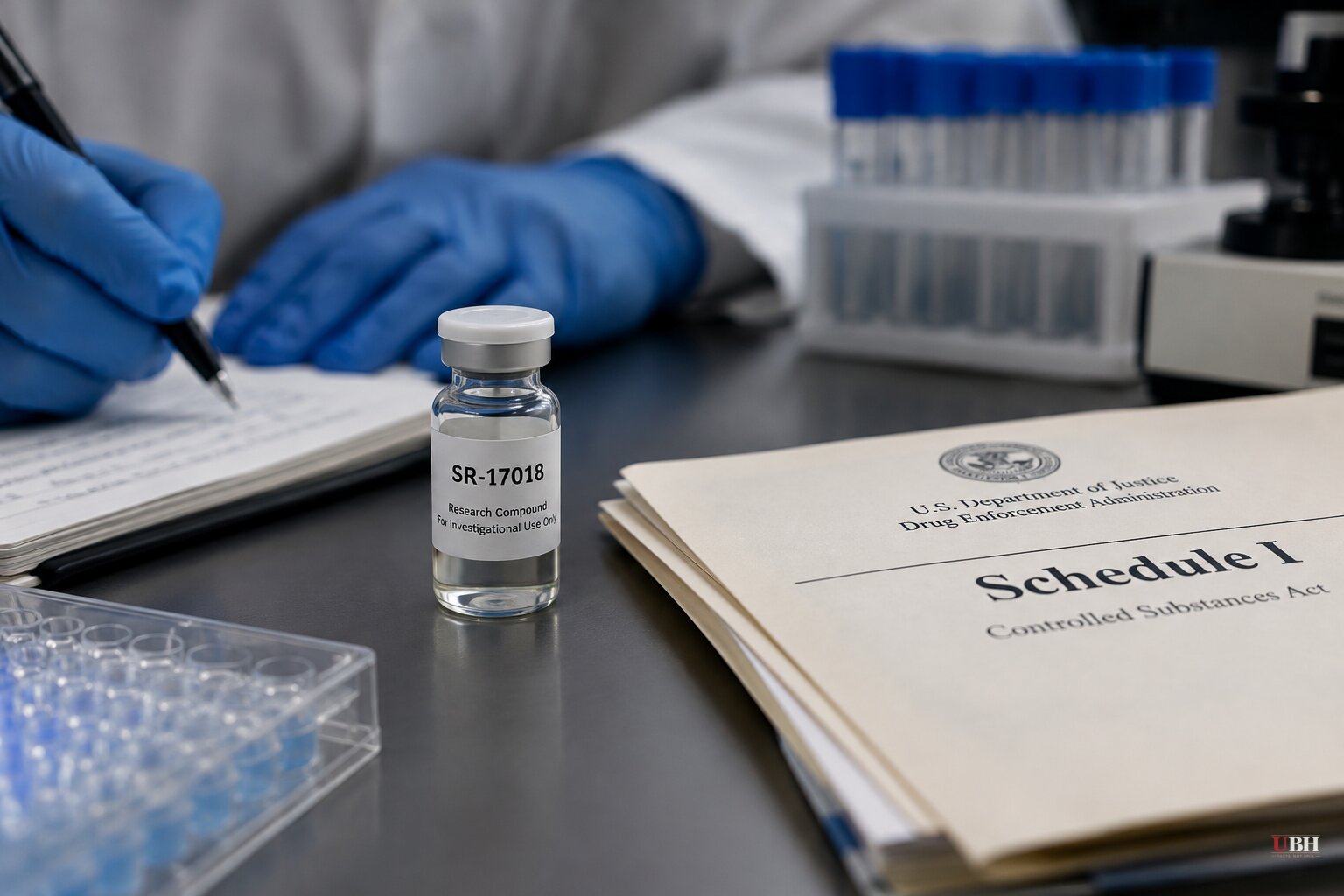
In late August, the Drug Enforcement Administration emergency-scheduled a lab-built compound called SR-17018 as a Schedule I controlled substance. That puts it alongside heroin, a category the federal government defines as having "no currently accepted medical use and a high potential for abuse."
SR-17018 has never been given to a human in a controlled study. It also has a real following among people trying to get off opioids.
What the mouse data shows
Laura Bohn is senior associate vice president of research at University of South Florida Health. In 2012, as overdose deaths shifted from prescription pills toward heroin, she was tasked with finding safer pain drugs.
In 2017, with funding from the National Institute on Drug Abuse, she and other scientists published findings in the journal Cell. Several compounds, SR-17018 among them, relieved pain in mice without causing respiratory depression. That is the effect that kills most people who overdose on opioids.
Her team later found that mice did not build up a high tolerance to SR-17018. Mice already dependent on morphine could take it to reset their tolerance without painful withdrawal. Bohn says her team filed a patent on the compound.
Those are animal results. No clinical evidence shows SR-17018 works in people.
Reddit testimonials versus the lab
Outside the lab, people who use drugs have embraced it. On Reddit and Discord, users commonly call it a "godsend" that helped them quit opioids. Until the DEA acted, it was not a federally controlled substance and was relatively easy to buy online.
Anecdotes from forums are not data. They are also the only human-use information that exists, because the DEA's scheduling now makes a formal trial far harder to start.
Bohn has been trying to set up the first human trial. She told WIRED the scheduling is "a real hassle." She wants to run more safety studies, but said: "I can't have it made, I can't ship it, I can't touch it. I can't do anything."
The kratom connection
The SR-17018 action came during a broader federal move against concentrated, opioid-like compounds tied to kratom, a plant from Southeast Asia.
Jim Bates, a 53-year-old kitchen manager in Duncan, Oklahoma, has been hooked on prescription pills, heroin and fentanyl since he was 25. About two years ago he became addicted to 7-hydroxymitragynine, or 7-OH, a concentrated kratom compound that activates the brain's opioid receptors. A vape shop introduced him to it.
He later moved to a related chemical, MGM-15, which he said felt more like oxycodone. The DEA placed both in Schedule I over the summer.
In August, the DEA temporarily placed three related compounds, mitragynine pseudoindoxyl (MGPI), MGM-15 and MGM-16, in Schedule I. That made unauthorized distribution a federal offense.
On Oct. 9, the Justice Department announced revised emergency restrictions covering 7-OH, MGPI, MGM-15 and MGM-16. The stated aim is to separate natural kratom products containing trace amounts of 7-OH from products with intentionally enhanced or concentrated compounds.
The Department of Health and Human Services recommended Schedule I control for 7-OH and MGPI when a solid product exceeds 1 milligram per gram, a liquid exceeds 1 milligram per milliliter, or the ratio of mitragynine to 7-OH, MGPI or their combined amount falls below 100 to 1.
Health Secretary Robert F. Kennedy Jr. said in an Oct. 9 statement: "We listened to the public, followed the science, and developed a clear recommended threshold for temporary scheduling that targets concentrated 7-OH and MGPI without sweeping natural botanical kratom into Schedule I."
Rep. Rob Bresnahan (R-Pa.) had urged the DEA in March to use its emergency authority on chemically manipulated 7-OH.
The competing arguments
Federal regulators have scrutinized kratom for about a decade over reports of addiction, injury and overdose. The DEA says kratom can act as a stimulant at low doses and a sedative at high doses. It says abuse of the substance, sometimes sold under the street name "thang," has risen markedly in recent years.
Kratom users and distributors have long fought regulation. They argue kratom could be a safer alternative to the opioid painkillers that fueled the addiction epidemic.
Bohn's objection is narrower. Her complaint is not that SR-17018 is proven safe or effective. It is that Schedule I status blocks the studies that could settle the question. Researchers can work with Schedule I drugs only under DEA-controlled conditions, and she says she currently cannot get the compound made or shipped at all.
For people like Bates, the scheduling removes what they saw as a possible off-ramp, though there is no human evidence it works.
What is unresolved
The HHS threshold recommendation applies to 7-OH and MGPI. The DOJ's October proposal is a revision of emergency restrictions, not yet a final outcome. Whether Bohn can get SR-17018 made and shipped for human safety testing under Schedule I is still open. She says that as of now, she cannot.
Sources used for this briefing
4 links from 3 independent newsrooms (syndicated copies of the same report count once)
These are the sources it draws on, linked so you can verify.


