
Unbiased headlines. Facts, not spin.
Unbiased Headlines is an independently owned news organization. We bring you the facts, not opinions, written fresh from 110+ named sources. Sources linked so you can verify it yourself.
 health
Major Story (7/10)
Event date: November 2, 2026 ·
FDA Tentatively Approves Generic Lenacapavir at $40 a Year for 120 Countries
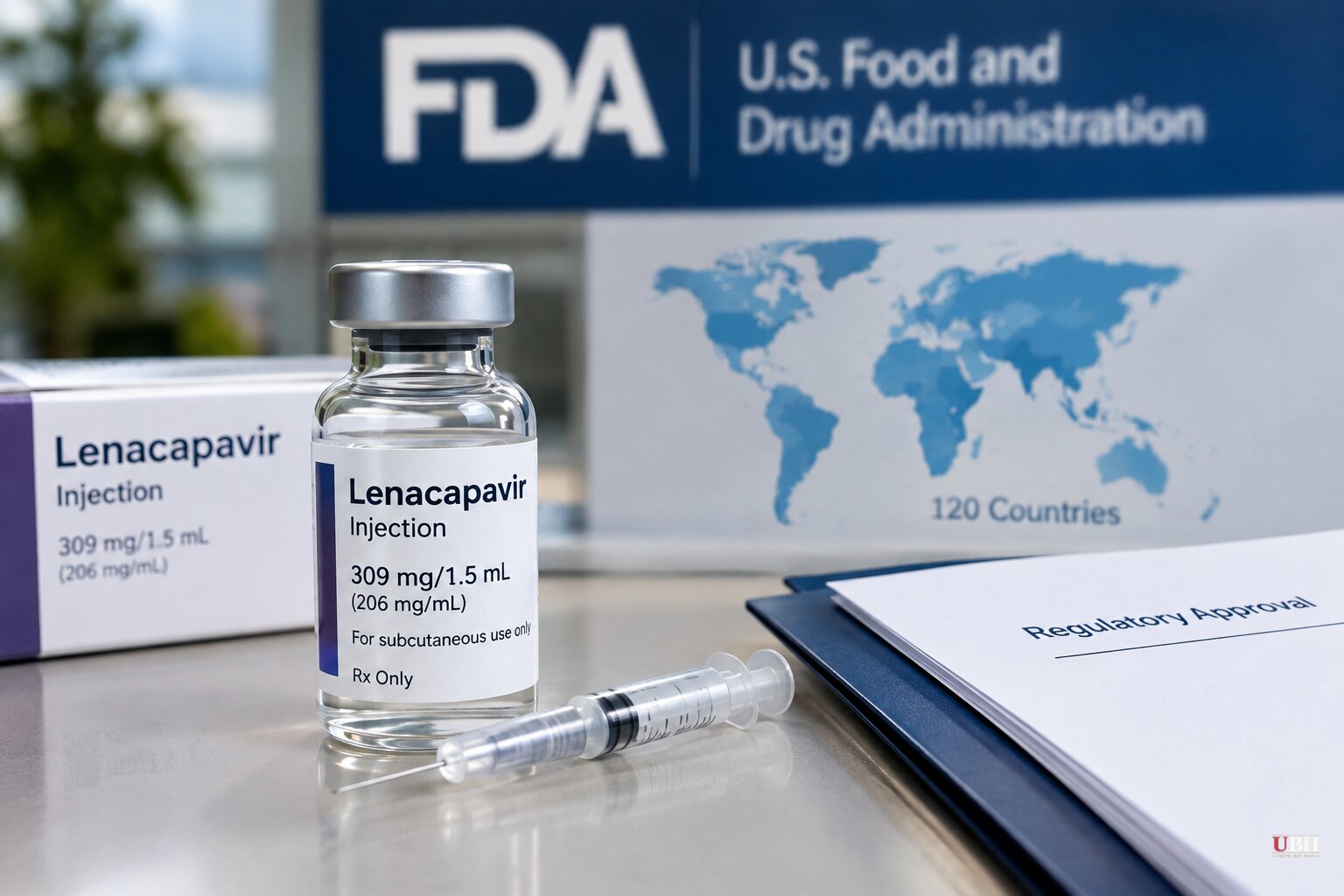
The U.S. Food and Drug Administration has tentatively approved the first generic version of lenacapavir, the twice-a-year injection that prevents HIV. The manufacturer and the groups that helped speed its development announced the decision Monday, Nov. 2.
The generic is made by Dr. Reddy's Laboratories. It is intended for the 120 low- and middle-income countries covered by Gilead Sciences' voluntary licensing program, at an expected price of $40 a year per person.
That is the same price as the daily PrEP pills already on the market. The shots are needed far less often than daily pills, and they nearly eliminated new infections in two studies of people at high risk.
What "tentative" means
The FDA's "tentative" label is its standard designation for a generic while the original drug is still under patent. It does not allow sale in the United States. Gilead's brand-name version, Yeztugo, was approved in June 2025 and remains patent-protected here. Its U.S. list price is $28,218 a year, before insurance. Gilead officials say that is similar to some other types of PrEP.
Tentative approval does make the generic eligible for purchase by the U.S. government. The FDA reviewed it under a longstanding process meant to ensure the quality of HIV drugs supplied to other countries with U.S. backing. An FDA nod can also speed approval by regulators elsewhere.
The approval came 16 months after the original. "Getting a generic approved just 16 months after the originator, rather than a decade later, shows what's possible when we prioritize access from the start," said Neil Buddy Shah, CEO of the Clinton Health Access Initiative (CHAI).
How the timeline got compressed
The path began in late 2024, when Gilead granted voluntary licenses to six generic makers: Dr. Reddy's, Emcure, Eva Pharma, Ferozsons, Hetero and Mylan.
In September 2025, Unitaid, Wits RHI (a research institute of the University of the Witwatersrand) and CHAI reached a pricing agreement with Dr. Reddy's. It paired an early price commitment with financial, technical and regulatory support.
Dr. Reddy's also filed one application covering both HIV prevention and HIV treatment, the two indications for lenacapavir, through the FDA's 505(b)(2) pathway. That let the company request and secure a priority review.
Initial supplies are expected to reach countries by the end of 2026. Shah said more than 125,000 people in Africa have already started on lenacapavir. Rollouts began earlier this year in places such as Zimbabwe and Kenya, and a nurse was photographed injecting a patient in western Uganda in August. Generic versions made by the other five manufacturers have yet to be approved by the FDA.
The scale of the problem
The World Health Organization says 41 million people worldwide were living with HIV last year, and 570,000 died of HIV-related causes.
Carolyn Amole, who leads CHAI's HIV program, said an affordable generic means "we could help to scale this to the 20 million people around the world who need PrEP." She added: "And if we scale to those levels, we can actually begin to bring an end to the HIV epidemic."
Carmen Pérez Casas, HIV lead at Unitaid, pointed to the weakness of the pill. "If you do not take it, you cannot get protected against HIV," she said. "With lenacapavir, we are much more hopeful."
Until now Gilead has been the only supplier. Demand has outstripped supply in poorer countries, and the licenses cover only a specific set of countries in sub-Saharan Africa, Asia and Latin America.
In Mbarara, Uganda, a sex worker named Lisa Mutoni says she has tried repeatedly to get the shot. "They tell me that it is finished," she said. She says a six-month injection would suit sex workers who move for months at a time, and that pills are easy to forget. A nearby health facility received 40 doses in April and another 70 in June; the second batch was used up within 10 days.
Andrew Hill, a senior visiting research fellow at the University of Liverpool who studies HIV treatment, said the rollout is too slow. "We need to be getting to the millions pretty soon," he said.
The approval also lands as prevention programs absorb funding cuts. UNAIDS data show the number of people who received PrEP at least once across 62 countries fell from 3.3 million in 2024 to 2.1 million in 2025.
Gilead and its critics
The Global Fund's stated goal is to reach 3 million people with lenacapavir by the end of 2028. Doctors Without Borders (MSF) says that is nowhere near enough. The group wants Gilead to make low-cost doses available to more countries and to sell directly to MSF so it can protect more people faster.
"Gilead says it wants to end the HIV epidemic 'for everyone, everywhere,' but its actions say otherwise," said Melissa Barber, MSF USA global health advocacy and policy adviser.
Gilead defends its approach. "We share the sense of urgency around expanding access to lenacapavir for HIV prevention," a company spokesperson said. "We believe we have enabled the fastest and most sustainable path to expanding access for communities most affected by HIV."
The two positions turn on the licensing map. Gilead says its six-manufacturer structure is the quickest route. MSF says the drug should reach more countries than the 120 covered.
What comes next
Amole said funding is the next hurdle. "The work is not done. Now, we need the funding to actually buy it for everyone who needs it, and then we need to do the hard work of getting it to the millions of people who need it and want it," she said. "But this is a great milestone."
The partners say generic lenacapavir should start to become available in some places within weeks, though it could take longer in countries that require their own approval processes. The next marker is the end of 2026, when initial supplies are expected to reach countries. The Global Fund's 3 million target for 2028 compares with the 20 million people CHAI says need PrEP.
Sources used for this briefing
7 links from 7 independent newsrooms (syndicated copies of the same report count once)
These are the sources it draws on, linked so you can verify.


