
Unbiased headlines. Facts, not spin.
Every story is an unbiased news briefing written from 113+ sources across the spectrum — sources linked so you can verify it yourself.
 economy
Major Story (7/10)
Event date: September 29, 2026
economy
Major Story (7/10)
Event date: September 29, 2026
Data Center Rankings Disagree on the Winner as Grid Delays and Local Backlash Pile Up
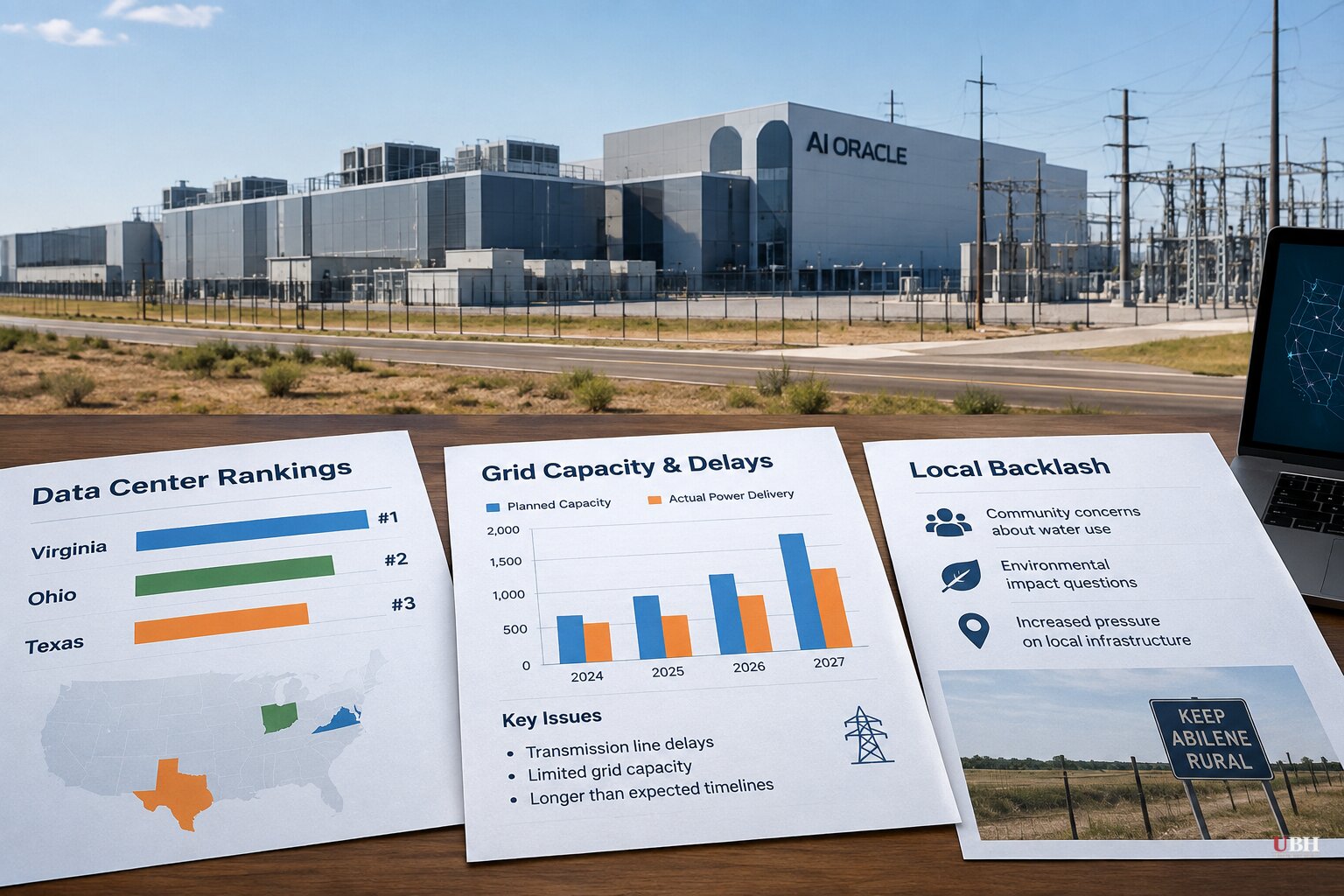
Since Oracle's Stargate campus in Abilene, Texas began delivering partial power to OpenAI in September, according to Power Engineering, the national data center buildout has fractured into three separate stories: a scorekeeping fight over which state is winning, a grid connection problem that's quietly delaying projects nationwide, and a bipartisan backlash that's now splitting local officials within their own parties.
Nobody Agrees on Who's Winning
Texas-based TRG Datacenters put Virginia at the top of its August 2026 "readiness index," awarding it a perfect 100 score. Virginia hosts seven large AI data center sites totaling 1,085 megawatts, more than Georgia, New York and Oregon combined, according to TRG. Ohio took second with a score of 88.2, followed by Tennessee, Georgia and Texas.
CNBC's 2026 Top States for Business rankings, published in July, flipped that order: Ohio first, Virginia second, Illinois third, Indiana fourth. CNBC credited Virginia with the most deliverable computing power of any state and more than 600 data centers, but also warned the state's grid is strained and public backlash is growing enough that some localities are weighing outright bans.
Then there's Labrynth, a regulatory tech firm, which put Texas first, followed by Oregon, Illinois, Florida and Georgia, as reported by Yahoo Finance in May. Virginia barely cracked that list at tenth. Commercial real estate firm Cushman & Wakefield separately named Dallas the world's top primary data center market, and Texas grid operator ERCOT projects data centers alone will need more than 22,000 megawatts by 2030. Synergy Research Group found Texas and the Midwest already hold a third of the nation's operational hyperscale capacity, a share expected to grow past half of new capacity in coming years, according to TechNewsWorld.
The rankings disagree because they're measuring different things: raw capacity, carbon output, water stress, business climate, regulatory speed. Tennessee, for instance, has the most large sites of any state in TRG's study, 13, but nearly 59% sit in water-stressed areas. Ohio's SoftBank-backed Pike County project, billed as the world's largest data center, sidesteps that problem by pairing a gas plant with 18 small nuclear reactors.
Not everyone in Texas is celebrating the state's standing. Texas Agriculture Commissioner Sid Miller has called for a statewide pause on large data center projects, according to Yahoo Finance, putting him at odds with his own state's grid operator and its hyperscaler pipeline.
The Grid Can't Keep Up With the Spreadsheets
Announced megawatts and actual delivered power are turning out to be two different things. Nearly 40% of U.S. data center projects scheduled for completion this year could miss their targets by more than three months, according to geospatial analytics firm SynMax, cited by Power Engineering.
Oracle's 1.3-gigawatt Project Lighthouse campus in Port Washington, Wisconsin, illustrates the bottleneck. American Transmission Co. filed for more than $1 billion in transmission infrastructure approval in September 2025, but Wisconsin regulators later withdrew their determination that the application was even complete, forcing a restart. Oracle still lists customer delivery for the second half of 2027, though independent forecaster Aterio estimates partial power may not arrive until December 2027, with full capacity not online until October 2028.
In New Mexico, Oracle's 2.45-gigawatt Project Jupiter campus near Santa Teresa was designed to sidestep grid limits entirely by running on Bloom Energy fuel cells. But the pipeline meant to supply those fuel cells is roughly six months behind schedule on permitting, pushing completion to February 2027. Oracle issued a force majeure notice tied to the broader Stargate initiative, though the company says the project remains on track for 2028, according to Power Engineering.
Communities Are Pushing Back, Across Party Lines
A poll by The Economist and YouGov of nearly 1,600 adults found roughly two-thirds of Americans oppose new data center construction in their own communities, according to NPR. Brookings Institution senior fellow Darrell West called the reaction a genuine grassroots movement cutting across Republicans and Democrats, driven partly by fears that AI will cost jobs. Muhlenberg College political science professor Chris Borick put it more bluntly: "If you're in power right now and you are dealing with this issue, you have a target on your back."
That tension is splitting Democrats against each other in Loudoun County, Virginia, where board member Juli Briskman is challenging board chair Phyllis Randall in next year's primary. Briskman has pushed to slow development; Randall has defended the tax revenue data centers generate while calling the arrangement a "double-edged sword" for nearby residents, according to NPR.
In Hood County, Texas, commissioner Dave Eagle told CBS News a data center developer, later identified as Amazon Web Services, pitched jobs and good-neighbor promises for a year without specifying what it actually wanted to build, while requesting up to 90% property tax rebates for 30 years. Eagle voted no. The project moved to a neighboring county instead, where AWS got the rebate it asked for. Amazon told CBS News it evaluates many site options and works with local leaders "to create jobs and generate revenue for public services" wherever it builds.
Residents in Hood County and across Indiana are objecting not to data centers in the abstract but to deals negotiated under nondisclosure agreements, with tax breaks locked in for three decades before residents see a specific building plan. That's a legitimate transparency complaint, not simple NIMBYism, and it's one even red-state officials like Sid Miller are raising.
California's Separate Problem: Who Pays for the Grid
PG&E CEO Patti Poppe told CNBC her utility's data-center pipeline has grown to 12.7 gigawatts, but said unresolved wildfire liability rules are complicating how PG&E funds the grid upgrades that growth requires. Poppe said the Los Angeles wildfires pushed credit-rating agencies to raise concerns about PG&E's wildfire exposure, adding roughly $600 million to customer costs over two years. California's Senate Bill 492, meant to overhaul wildfire liability after two years of legislative work, emerged narrower than planned and did not substantially cut utility liability, according to Poppe. PG&E has since cut its planned 2027 investment by about $2 billion.
What's Still Unsettled
None of the competing rankings have converged, and none are likely to soon, since each measures a different variable. The harder question is whether SynMax's 40% delay rate holds up as more of the roughly 1,500 planned U.S. data centers identified by Pew Research Center move from announcement to construction. Wisconsin regulators have not set a new timeline for American Transmission Co.'s restarted application, and Oracle has not said whether a further delay to its New Mexico pipeline would trigger additional force majeure claims.
Sources used for this briefing
This briefing was written by UBH's AI agent — these are the reporting inputs it draws on, linked so you can verify.


