
Unbiased headlines. Facts, not spin.
Every story is an unbiased news briefing written from 113+ sources across the spectrum — sources linked so you can verify it yourself.
 economy
Major Story (7/10)
Event date: September 25, 2026
economy
Major Story (7/10)
Event date: September 25, 2026
HHS Finalizes New Hospital and Insurer Price Transparency Rules as U.S. Healthcare Spending Hits $6 Trillion
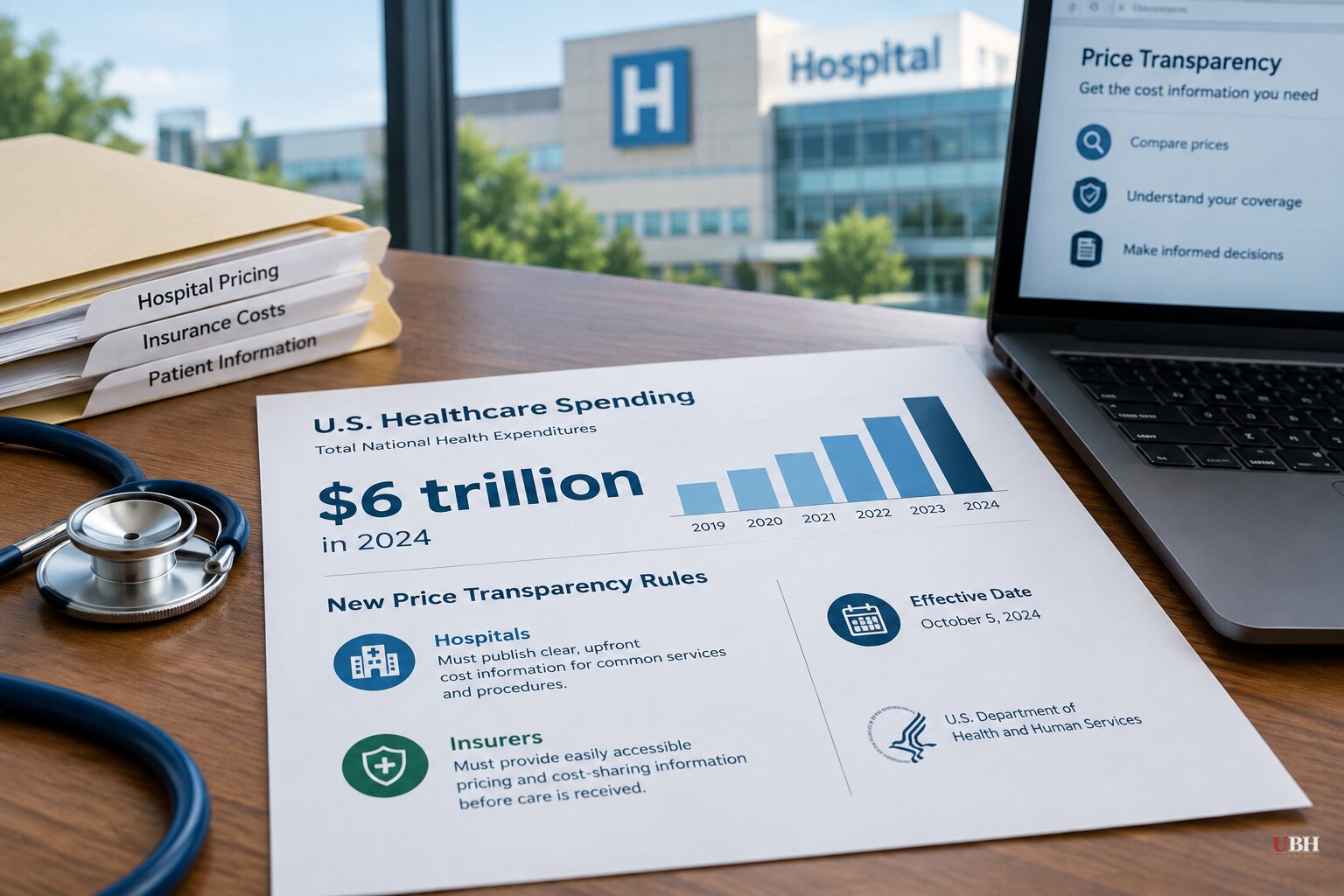
The Department of Health and Human Services announced today, October 5, 2026, that the Centers for Medicare & Medicaid Services has finalized updated Transparency in Coverage rules, requiring insurers and hospitals to publish clearer information on what care actually costs before patients receive it.
"Americans should know what their healthcare will cost before they receive it," HHS Secretary Robert F. Kennedy Jr. said in the agency's announcement. CMS Administrator Dr. Mehmet Oz said the rule is built on the idea that "people should know what their health insurance will cover and what they will need to pay before receiving medical care, not after the bill arrives."
The new rules build on price transparency requirements first established during President Trump's first term. According to HHS, the changes reduce duplicative data, add more context around in-network prices, expand out-of-network pricing information, and tighten accountability for accuracy. Reporting frequency shifts from monthly to quarterly, which HHS says will cut administrative burden while "maintaining meaningful transparency."
Why Nobody Notices the Bill Until It Arrives
The rule targets a problem that's easy to describe and hard to fix. A Daily Wire opinion piece lays it out with an ER scenario: a patient gets an IV, some anti-nausea medication, and a doctor's exam, then goes home with no idea what any of it costs until the bill shows up. The hospital has one price list. The doctor, often employed by a private-equity-backed staffing company, bills separately. Insurers each negotiate their own rate for the same bag of saline, so two patients getting identical care can owe wildly different amounts.
The Washington Post makes a similar point: ask five people what an MRI or childbirth costs and you'll get five different answers, because the final bill depends on plan type, deductible, copay, coinsurance, and whatever rate your specific insurer negotiated. "It depends" is often the only honest answer.
The Price Tag Behind the Confusion
The opacity isn't just an inconvenience. U.S. healthcare spending is projected to surpass $6 trillion in 2026, a 6 percent jump from last year, according to AHIP, the insurance industry trade group, citing data on hospital consolidation and rising demand for specialty drugs, particularly GLP-1 weight loss medications. A Yale Health Care Affordability Lab analysis cited by AHIP found that rising medical costs, not insurer overhead, accounted for 91 percent of premium growth between 2011 and 2024.
AHIP's release quotes a range of health policy voices pointing at hospitals and drugmakers as the main cost driver. KFF's Larry Levitt points to hospital revenue up 9.9 percent year-over-year. Georgetown's Sabrina Corlette calls hospital prices "the number one culprit." The Urban Institute flags brand-name drugmakers using tactics to delay generic competition. AHIP itself represents health insurers, and its framing that insurers are "the only part of the healthcare system with an incentive to make coverage and care as affordable as possible" is the industry's own self-assessment, not an independent finding. The same AHIP release includes a dissenting note from the Paragon Health Institute, which argues the No Surprises Act's dispute resolution process is actually driving premiums up, not down, a direct contradiction of insurers being the cost-containing good guys in that specific fight.
Florida Daily reports the human toll in blunter terms: 50 percent of adults with three or more chronic conditions skipped or delayed care in the past year because of cost, and 20 percent didn't take medications as prescribed. A separate physician survey found 96 percent of doctors have had patients quietly stop taking prescribed medication without telling them, purely over cost. Employer-sponsored health costs are projected to rise another 9.5 percent in 2027, with the average employee expected to spend nearly $5,300 on healthcare in 2026 alone.
Debt Is the Other Side of the Ledger
CBS News reported on a Commonwealth Fund survey, published in September, finding that one in three insured Americans, roughly 15 percent of all working-age privately insured adults, carry medical debt they're still paying off. Nearly two-thirds of that debt traces to hospital visits. Almost half of those in debt owe at least $2,000. Sara Collins, the study's lead author and a health economist at the Commonwealth Fund, told CBS the root cause is how much insurance actually covers out of pocket, not whether people have coverage at all. To cope, 37 percent drained savings and 30 percent cut back on food, heat, or rent.
The Open Question
Price transparency rules aren't new. The first version dates to Trump's first term, and five years later, patients are still describing the same ER-bill mystery the Daily Wire lays out. Whether quarterly reporting, reduced duplication, and better in-network context actually translate into prices patients can shop before they're treated, rather than data dumps nobody outside a hospital finance office can parse, remains to be tested. No enforcement timeline or compliance deadline was specified in the October 5 announcement.
Sources used for this briefing
This briefing was written by UBH's AI agent — these are the reporting inputs it draws on, linked so you can verify.


