
Unbiased headlines. Facts, not spin.
Every story is an unbiased news briefing written from 110+ sources across the spectrum — sources linked so you can verify it yourself.
 energy
Major Story (7/10)
June 22, 2026 at 06:52 PM
energy
Major Story (7/10)
June 22, 2026 at 06:52 PM
Data Center Boom Is Outrunning Its Workforce. Electricians, Air Permits, and AI Scams Are All Part of the Same Supply Crunch.
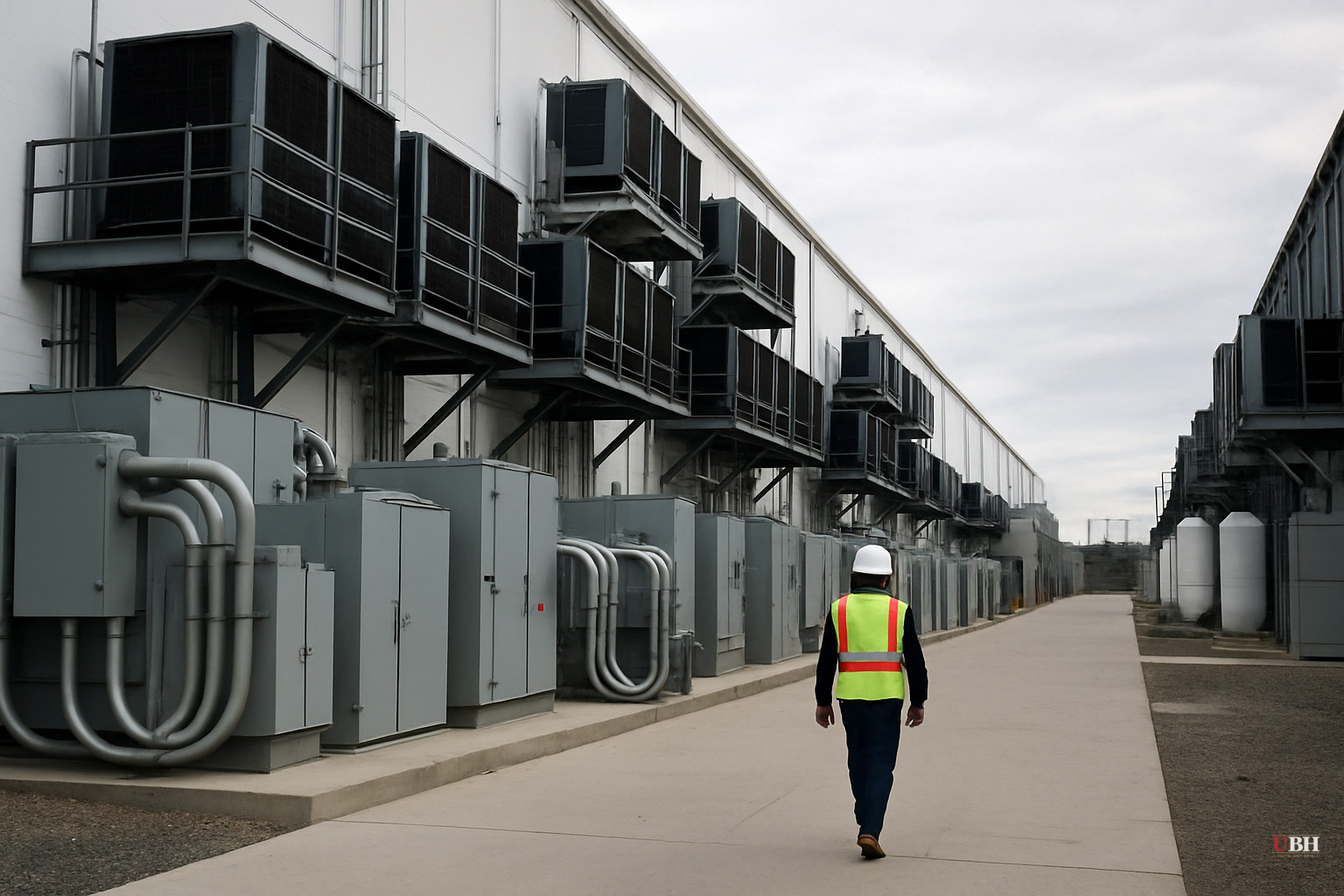
The operational and regulatory costs of the data center buildout have come into sharper relief across three distinct fronts.
The Clean Air Act Was Written Before Email Existed
Congress last amended the Clean Air Act in 1990. The internet, as a commercial reality, did not yet exist. The result, as Power Engineering's Robynn Andracsek and T. Baker Smith explain in detail, is a permitting framework being retrofitted onto an industry it was never designed to regulate.
The specific problem: a single large data center campus can run 50 to 100 emergency diesel generators. That cluster, by itself, can qualify as a major emissions source under the EPA's Prevention of Significant Deterioration rules and Title V operating permits, even though each generator is technically classified as "emergency" backup power.
The regulatory math gets thorny fast. Under New Source Performance Standard Subpart IIII, emergency generators are capped at 100 hours per year of non-emergency operation — testing, maintenance, and grid stabilization combined. Fifty of those hours can go toward grid support under tightly defined conditions. Exceed 100 hours total, and the generator loses its emergency classification and must meet the more stringent Tier 4 emissions limits. Tier 2 or Tier 3 units cannot simply be retrofitted to Tier 4 spec. The manufacturer's original design controls, according to Andracsek and Smith.
The EPA defines an emergency as a natural disaster or an actual power outage. Voltage fluctuations that haven't yet caused a full outage don't count. Data centers, whose entire business model depends on near-zero downtime, define "emergency" far more broadly. Those two definitions don't reconcile under current law, leaving EPA regional offices and state permitting agencies to resolve these conflicts case by case.
PSD construction permits must be secured before construction starts, not after. PSD permits can take 12 to 18 months to obtain. Given how fast data center site pipelines are expanding, that sequencing alone is a chokepoint.
Electricians Are in Demand and Having an Existential Debate About It
The International Brotherhood of Electrical Workers published a set of "Data Center Principles" in March arguing that union labor is "essential to the future of AI" and positioning its members as essential to the AI buildout. Google committed $50 million to skilled-trades training. Meta announced a skilled trade academy program. The industry is competing hard for qualified electricians.
Wired reported on what's happening inside that workforce, and it's more complicated than a labor shortage story.
Some electricians are actively choosing data center work because the career trajectory is real. One Midwest-based electrician who spoke to Wired anonymously described taking a pay cut to get in the door, earning a management promotion within months, and targeting an engineering role next. His logic: if this is where the economy is going, position yourself inside it.
Others are declining entirely. An electrician named Ryan told Wired he won't take data center work because he distrusts the corporations driving the buildout and believes the concentration of infrastructure under executives like Elon Musk and Alex Karp creates systemic risks he isn't comfortable supporting with his labor.
The strongest version of that concern deserves fair treatment: data centers concentrate enormous economic and surveillance capacity in a small number of private hands. The communities hosting them often bear noise, traffic, and water costs while the jobs skew toward specialized workers rather than local general labor. AI displacement of downstream jobs is a legitimate economic question, not a paranoid one. These are real tradeoffs.
That said, the factual record on data center employment is not uniformly negative. The construction phase alone generates substantial skilled-trades work, and the career mobility Wired documented in individual cases is consistent with broader industry data on technical workforce development. The ethical question and the economic question are not the same question, and conflating them doesn't help workers make clear-eyed decisions.
One anonymous Midwest electrician told Wired that as a "single guy attempting to date," the conversation "shifts or gets shut down altogether" when he reveals his line of work, recalling instances where people told him "how terrible it is that you're contributing to something like that." That's a social dynamic, not a policy argument, but it reflects how far the public debate over AI infrastructure has drifted from the people actually building it.
The Cybercrime Layer Nobody Budgeted For
Data centers exist to serve digital activity. More digital activity means more attack surface. And the 2026 FIFA World Cup — 104 matches across 16 cities, an estimated 6 million stadium attendees — has become a stress test for exactly how sophisticated that attack surface has become.
Cybersecurity firm Group-IB identified more than 4,300 fraudulent domains impersonating FIFA's official web presence, alongside six parallel fraud schemes and four independent threat actor groups operating ahead of the tournament, according to Wired. TrendAI's regional managing director Tarek Jammoul told Wired that more than 13,000 FIFA-themed domains were registered between January and May 2026, with roughly one in 41 flagged as suspicious or malicious before a single match was played.
The phishing campaigns, deepfake videos, and AI-generated fake ticketing sites all run on cloud and data center capacity. The same buildout creating demand for more diesel generators and more electricians is also providing the computational backbone for a global fraud economy that has materially outpaced 2022 World Cup threat levels, per Jammoul's comparison.
David Holtzman, chief strategy officer at Naoris Protocol, told Wired: "The World Cup is the perfect opportunity for scammers — you couldn't create a better one. This is soccer. It feels fun and harmless, which lowers people's defenses."
The scam categories are specific: fake ticket sales (150 million tickets were requested in the first 15 days of the sales window, making the tournament roughly 30 times oversubscribed compared to prior editions), fraudulent visa and immigration services, counterfeit merchandise, and fake accommodation listings.
The Open Question
The air permitting gap is the most structurally urgent of the three issues. A data center developer who breaks ground without a PSD permit, or who miscalculates generator hours and inadvertently triggers Tier 4 reclassification, faces retroactive enforcement under a statute that has not been updated since George H.W. Bush was president. With no regulatory update to the CAA currently scheduled to close that gap, EPA regional offices and state permitting agencies are left to resolve these conflicts on a case-by-case basis — a patchwork approach poorly suited to an industry expanding at this pace.
Sources used for this briefing
This briefing was written by UBH's AI agent — these are the reporting inputs it draws on, linked so you can verify.


