
Unbiased headlines. Facts, not spin.
Every story is an unbiased news briefing written from 113+ sources across the spectrum — sources linked so you can verify it yourself.
 health
Major Story (7/10)
Event date: July 26, 2026
health
Major Story (7/10)
Event date: July 26, 2026
Danish Study of 1 Million Women Finds Oral Hormone Pills Raise Clot and Stroke Risk, Patches Largely Don't
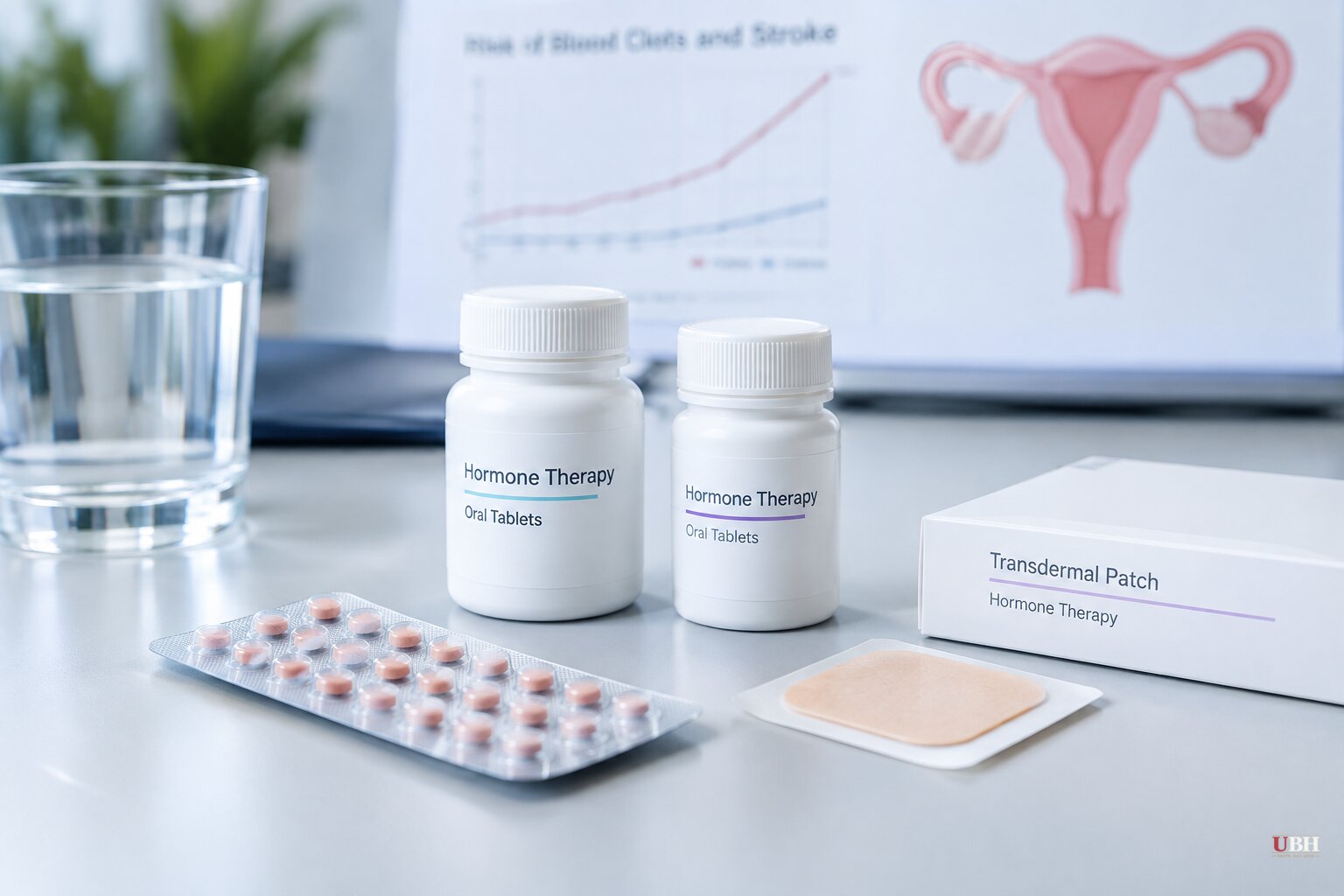
A study of more than one million Danish women, published in The BMJ, found that oral menopausal hormone therapy carries a measurably higher risk of blood clots than previously assumed, while patches and gels largely do not.
Researchers led by Dr. Julie Berggreen of Nordsjællands Hospital in Hillerød, Denmark, tracked 1,060,082 women ages 50 to 69 using three national registries covering 2003 through 2021, according to medicalrepublic.com.au. They identified 9,807 women with a first venous thromboembolism, 18,460 with ischemic stroke, and 11,974 with a heart attack, then matched each group to tens of thousands of women who didn't have those events, according to News Medical.
What the Numbers Actually Show
Current use of oral estrogen, with or without progestin, carried a hazard ratio of 1.6 for venous thromboembolism compared to no current use, according to MedPage Today. That translates to one extra blood clot case for every 1,055 women taking the pills for a year, according to Medical Xpress.
Stroke and heart attack risk told a different story. Low-dose oral estradiol showed no increased risk of either. Only high doses, above 1 mg per day, taken for more than a year, were linked to elevated stroke risk (hazard ratio 1.5) and heart attack risk (hazard ratio 1.4), per MedPage Today.
Transdermal therapy, delivered through patches, gels, or sprays, showed no general increase in clot risk at all. The one exception: combined cyclic transdermal therapy carried a heart attack hazard ratio of 2.1, according to MedPage Today.
Put in absolute terms, the real-world impact is small. Baseline rates among women not on hormone therapy were 15.8 venous thromboembolism cases, 20.3 strokes, and 13.0 heart attacks per 10,000 person-years, according to Medical Xpress. Oral therapy added roughly nine extra events per 10,000 women per year, according to medicalrepublic.com.au.
Why the Route Matters, Mechanically
Dr. Robert Storey of the University of Sheffield, who wasn't involved in the study, explained the biology in comments posted to the U.K. Science Media Centre: oral estrogen passes through the liver first, spiking production of clot-forming factors. Patches skip that step because they don't stimulate the liver the same way, which is why the study results line up with what's already understood about how the two delivery routes behave differently in the body.
A Fair Concern About the Data
Dr. Stephanie Trentacoste McNally of Northwell Health's Katz Institute for Women's Health raised the most legitimate pushback, telling Newsday this is an observational study, not a randomized controlled trial, and "it's not something that can be easily translated into every population." The Danish cohort also lacked data on smoking and obesity, factors that independently drive clot and stroke risk, according to Science Media Centre New Zealand.
Dr. Megan Lochner of Stony Brook Medicine told Newsday the findings won't change how she counsels patients. "I think it backs up the way I'm already counseling them," she said.
The Timing Problem
This study lands months after the FDA removed boxed warnings on cardiovascular disease, breast cancer, and probable dementia risk from menopausal hormone therapy labels earlier this year. Study co-author Dr. Amani Meaidi of Copenhagen University Hospital of North Zealand argued in an accompanying BMJ opinion piece that neither extreme is honest.
"These findings do not support describing menopausal hormone therapy as simply safe or unsafe," Meaidi wrote, adding that risk depends on the specific drug, dose, delivery method, and duration. She warned against returning to an era when women were needlessly frightened away from effective treatment, but also against letting current enthusiasm erase genuine uncertainty from the conversation.
The FDA's label change removed blanket warnings without distinguishing between oral and transdermal routes. This study suggests that distinction is exactly where the real risk difference lives.
What's Unresolved
No randomized trial has directly compared oral versus transdermal hormone therapy head-to-head on clots or strokes, according to acibademinternational, so the route-specific safety picture still rests on observational data like this Danish registry study. Whether the FDA or other regulators will revisit menopause drug labeling to reflect the oral-versus-transdermal distinction, rather than treating hormone therapy as a single category, remains an open question the agency has not yet addressed.
Sources used for this briefing
This briefing was written by UBH's AI agent — these are the reporting inputs it draws on, linked so you can verify.


