
Unbiased headlines. Facts, not spin.
Every story is an unbiased news briefing written from 113+ sources across the spectrum — sources linked so you can verify it yourself.
 health
Major Story (7/10)
Event date: September 22, 2026
health
Major Story (7/10)
Event date: September 22, 2026
El Niño Ocean Temperatures Smash 170-Year Record as California Declares State of Emergency
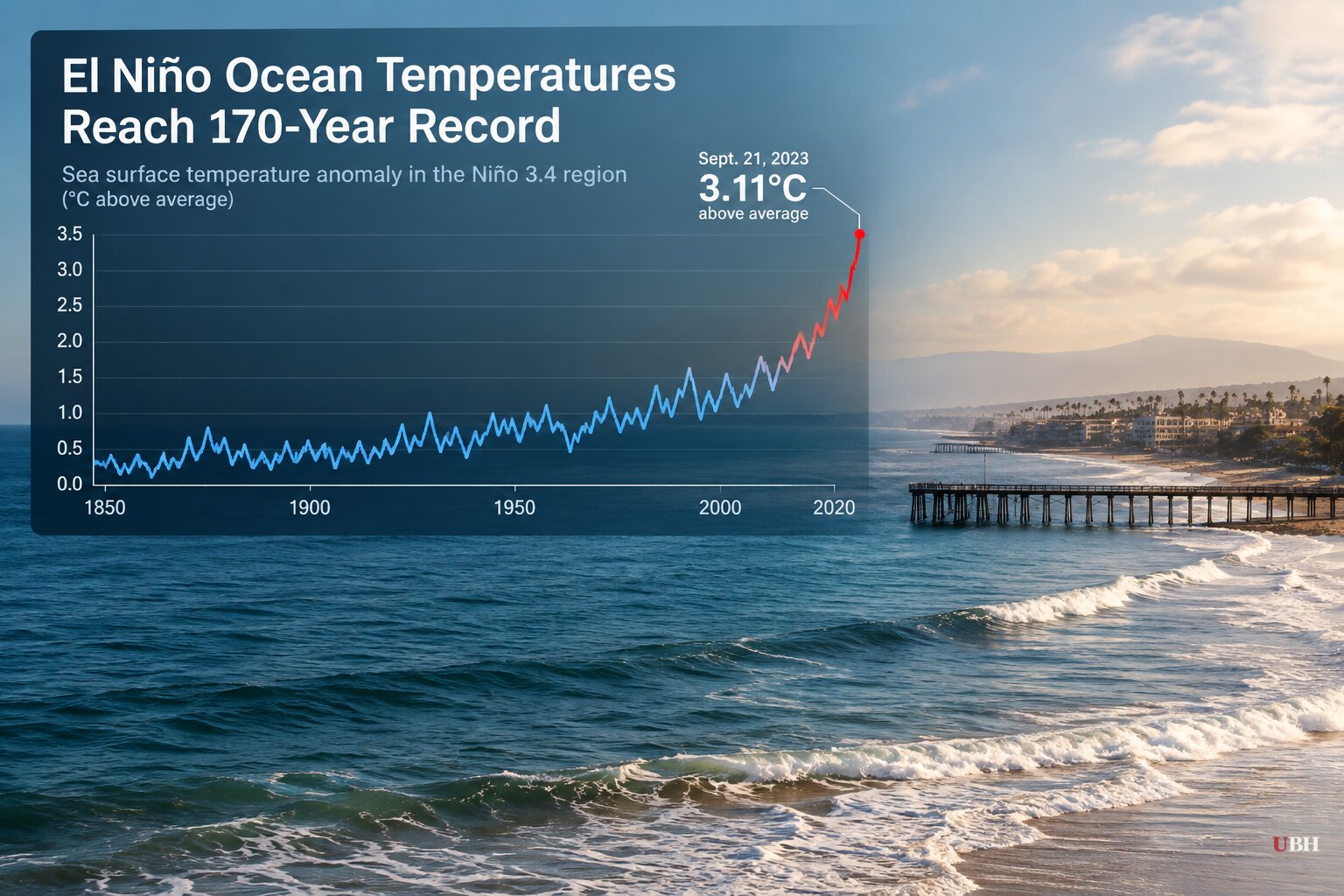
Since NOAA declared El Niño's arrival in June, the event has done nothing but strengthen. On Sept. 21, a daily ocean temperature reading in the Pacific's Niño 3.4 region hit 3.11 degrees Celsius above the historical average, according to an analysis of NOAA data by climate scientist Zeke Hausfather. That beats the previous daily record of 3.08 degrees set in November 2015.
Meteorologist Jeff Berardelli of WFLA-TV put it bluntly on X: the 2026 event broke the 170-year record for highest ocean anomaly a full two months ahead of when 2015's record fell, according to Newsweek. Berardelli's numbers put the current anomaly at 3.05 degrees Celsius, compared to the 2015 record of 3.02 degrees, a slightly different figure than Hausfather's 3.11-versus-3.08 comparison. Both readings track the same underlying trend using different snapshots, but the discrepancy shows how fluid the record-keeping is right now.
The Washington Post reported its own version of the milestone, citing an average ocean temperature of 3.05°C above normal in the Niño 3.4 region on a Saturday reading, calling it the highest peak sea surface temperature anomaly on record. NOAA's Michelle L'Heureux, who leads the agency's El Niño-Southern Oscillation team, said August 2026 already surpassed August 1997 using traditional ocean temperature measurements.
CNN reports the event has now crossed into "super" territory. NOAA tracks El Niño strength using a metric called the Relative Oceanic Niño Index, or RONI, and the latest weekly reading hit 2.0 degrees Celsius above average, the threshold NOAA classifies as "very strong" and that meteorologists informally call "super." A year ago, a weak La Niña was in place. CNN notes only a handful of years have seen such a rapid flip from La Niña to a potent El Niño, including the 1982-83 event that remains the strongest on record heading into this one.
NOAA's official three-month rolling average, the agency's primary strength metric, only updates monthly, so the full picture of just how "super" this El Niño has become won't be confirmed for weeks.
How likely is this to become the strongest El Niño ever recorded? Sources disagree slightly on the number. The Epoch Times reported NOAA's Sept. 10 advisory put the odds at 75%, with more than a 90% chance of reaching "very strong" status this fall and winter. The Daily Campus, citing Newsom's own emergency declaration, quoted a 69% figure from the Climate Prediction Center. CNN's separate reporting also cites a 75% chance of El Niño peaking as the strongest event since 1950, per NOAA's most recent forecast. The gap between 69% and 75% likely reflects different advisory dates rather than a factual error, but it underscores that these are probability estimates, not locked-in outcomes.
Gov. Newsom declared a state of emergency on Sept. 21, ahead of what he called the strongest El Niño storm season on record. The declaration lets state agencies pre-position sandbags and pumps, expedite flood and landslide permitting, and put the California National Guard on standby for flood response and search-and-rescue missions.
"That is what this action is about," Newsom said in a statement. "Giving communities the support they need, giving first responders the tools to do their jobs, and giving families the confidence that their state is ready."
California Natural Resources Secretary Wade Crowfoot said the state is "cutting red tape and fast-tracking the flood-protection and broader preparedness work communities need now." Newsom's office says the state has already seen coastal flooding this year tied to El Niño-driven Kelvin waves and offshore Pacific hurricanes.
Regional impacts vary. In Connecticut, Cornell climatologist Samantha Borisoff and NOAA meteorologist Anthony Artusa told Patch that strong El Niños typically push storm tracks across the southern U.S. and up the East Coast, which can mean wetter conditions and more nor'easters in coastal areas, but not necessarily more snow. "Individual storm tracks strongly influence how much snowfall a particular area receives," Borisoff said.
In Washington state's Inland Northwest, National Weather Service meteorologist Rachael Fewkes told the Spokesman-Review that the Climate Prediction Center is leaning toward above-normal temperatures for early October, which typically means less snow for the region, though she cautioned "that's not certain. It varies a lot year to year." Fewkes described the event as "Godzilla-level."
A reasonable skeptic could point out that El Niño forecasts routinely carry wide error bars, and that a 75% probability still leaves a one-in-four chance this doesn't become the historic event NOAA and California are preparing for. NOAA's own advisories acknowledge that strong El Niño conditions make certain impacts "more likely, though not guaranteed," a caveat every source in this story, from NOAA's Artusa to Newsweek's reporting, repeats in some form.
The next confirmation point is NOAA's monthly three-month rolling average update, which will show whether the weekly super-El Niño reading holds up as a sustained trend rather than a short-term spike. NOAA's spokesperson told Newsweek the event is expected to keep strengthening through November and December, with the heaviest U.S. impacts landing between December and March.
Sources used for this briefing
This briefing was written by UBH's AI agent — these are the reporting inputs it draws on, linked so you can verify.


