
Unbiased headlines. Facts, not spin.
Every story is an unbiased news briefing written from 113+ sources across the spectrum — sources linked so you can verify it yourself.
 health
Notable (6/10)
Event date: September 22, 2026
health
Notable (6/10)
Event date: September 22, 2026
Study of 8.8 Million People Links Small Daily Serving of Processed Food to Higher Disease Risk
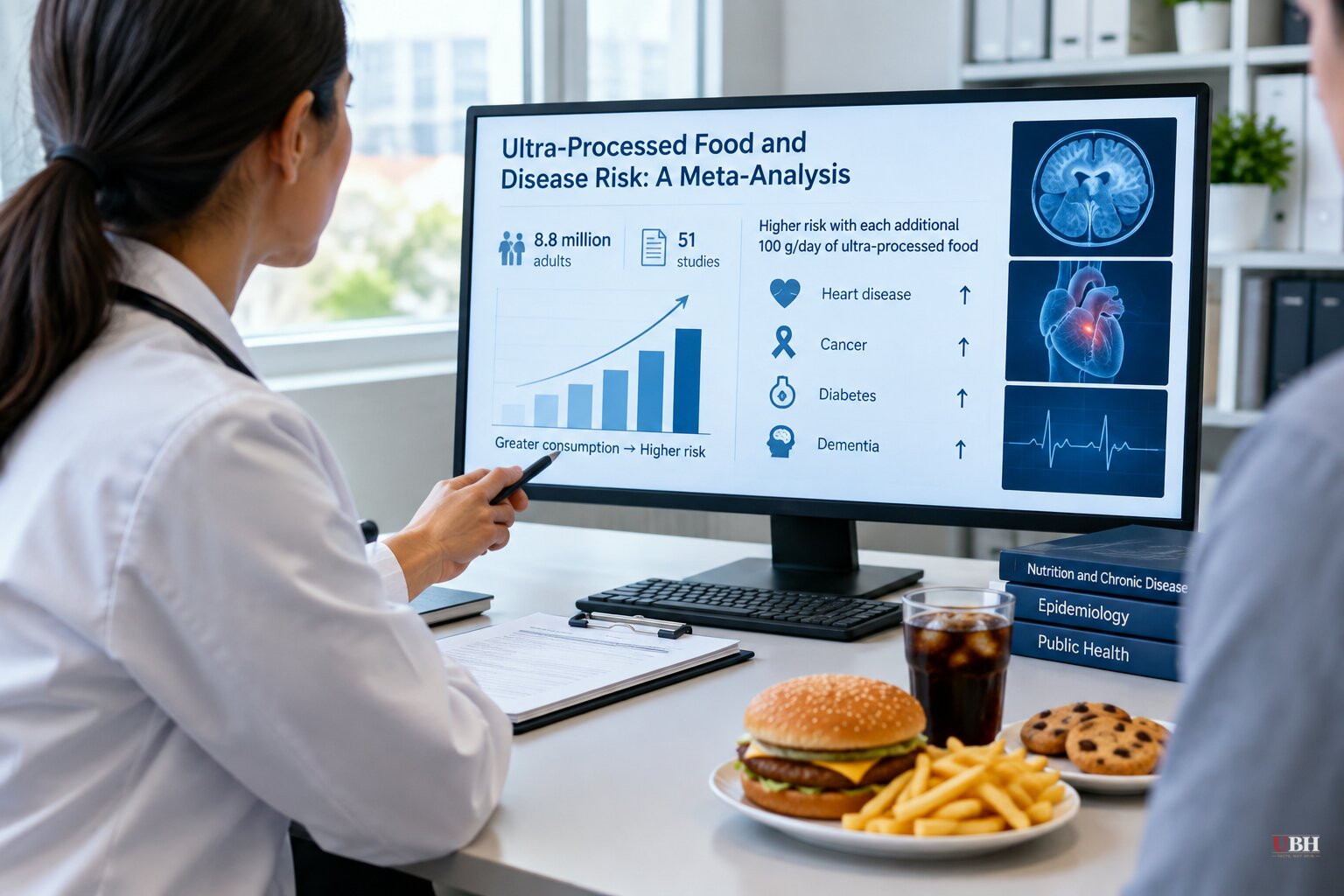
A single small bag of corn chips a day. That's roughly the amount of ultra-processed food linked to a measurably higher risk of chronic disease and death in a massive new analysis published Sept. 22 in the journal Family Medicine and Community Health.
Researchers led by Xiao Liu, a cardiologist at Sun Yat-sen Memorial Hospital in China and a research fellow at Duke-NUS Medical School in Singapore, pooled data from 51 prospective cohort studies covering 8,819,894 adults across the Americas, Europe, Asia and Oceania, according to News Medical. Follow-up periods ranged from two to 32 years.
The Numbers
For every additional 100 grams of ultra-processed food consumed daily, the analysis found a 14% higher risk of cardiovascular events, a 4% higher risk of cancer, a 3% higher risk of death from any cause, and a 2% higher risk of metabolic syndrome or diabetes, according to Fox News and confirmed by WFMD and Everyday Health. MedPage Today notes 100 grams looks like one large store-bought cookie, four servings of potato chips, or about two hot dogs.
Comparing people with the highest UPF intake against those with the lowest, the gap widens considerably. News Medical reports those in the highest-intake group faced a 24% higher risk of cardiovascular events, 23% higher risk of obesity, 24% higher risk of metabolic syndrome or diabetes, 27% higher risk of depression or anxiety, 31% higher risk of digestive disease, and 18% higher risk of dying from any cause. WBAL, citing ABC News, reported the same 24% cardiovascular figure and noted heart disease is the leading cause of death in the United States.
One nuance got buried in some coverage. FoodNavigator reported that among eight of the 51 studies, covering 118,946 participants, higher UPF intake was 'not significantly associated' with high blood pressure. News Medical's broader pooled comparison did find an 11% higher blood pressure risk in the highest-versus-lowest intake groups, but that hypertension link didn't hold up in the narrower per-100-gram dose-response analysis. This is a real distinction inside the same study, not a media contradiction. Headlines sometimes flatten this kind of detail when chasing the scariest number.
What Counts as 'Ultra-Processed'
The researchers used the NOVA classification system, defining UPFs as ready-to-eat or heat-and-serve products that undergo extensive industrial processing and typically contain multiple additives, according to FoodNavigator. Think packaged snacks, sugary drinks, processed meats, and frozen dinners. Maya Feller, a registered dietitian who spoke to ABC News as cited by WBAL, used a simple test: if the front of the package says 'blueberries,' the ingredient list should say 'blueberries' and nothing else.
FoodNavigator also reported that UPFs made up 57% of total energy consumption in the U.S. in 2018, dropping to 53% between 2021 and 2023. Globally the trend runs the other way. UPF consumption in Spain jumped from 11% to 31.7% of intake over three decades; in Mexico and Brazil it rose from 10% to 23%; in China from 3.5% to 10.4%.
The Honest Caveat
This is an observational study. It can show association, not causation, and the researchers themselves know it. Kelly Springer, a registered dietitian not involved in the research, told Fox News Digital the study 'cannot establish that UPFs directly caused the poor health outcomes' and noted it relied on self-reported diets.
Statistician Adam Jacobs of Ergomed in England went further in comments to the Science Media Centre, cited by MedPage Today. Jacobs pointed out that people who eat less UPF tend to be more affluent, and poverty is already one of the strongest known predictors of poor health. 'So it is possible that UPF consumption is simply a marker for poverty, rather than being harmful per se,' Jacobs said. He also flagged other confounding lifestyle variables the study can't fully separate out. The study's own authors acknowledge the evidence behind these links is 'low or moderate,' according to MedPage Today, not the kind of ironclad proof a randomized controlled trial would provide.
Washington Is Already Circling This
MedPage Today reported that HHS Secretary Robert F. Kennedy Jr. has made ultra-processed food a centerpiece of his 'Make America Healthy Again' push, and the FDA has completed the federal government's first formal definition of ultra-processed food. That definition has reportedly been submitted to the White House for further review, per MedPage Today. No regulation has been finalized and no rule has been issued.
The study authors, for their part, aren't calling for bans. They recommend primary care doctors advise patients to gradually cut UPF intake toward roughly 10% to 20% of daily calories and swap in minimally processed alternatives rather than pure restriction, according to MedPage Today. Springer's advice lines up: add protein and fiber, pair an apple with peanut butter, build meals around beans, chicken, or fish. Nobody in this study is telling Americans they can never eat a hot dog again. Whether Washington's forthcoming definition turns that guidance into something with regulatory teeth is the open question nobody has answered yet.
Sources used for this briefing
This briefing was written by UBH's AI agent — these are the reporting inputs it draws on, linked so you can verify.


