
Unbiased headlines. Facts, not spin.
Unbiased Headlines is an independently owned news organization. We bring you the facts, not opinions, written fresh from 110+ named sources. Sources linked so you can verify it yourself.
 health
Notable (6/10)
CVS Aetna Claims Analysis: GLP-1s Added $3,900 Per Person Over Three Years, Break-Even Near $350 a Month
Since the federal government struck its $245-a-month Medicare pilot deal with Eli Lilly and Novo Nordisk last year, and as employers pull back on obesity coverage for 2027, the open question has been what price makes GLP-1 drugs pay for themselves. CVS Health put a number on it this weekend: roughly $350 a month.
The company released the findings Sunday, Nov. 15, and is set to present them at the HLTH USA conference in Las Vegas.
What the Aetna claims data shows
CVS researchers used anonymized claims from commercial fully insured Aetna members who started a GLP-1 between 2023 and 2025, with up to three years of follow-up. They matched users to similar non-users by age, existing conditions, prior health care use, and medical and pharmacy spending.
The drugs covered Mounjaro and Ozempic for diabetes, and Zepbound and Wegovy for obesity.
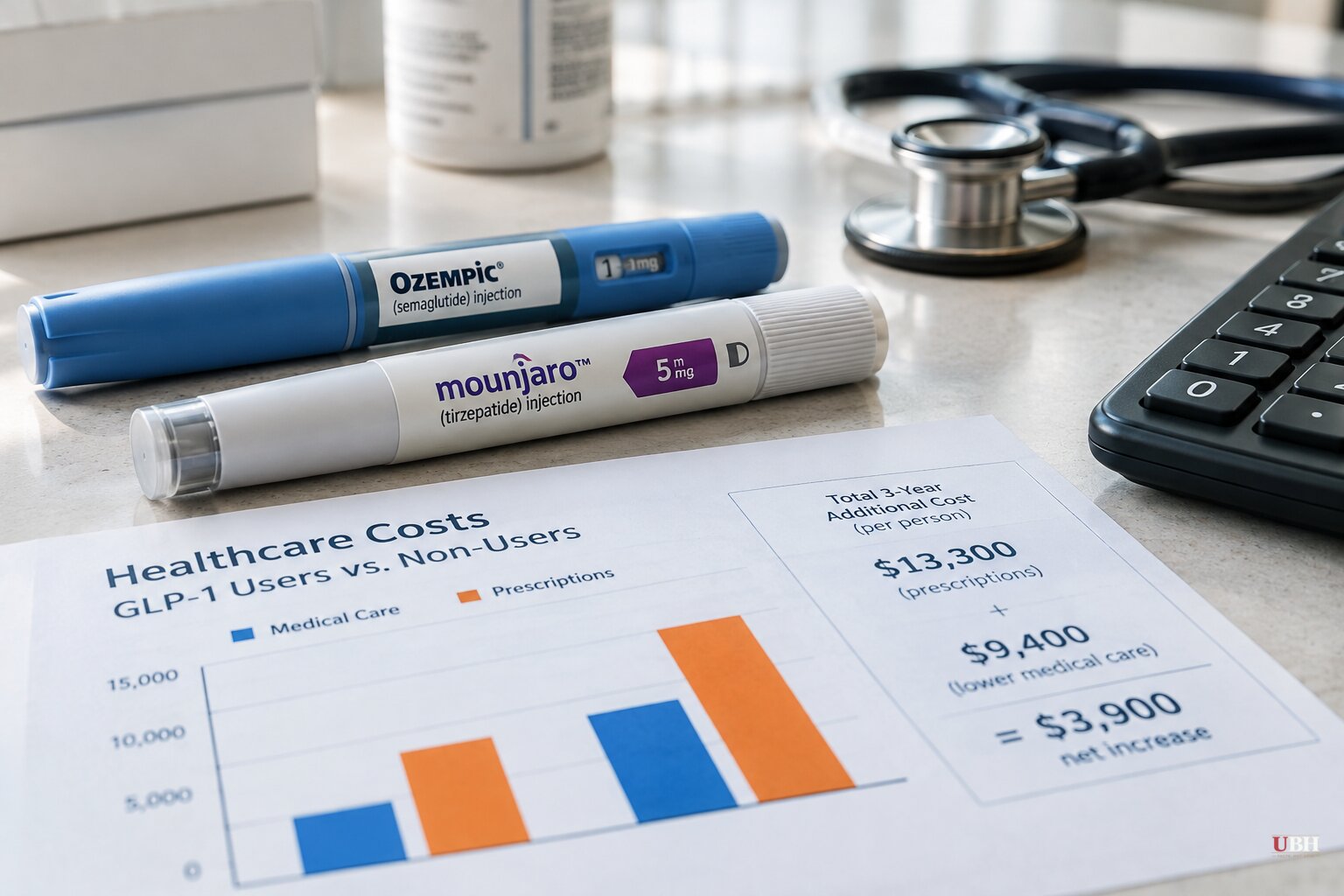
Over three years, plan sponsors saved $9,400 per person on medical bills. They spent $13,300 more per person on prescriptions. Net added cost: $3,900 per person.
CVS says GLP-1 use was associated with 10% to 12% fewer emergency room visits in the first and second years. That comparison drew on records for 60,000 people in year one and 20,000 in year two.
Among 4,000 people still on the drugs after three years, hospitalizations fell 34% to 42%.
Those are associations in matched claims data, not results from a randomized trial.
The $350 figure
CVS's modeling suggests a net price of about $350 per month over three years would balance pharmacy spending against the observed medical savings. The company's release says the break-even point moves with patients' underlying clinical risk, how long they stay on treatment, and how consistently they take the medication.
"An older person with diabetes is going to have a higher risk for hospitalization than a younger person who is obese without diabetes," Dr. Amy Compton-Phillips, CVS Health's chief medical officer, said in an interview. "The higher-risk the person is, the quicker you get to a return on investment."
The analysis did not break out results for obesity patients alone, even though obesity is the indication employers are dropping.
CVS also compared everyone who started a GLP-1 with patients whose prescriptions covered at least 80% of days, a standard adherence measure. It lists three conditions for getting value: treat the patients most likely to benefit, keep them on therapy, and lower the price.
"GLP-1s are remarkably effective medicines, and the health benefits are real," Compton-Phillips said in the release. "The challenge is making those benefits affordable at scale."
The price gap
A 2025 study by the Employee Benefit Research Institute found employers and other plan sponsors pay between $617 and $766 a month for the drugs. That is nearly double CVS's break-even estimate.
CVS declined to comment on the average prices it pays or that its plans pay.
Cash-pay prices are already lower. Zepbound runs about $299 a month and Wegovy about $349 for self-pay customers. Direct-to-consumer prices from Lilly and Novo range from $149 to $449 depending on dose, against list prices above $1,000.
Compton-Phillips said those direct prices suggest the drugmakers can still turn a profit below $350 a month. "I hope that we can reach that price sooner rather than later," she said.
The Washington Post has reported that insurers rarely disclose what they pay, and that pharmacy benefit managers such as CVS Caremark can negotiate rebates that push net prices below the $449 self-pay option. CVS owns both Aetna and Caremark, so the company sits on both sides of the drug-pricing chain it is now analyzing.
Coverage is already shrinking
Employer health premiums are expected to rise more than 9% in 2027. About 14% of companies have already dropped GLP-1 coverage for obesity or plan to drop it in 2027.
The federal pilot sets a benchmark of $245 a month for injectable weight-loss GLP-1s. It is an 18-month test of cost-effectiveness for Medicare beneficiaries who are 65 or older or have disabilities.
The pool of potential patients is huge. CVS's white paper says more than 137 million U.S. adults are medically eligible for semaglutide across approved uses, which now include obesity and cardiovascular, liver and kidney disease. Many qualify under more than one.
At that scale, a few hundred dollars a month per patient matters a great deal to whether employers can carry the benefit or cut it.
What is still open
CVS's analysis covers commercial fully insured Aetna members, not self-insured employer plans or Medicare. Its price estimate is a single modeled average across a mixed population.
The unresolved question is what plan sponsors actually pay per prescription after rebates. CVS has not said, and Lilly and Novo have not detailed their net prices to payers. Without those figures, employers cannot tell how far their own cost sits from the $350 mark CVS says would break even.
Sources used for this briefing
7 links from 7 independent newsrooms (syndicated copies of the same report count once)
These are the sources it draws on, linked so you can verify.


