
Unbiased headlines. Facts, not spin.
Unbiased Headlines is an independently owned news organization. We bring you the facts, not opinions, written fresh from 110+ named sources. Sources linked so you can verify it yourself.
 health
Major Story (8/10)
Africa CDC Says Congo Ebola Outbreak Is Still Not Under Control; $1.3B of $2.9B in Pledged Aid Released
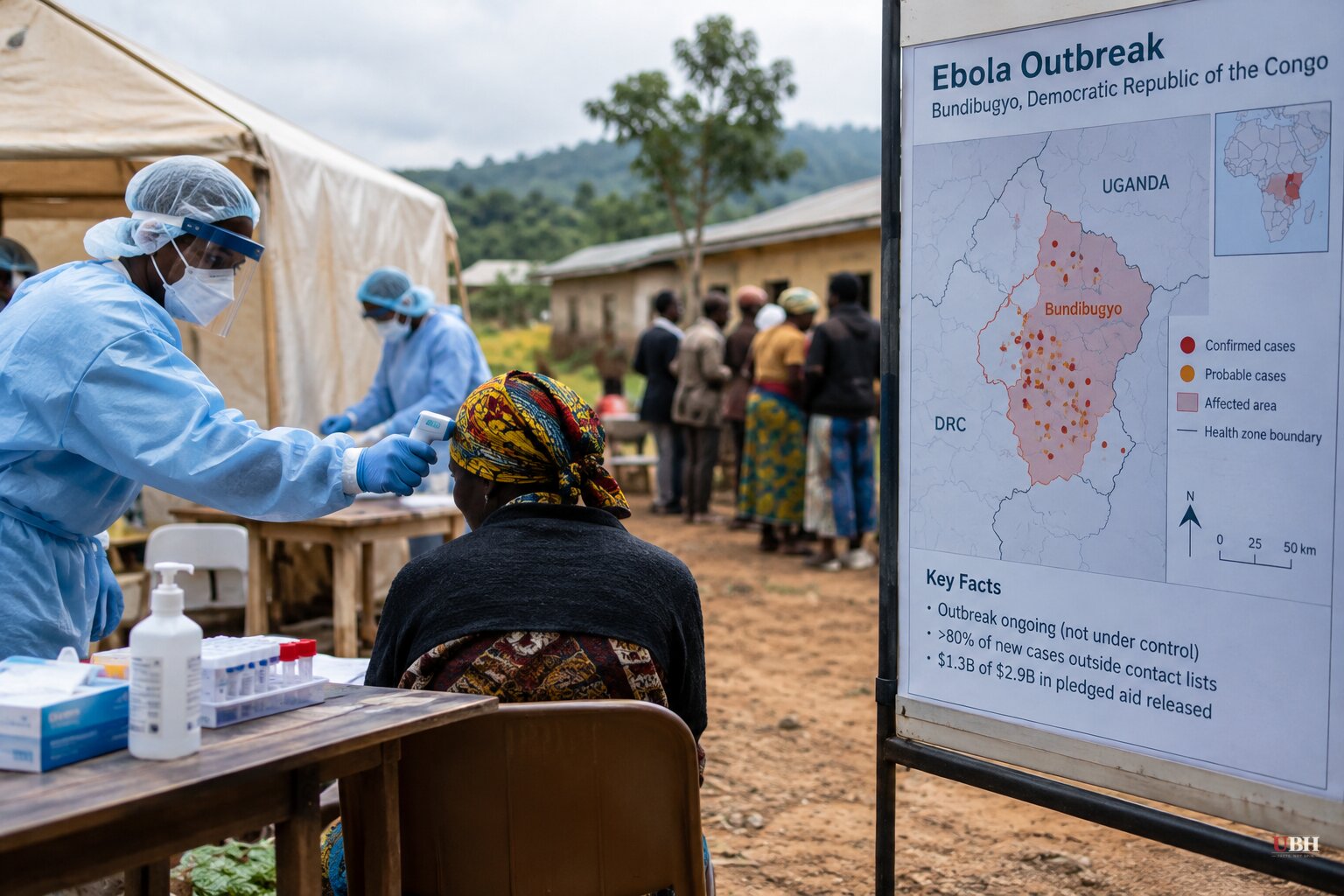
Six months after Congo declared its Bundibugyo Ebola outbreak on May 15, the continent's top public health agency says the response is still losing ground. Jean Kaseya, director-general of the Africa Centres for Disease Control and Prevention, told Reuters in an interview on Sunday, Nov. 15, that "this outbreak is still serious, and is still not under control."
Government data show more than 11,200 cases and 5,500 deaths since the declaration. That is up slightly from the 11,114 cases and 5,433 deaths Congo's National Institute of Public Health reported on Nov. 11.
"If we don't stop this outbreak now," Kaseya said, "it would be the worst Ebola outbreak that the world will have."
Cases are appearing outside the tracing system
Kaseya said more than 80% of new cases emerge outside contact lists. That means health workers are not finding them through the people already being monitored. He also said more than 65% of deaths occur in the community, outside health centres.
Estimates of community deaths vary. AP reported that one-third of deaths occur at home or elsewhere in the community, where burials are often done without specialist supervision.
Kaseya added that Ebola is most contagious in the late stages of the disease. That makes unsupervised deaths and burials a direct transmission risk.
Eight of Congo's 26 provinces have confirmed cases. The U.S. CDC lists Bas-Uele, Haut-Uele, Ituri, North Kivu, South Kivu, South Ubangi, North Ubangi and Tshopo. Africa CDC says cases have now been reported in East, Central and West Africa, the widest geographic spread of any Ebola outbreak on the continent.
The U.S. CDC says Kenya has confirmed nine cases and two deaths as of Oct. 23, all in Nairobi. It reports no community spread there. It also says Nigeria reported its first case of this outbreak on Oct. 20. The agency says no cases have been confirmed in the United States and the risk to Americans remains low.
$1.3 billion out the door, $1.6 billion still pledged
Donors have pledged about $2.9 billion. Kaseya said only $1.3 billion has been released and asked donors to release roughly $1.6 billion more.
He called the coordination problem between Kinshasa and donors "a collective failure." "We are not pointing fingers," he said. Africa CDC is working with Congo's government to prevent duplication, he added.
Kaseya acknowledged that some health workers have not been paid for months. He said Congo's government is working to digitise the payroll.
The money trail was already a concern. Last month Africa CDC raised questions about more than $700 million in Ebola aid that remains unaccounted for, AP reported.
Doctors Without Borders (MSF) said on Nov. 12 that response staff are untrained and unpaid, ambulances have no fuel, and surveillance has left entire areas poorly covered or neglected. "Despite the vast amounts of money provided for the response, many frontline responders are left trying to contain the outbreak with empty hands and empty pockets," said Dr. Javid Abdelmoneim, MSF's international president. Congo's government and the WHO did not respond to the Epoch Times' requests for comment on the MSF statement.
Children, insecurity and a different read from the WHO
UNICEF says children made up 35% of recorded deaths through Nov. 4. Children under 5 accounted for 21% of all deaths, and nearly 72% of infected children in that age group have died.
Insecurity is also a problem. WHO Director-General Tedros Adhanom Ghebreyesus told member states in Geneva on Nov. 11 that "insecurity is now one of the greatest obstacles to the response." Health workers have been attacked since the outbreak began, according to AP, and have repeatedly struck over overdue pay.
The WHO paints a somewhat more hopeful picture than Africa CDC. Tedros wrote on X that "transmission is slowing in several early epicentres, and clinical trials, including the Tumaini trial and new vaccine candidates, are advancing rapidly." The WHO says at least 3,000 people have recovered and gone home.
Those two readings are not necessarily contradictory. Slowing in early hotspots does not offset new hotspots elsewhere, and AP reports that new ones keep emerging.
Experts told AP there is little chance of bringing the outbreak under control within the next year. AP also reports that 43 deaths had already been recorded by the time the outbreak was announced, which suggests the virus circulated undetected for some time.
No vaccine or treatment yet
No vaccine or treatment has been developed specifically for the Bundibugyo strain, which kills about half of those it infects. Earlier this month the WHO approved clinical trials of two new Ebola vaccines and said it expects results in early 2027.
That leaves containment resting on tracing, isolation and safe burials, the same basics MSF and Africa CDC say are failing. Whether donors release the remaining $1.6 billion, and whether it reaches unpaid health workers and fuel-starved ambulances, is the open question for the coming weeks.
The outbreak is already the second-largest and second-deadliest on record, behind the 2014-2016 West African epidemic that infected more than 28,600 people and killed more than 11,000.
Sources used for this briefing
7 links from 7 independent newsrooms (syndicated copies of the same report count once)
These are the sources it draws on, linked so you can verify.


