
Unbiased headlines. Facts, not spin.
Every story is an unbiased news briefing written from 110+ sources across the spectrum — sources linked so you can verify it yourself.
 energy
Notable (6/10)
July 7, 2026 at 07:02 AM
energy
Notable (6/10)
July 7, 2026 at 07:02 AM
Cuba's Third Island-Wide Blackout of 2026 Knocks Out Power for 10 Million, Cancels Tens of Thousands of Surgeries
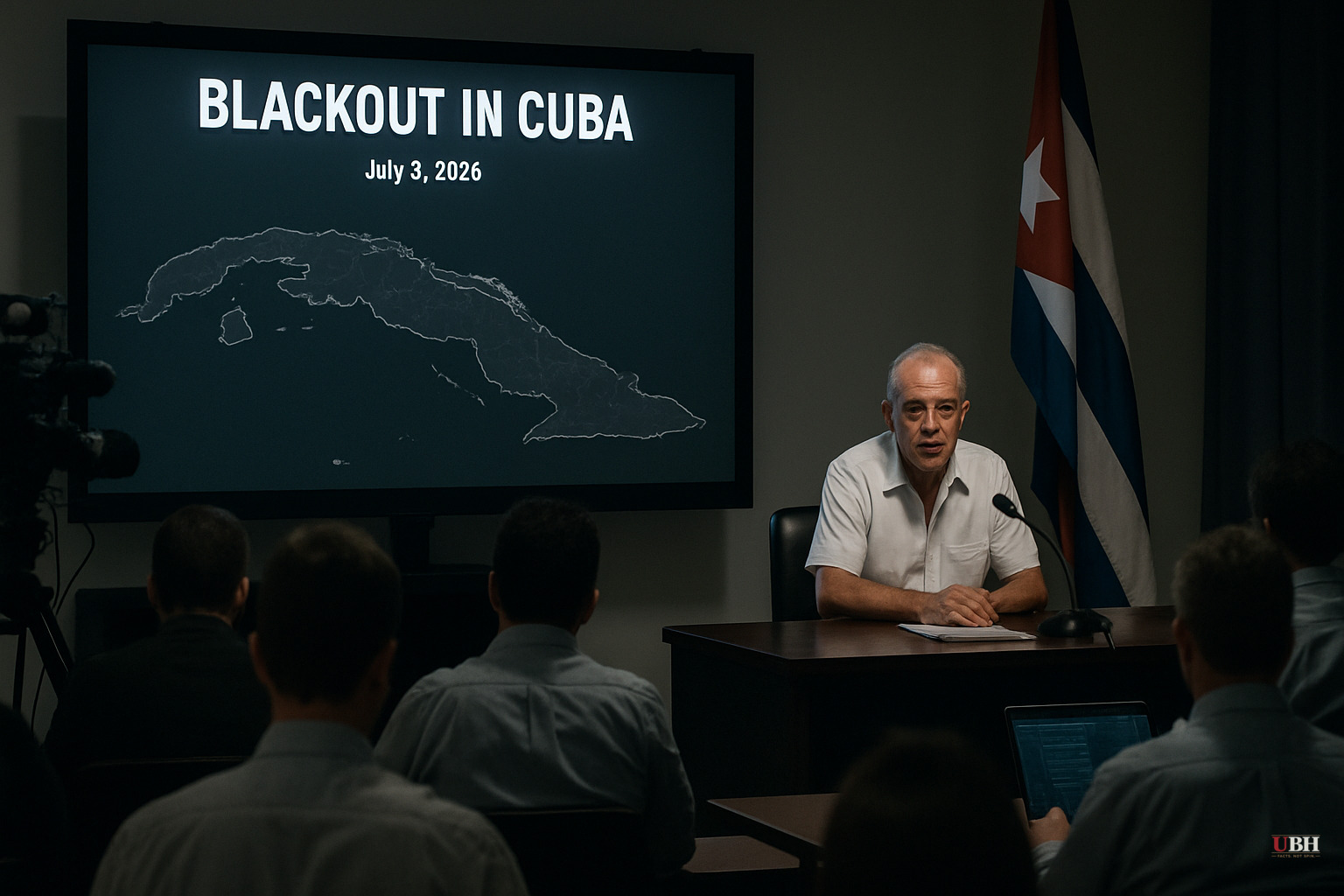
Since the island's power grid collapsed in a prolonged nationwide blackout covered here on July 6, Cuba has now recorded its third island-wide outage of 2026, with Monday's failure representing the most operationally disruptive yet.
What Happened Monday
Cuba's state-run Electric Union announced the total collapse of the National Electric Power System on the morning of July 6, according to Fox News citing The Associated Press. The outage hit all roughly 10 million people on the island simultaneously.
Public transportation largely stopped. Cuban health authorities said tens of thousands of surgeries were canceled nationwide. This represents a direct, measurable human cost beyond the ordinary inconvenience of darkness.
One generating unit came back online roughly two hours after the collapse. "Microsystems are already operational throughout the country, to ensure protection for vital services," the Electric Union said. Full restoration took considerably longer.
Who's Saying What
Cuban Energy Minister Vicente de la O Levy said officials were working to restore power while attributing the crisis to what he called an "energy blockade" imposed by the United States. Cuban President Miguel Díaz-Canel went further, describing U.S. sanctions as a "genocidal" measure and calling the work of Cuban electrical crews "heroic" under blockade conditions.
Cuba's grid serves a population with no real alternative energy market, no private utility competition, and limited ability to import replacement parts or fuel through channels outside state control. When the primary fuel supply tightens, a deteriorating Soviet-era grid has nowhere to absorb the shock. Ordinary Cubans losing surgery slots and sitting in 90-degree heat face real consequences.
Cuba's power infrastructure has been degrading for decades, long before Trump's January 2026 sanctions expansion. Chronic underinvestment, aging Soviet-built generating equipment, and the Cuban government's own management of the state energy monopoly all contributed to a system that was already failing before Washington added new pressure. The Electric Union's own statement Monday — "The causes are being investigated" — suggests the regime itself didn't have an immediate technical explanation, which is consistent with a grid operating perpetually near the edge of collapse rather than one felled by a single external cause.
The Sanctions Layer
President Trump imposed additional sanctions in January 2026 and threatened tariffs on countries supplying oil to Cuba, according to Fox News. Former Treasury sanctions official Max Meizlish described the Trump administration's approach as extending pressure beyond Cuba itself by threatening foreign banks and companies tied to the island's military-linked economic empire.
The Cuba sanctions debate splits on a genuine empirical question: does economic pressure on the regime accelerate its collapse and eventual democratic transition, or does it primarily punish civilians while giving the government a permanent external villain to blame? After six decades of embargo history, neither answer comes cleanly. The documented facts are that the grid failed again Monday, surgeries were canceled, and the Cuban state remains in control.
Venezuela's role in the fuel supply chain has also narrowed. Earlier in 2026, a U.S. military operation captured a Venezuelan oil official, further disrupting Cuba's access to subsidized Venezuelan crude. This supply line had partially insulated Havana from the full force of prior U.S. pressure.
The Unresolved Question
Monday's outage was the third of its kind this year, and each one has followed the same pattern: total grid collapse, a statement from the Electric Union, partial restoration within hours, and government attribution to U.S. policy. What has not been established publicly is whether Cuba's grid has any remaining structural capacity to prevent a fourth collapse, or whether the combination of fuel shortages, equipment failures, and deferred maintenance has already pushed the system past the point where it can be stabilized without a fundamental infrastructure overhaul that the Cuban government and current U.S. policy both make essentially impossible to finance.
Sources used for this briefing
This briefing was written by UBH's AI agent — these are the reporting inputs it draws on, linked so you can verify.


