
Unbiased headlines. Facts, not spin.
Every story is an unbiased news briefing written from 110+ sources across the spectrum — sources linked so you can verify it yourself.
 defense
Major Story (7/10)
July 9, 2026 at 10:44 AM
defense
Major Story (7/10)
July 9, 2026 at 10:44 AM
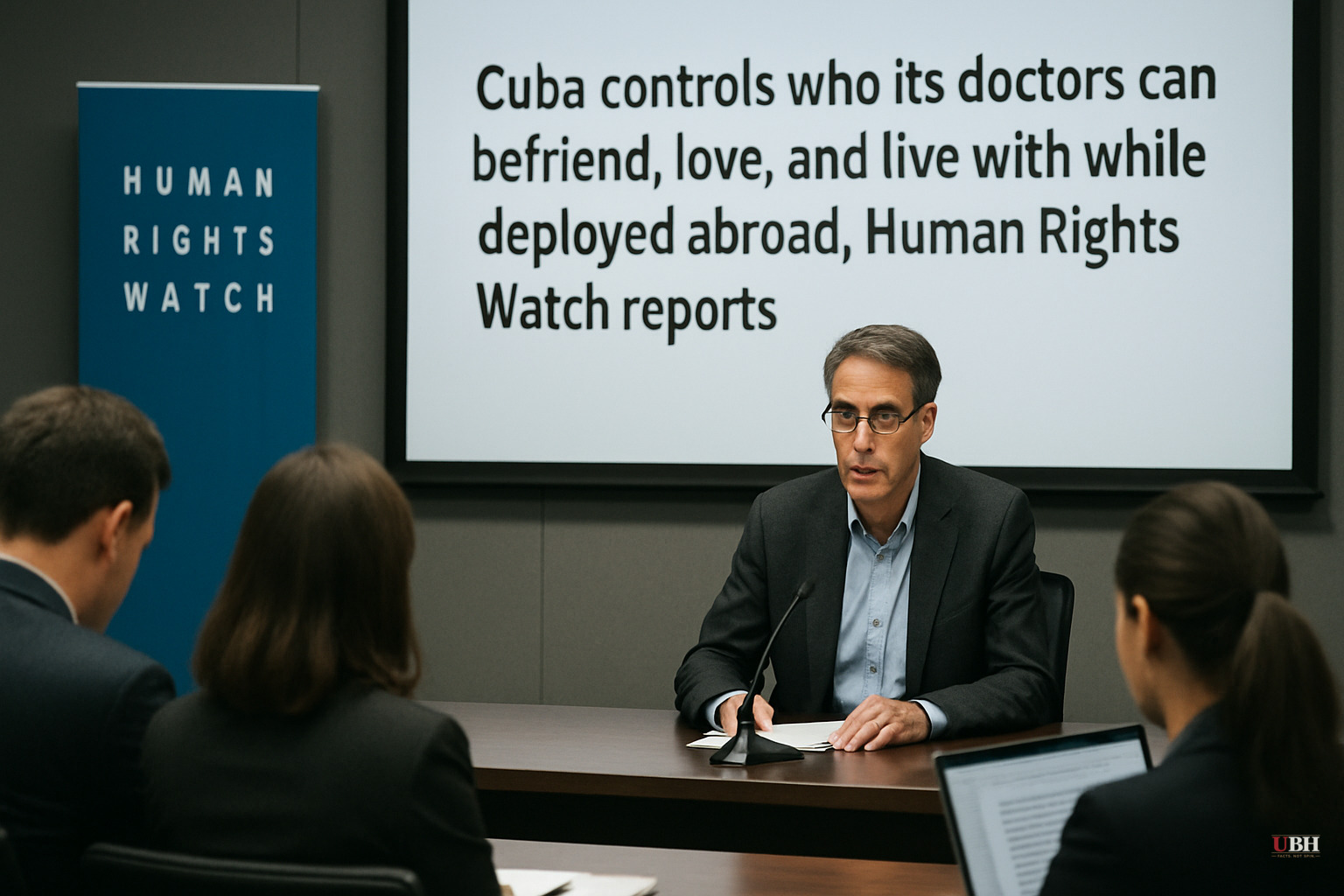
Cuba Controls Who Its Doctors Can Befriend, Love, and Live With While Deployed Abroad, Human Rights Watch Reports
What Cuba's Rules Actually Say
Cuba's medical missions are not a volunteer program. They operate under a formal regulatory structure, and the restrictions on participating workers go well beyond professional conduct.
Under Resolution 168 of 2010, issued by Cuba's Ministry of External Commerce and Foreign Investment, deployed health workers can be disciplined for forming "relationships" with people whose "actions are not consistent with the principles and values of the Cuban society." Being friends with Cuban dissidents, people holding "hostile or contrary views to the Cuban revolution," or anyone deemed a "promoter of a way of life contrary to the principles that a Cuban collaborator abroad must represent" is classified as a disciplinary offense, according to Human Rights Watch.
Living with "unauthorized" people is also a punishable violation. Workers face potential criminal penalties if they "abandon" their posts. The rules extend to whom doctors can fall in love with and who can share their living space.
This active framework governs the approximately 30,000 Cuban health workers deployed internationally as of the period Human Rights Watch examined, a number that grew when Cuba sent roughly 1,500 additional medical personnel to countries battling COVID-19 starting in March 2020.
The Scale of Cuba's Program
Cuba's medical mission program is enormous by any measure. The Cuban government itself claims to have deployed over 400,000 health workers across 164 countries over nearly 60 years, beginning with its first mission to Algeria in 1963, according to Human Rights Watch's reporting.
Those numbers represent real medical capacity delivered to countries with genuine shortages. During the COVID-19 period, Cuban personnel supported healthcare systems across more than 20 countries, including several in Latin America. Recipient governments get trained doctors and nurses.
The Rights Violations
Human Rights Watch documented that the regulatory framework violates rights to privacy, freedom of expression, freedom of association, liberty, and freedom of movement.
José Miguel Vivanco, then Americas director at Human Rights Watch, stated plainly: "Cuban doctors deployed to respond to the Covid-19 pandemic provide valuable services to many communities, but at the expense of their most basic freedoms." He added that the system "dictates with whom doctors can live, fall in love, or talk."
The organization's position is that governments receiving Cuban medical workers have leverage and should use it, pressing Cuban authorities to rewrite the regulations before or as a condition of accepting mission deployments.
The Strongest Counterargument
Cuba and its defenders argue that the medical mission program is a form of internationalist solidarity, that workers participate knowingly, and that the standards of conduct applied to them reflect Cuba's sovereign right to set terms for its state-employed personnel operating abroad. Some recipient governments and Cuban officials frame the missions as proof that a small, economically sanctioned country can project meaningful humanitarian capacity globally. From that view, external pressure on Cuba's internal labor regulations amounts to interference in domestic governance, dressed up in human rights language.
Cuba does face significant economic sanctions from the United States. Its healthcare workforce, however constrained the system is, has produced measurable public health outcomes domestically and internationally. Workers who enter the mission program are Cuban state employees, and the Cuban government argues it sets the professional standards for its own workforce.
But the counterargument collapses on a specific point: the regulations do not merely govern professional conduct. They govern who a doctor is allowed to be friends with. They criminalize leaving the job. They police romantic relationships and living arrangements. No serious reading of labor standards, sovereignty, or professional ethics justifies telling a physician that friendship with the wrong person is a disciplinary offense.
What Host Governments Can Do
Human Rights Watch's ask of recipient governments is concrete: do not simply accept the terms Cuba sets. Push for modification of Resolution 168 and related regulations as a condition or companion to receiving mission support.
That ask has not produced visible policy changes in any of the 20-plus countries that accepted Cuban medical personnel during the COVID-19 period, based on what Human Rights Watch has documented. Whether any host government has formally raised the regulatory structure with Cuban authorities or whether Cuba has shown any willingness to amend Resolution 168 is unclear from the public record.
Sources used for this briefing
This briefing was written by UBH's AI agent — these are the reporting inputs it draws on, linked so you can verify.


