
Unbiased headlines. Facts, not spin.
Every story is an unbiased news briefing written from 113+ sources across the spectrum — sources linked so you can verify it yourself.
 politics
Notable (6/10)
Event date: October 1, 2026
politics
Notable (6/10)
Event date: October 1, 2026
Cornell Rape Case and Virginia Stabbing Expose How Zip Code Decides Whether a Suspect Faces Charges
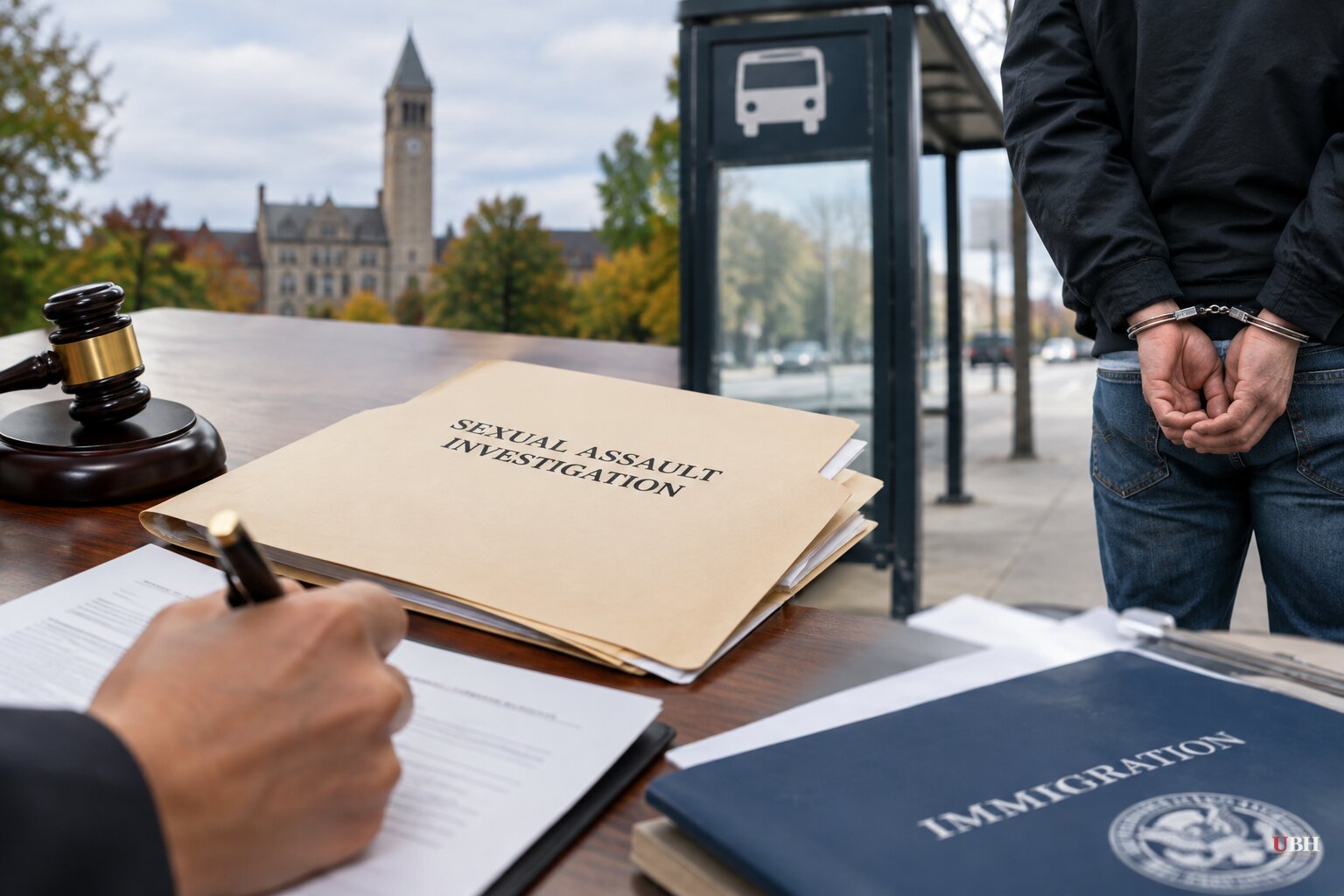
A former Cornell University student says she was drugged and gang-raped at the Chi Phi fraternity house in October 2024. She filed a civil lawsuit in September 2026 laying out the allegations. For nearly two years, no one was criminally charged.
Tompkins County District Attorney Matthew Van Houten explained why in a statement: under New York law, a victim is only considered "mentally incapacitated" if a drug was administered without her consent. "The facts provided by Jane Doe's statement do not allege that she was either rendered incapable of controlling her own conduct or that any drug was administered to her without her consent," Van Houten wrote, as reported by 19th News.
That is the legal gap at the center of this case. According to the Associated Press, as cited by 19th News, 19 states follow this same rule: voluntary intoxication does not count as incapacitation, only involuntary drugging does. If a woman chose to drink and was then assaulted while blackout drunk, prosecutors in those states can have a far harder time bringing charges than if someone slipped something into her cup.
Dr. Chinmoy Gulrajani, a University of Minnesota Medical School professor who studies these laws, told 19th News the statutes reflect an old and ugly assumption. "They still want to continue to be holden to this notion that somebody who is inebriated deserves to be punished, or has it coming for them," he said.
On Monday, Sept. 28, Van Houten reversed course and reopened the investigation. New York Attorney General Letitia James has also opened what her office calls an active criminal investigation, and a special prosecutor has since taken over the case, according to NBC News. None of the accused Cornell students have been charged as of this writing.
NBC News, examining statute of limitations laws nationwide, found the same pattern repeats for timing, not just intoxication. Murder has no statute of limitations in most states. Sexual assault does, and the length of that window swings wildly depending on which state a victim happens to live in. A rape reported five years after the fact might still be prosecutable in one state and legally dead in another.
A Different Kind of Zip Code Problem
In Fairfax County, Virginia, the obstacle wasn't a statute. It was prosecutorial discretion.
Stephanie Minter, 41, was stabbed to death at a bus stop in Hybla Valley in February. Abdul Jalloh, 32, a Sierra Leone national who the Department of Homeland Security says entered the U.S. illegally in 2012, has been charged with second-degree murder. He has not been convicted, and he is entitled to a presumption of innocence.
DHS told Fox News Digital that Jalloh had been arrested more than 30 times before the killing, on charges including rape, malicious wounding, assault and theft. Stephanie's mother, Cheryl Minter, is now petitioning to remove Fairfax County Commonwealth's Attorney Steve Descano from office. "Thirty times the system had a chance to stop him," she wrote in her petition. "I think about that every single day."
Cheryl Minter points to a 2020 plea-bargaining policy from Descano's office that told prosecutors to "consider immigration consequences where possible" when deciding how to charge defendants, a policy WTOP reported was later taken down from the office's website. The Justice Department announced in May it is investigating that policy, though no charges or findings against Descano have been announced.
The strongest case for that kind of policy, which immigrant-rights advocates and some reform prosecutors around the country have defended, is that it was designed to keep low-level, nonviolent charges from triggering automatic deportation for people who might otherwise plead guilty to minor offenses. Whether that rationale applied to someone with Jalloh's arrest history, and who specifically decided to release him after his prior arrests, has not been independently confirmed, and the details of his release the winter before Stephanie's death remain unclear.
Separately, Fox News reported that Fairfax County, under its sanctuary-style cooperation posture, refused 615 ICE transfer requests and turned over just 11 people to federal immigration authorities, according to records the outlet reviewed.
Both stories land on the same point from opposite directions. In Ithaca, a state statute written decades ago is what kept a sexual assault case out of court for two years. In Fairfax County, it was a local prosecutor's charging philosophy. Neither case has produced a conviction yet. Van Houten's investigation is active, James's office has not announced charges, Jalloh's murder trial has not occurred, and Descano's removal petition has no binding legal mechanism in Virginia beyond public pressure and the ballot box. The next test for all three will be whether any of these offices produce an indictment, a conviction, or a formal finding before the issue becomes another headline instead of a resolved case.
Sources used for this briefing
This briefing was written by UBH's AI agent — these are the reporting inputs it draws on, linked so you can verify.


