
Unbiased headlines. Facts, not spin.
Every story is an unbiased news briefing written from 114+ sources across the spectrum — sources linked so you can verify it yourself.
 politics
Notable (5/10)
Event date: October 3, 2026
politics
Notable (5/10)
Event date: October 3, 2026
Cornell Fraternity Case Widens: DA Reopens Probe, Accused Men's Accounts Surface, Democrats Tie It to Title IX
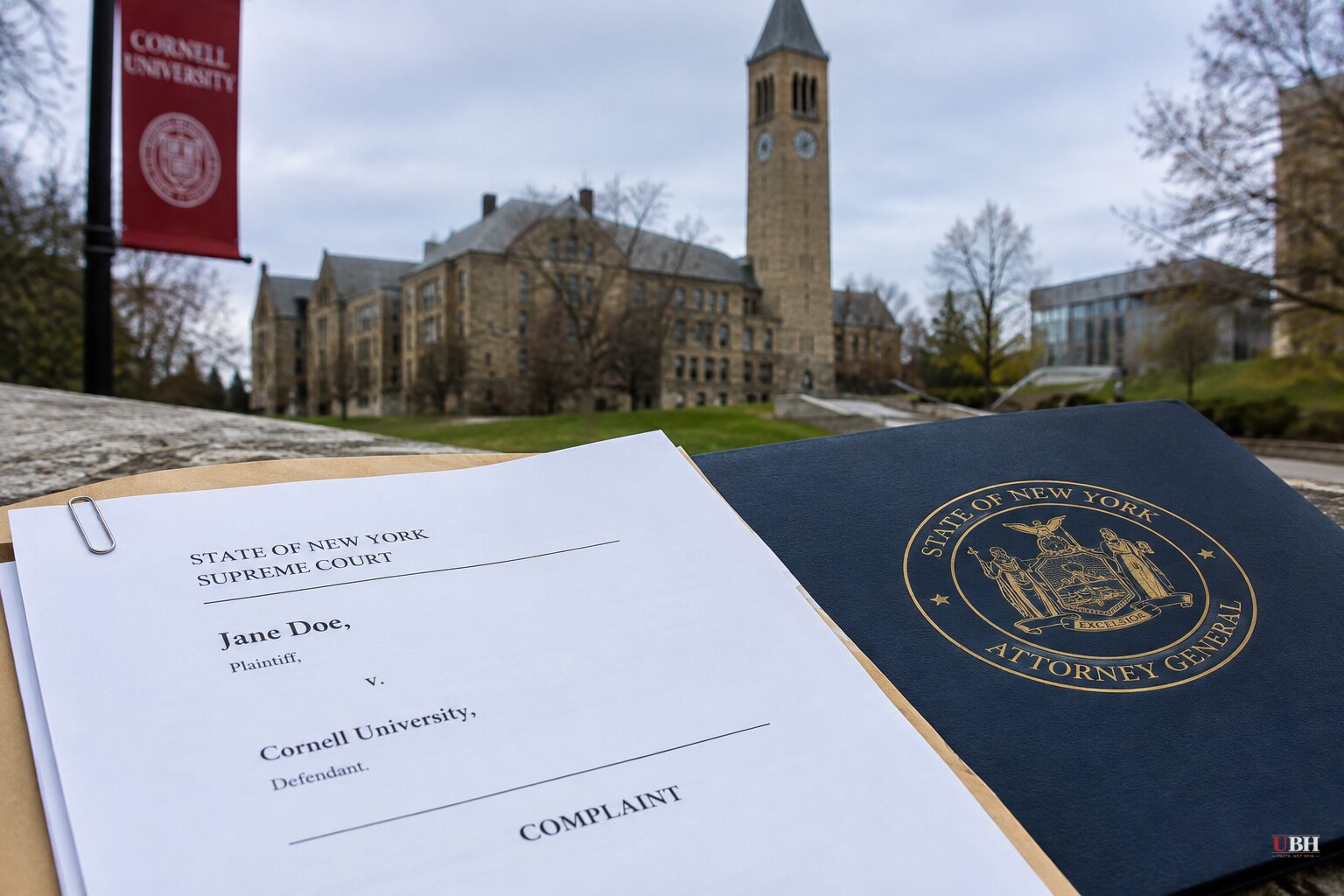
Since a woman identified as Jane Doe filed a civil lawsuit in September, the Cornell University fraternity case has moved from a campus dispute to a reopened criminal investigation, a state review and a national political argument. Most of that argument is about things the case itself has not yet settled.
What the lawsuit alleges
Doe, a former Cornell student, is suing seven members of the Chi Phi fraternity, the fraternity itself, Cornell and others. She alleges she was drugged with ketamine and alcohol and gang-raped at the Chi Phi house in October 2024.
The men have denied wrongdoing. Some say the sex was consensual. Others say they did not participate. No charges have been filed. The allegations have not been tested in court.
What Cornell and prosecutors did
Cornell ran a Title IX investigation after Doe reported the incident in 2024. Five of the seven men were sanctioned. Two were expelled, and the rest received penalties ranging from suspensions to disciplinary probation and campus restrictions.
Gillio Lopes, for one, received a three-semester suspension and two years of probation, according to records obtained by The New York Times and reported by The Cornell Daily Sun.
The Tompkins County district attorney has said charges were not pursued originally because Doe's first police statement did not allege she was gang-raped or drugged against her will. The DA reopened the criminal investigation after the lawsuit was filed. The New York attorney general has opened a separate review of how Cornell handled the allegations. An attorney for one accused student has called on Attorney General Letitia James to step aside from that review.
Cornell's president has said the university "must do better" in handling sexual assault allegations.
The accused men's accounts
Testimony from Cornell's internal investigation has now surfaced. Four of the seven men acknowledged sexual contact with Doe. Three denied any sexual encounter.
Lopes told investigators that Doe initiated sexual contact with him without asking for his consent. He said he had about six drinks and left around 2 a.m. for McDonald's with three friends. Winston Lee gave a similar account. He said that before a later encounter he asked for consent and Doe replied that they were "all consenting adults."
Another student told investigators he considered himself a victim of sexual misconduct because Doe performed oral sex on him while he was "too incapacitated" to consent.
Matthew Ingalls, one of the two expelled men, wrote to Cornell's Title IX office in February 2025 that he had been "sodomized by her while I was incapacitated." He complained that no one told him of his rights "as a survivor" and said the process was rife with "gender discrimination." Breitbart, citing text messages and Doe's November 2024 statement to campus police, reports that Doe described the night as consensual in the weeks afterward. Doe's lawsuit says otherwise.
The same dispute runs through the whole file. The men say the encounters were consensual or that Doe was the initiator. Doe says she was drugged and could not consent. A civil court or a prosecutor will have to sort that out.
The political fight
On Sept. 30, Democratic Women's Caucus Chair Teresa Leger Fernández and Vice Chairs Emilia Sykes and Hillary Scholten said the case showed failures by police and the university. "Her story should be a wake-up call Republicans cannot ignore: we need stronger protections and systems for survivors, and we need to act now," they said in a statement.
They tied the case to the Trump administration's move two days earlier to rescind the Biden-era Title IX rules and reinstate the rules adopted in Trump's first term. The caucus argues those rules have "eroded the processes in place for sexual misconduct investigations" and add barriers for people reporting assault. The lawmakers asked Republicans and the administration to "stand in solidarity with Jane Doe."
The timing complicates that argument. The alleged incident, Cornell's investigation and its sanctions all happened in 2024 and early 2025, under the Biden-era framework. The reinstated rules took effect after those events. Nothing in the record shows the 2020 rules played any role in how Cornell handled Doe's complaint.
The caucus has not claimed they did. Its argument is forward-looking: that the restored rules will leave future complainants worse off.
The Trump blame game
The case also became a media flashpoint. On ABC News on Sunday, Oct. 4, New York Times columnist Michelle Cottle said messages tied to the case reflect "a fundamental disrespect for women." She added: "We can go to the president for this one," citing a culture that glorifies "being thuggish and swaggering and mistreating women."
Critics pointed out the alleged assault occurred when Joe Biden was president. CNN contributor Scott Jennings mocked it as the latest "Trump turned me into a newt" take. Former DHS spokeswoman Tricia McLaughlin said pundits "fall all over themselves trying to make everything and anything about Donald Trump."
President Trump held no office in October 2024. Cottle's argument is about culture, not policy, and she offered no evidence tying any accused man's conduct to Trump.
What comes next
The open questions are procedural. The Tompkins County DA has not said whether charges will be filed or when the reopened investigation will conclude. The state attorney general's review of Cornell's handling is still underway. Doe's civil suit against the men, the fraternity and the university has yet to be heard on the merits.
Until one of those processes produces a finding, the claims on both sides remain allegations.
Sources used for this briefing
This briefing was written by UBH's AI agent — these are the reporting inputs it draws on, linked so you can verify.


