
Unbiased headlines. Facts, not spin.
Unbiased Headlines is an independently owned news organization. We bring you the facts, not opinions, written fresh from 110+ named sources. Sources linked so you can verify it yourself.
 finance
Major Story (8/10)
finance
Major Story (8/10)
CoreWeave Bonds Hit Record Low of 77 Cents as Firmus Pulls IPO and IMF Warns on AI Debt
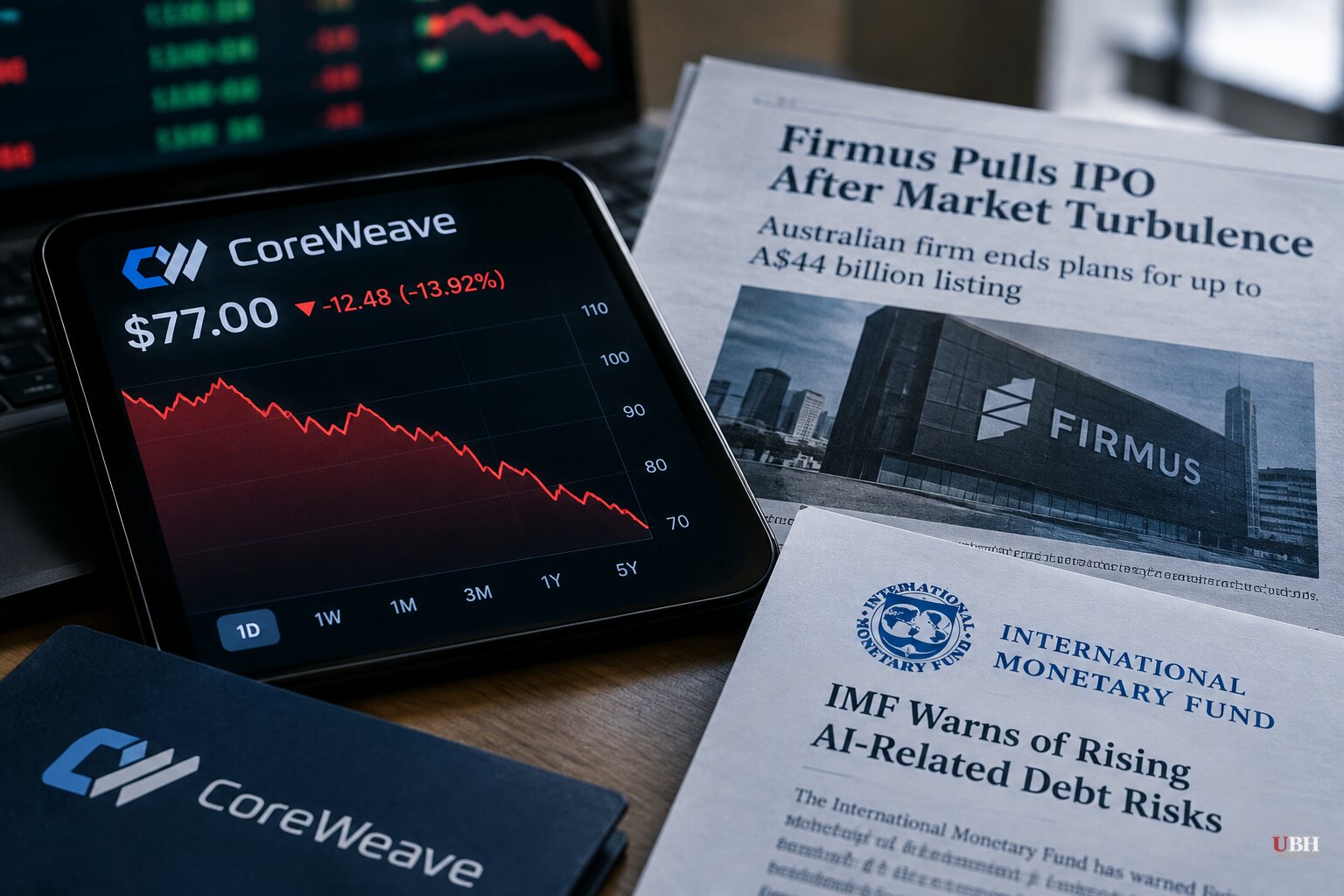
Since CoreWeave's stock and bonds started sliding earlier this week, the pain has moved from one company to the whole AI financing chain. A scrapped Australian IPO, record-high default insurance costs, a hot inflation print and a blunt warning from the IMF all landed within days of each other.
Firmus pulls the plug
Firmus, an Australian data centre company, abandoned its public listing on Friday, Oct. 9. It had been seeking a valuation as high as A$44 billion (£23 billion) and wanted to raise up to A$7 billion to build AI data centres across Australia and the Pacific.
The company blamed "recent market volatility and prevailing market conditions." Investors had baulked at the valuation it sought. It would have been Australia's largest float in decades.
Bond prices at rival data centre builders fell hard on Monday and Tuesday after the deal collapsed. Guillaume Dejean, an analyst at Allianz Trade, said those bonds were already under pressure from rising global borrowing costs and that "events such as the Firmus failure accentuate risk-off sentiment."
CoreWeave's bonds take the brunt
Some of CoreWeave's high-yield bonds dropped from 85 cents on the dollar on Friday to as low as 77 cents on Wednesday, Oct. 14, a record low. Yields on some of them reached as high as 17%.
The cost of insuring CoreWeave's debt against default, measured by credit default swaps, hit a record on Tuesday. The company's current debt stands at $35 billion. Bonds from Nebius and TeraWulf also fell sharply.
Elon Musk reposted a chart of CoreWeave's bond troubles on X with a single word: "yikes."
CEO Mike Intrator told staff on Wednesday that the market was acting "irrationally." He said "factors like the weakness and delays surrounding the attempted IPOs and debt financings" of rivals were "bleeding into the narrative around CoreWeave," according to a Bloomberg report.
On Wednesday CoreWeave shares fell as much as 16% in New York. Nebius slid 10% and TeraWulf 7%.
Rates and chips pile on
The credit stress hit a broader market. On Wednesday the S&P 500 fell 1.11% and the Nasdaq Composite dropped 1.88%, each its worst day since July, after a hotter-than-expected inflation report bolstered bets on further Federal Reserve rate hikes. Inflation rose to 3.7% last month.
Oracle sank 8.8%, Dell fell 11.3% and Marvell lost 8.7%. A semiconductor index dropped 4.3% and is down roughly 12% over the past week. Nvidia fell 3.2% and sits about 7.5% below its record high earlier this month.
Steve Sosnick, chief strategist at Interactive Brokers, told CNN that "there's just so much good news priced into the chip sector right now" that it is vulnerable without fresh catalysts. Chip stocks also took a hit this week after China's CXMT announced progress on advanced memory chips.
Today, Oct. 15, Asian tech shares sold off. South Korea's Kospi fell as much as 9.3%. A report last week on OpenAI's projected revenues, which came in lower than some expected, had already prompted a pull-back in AI shares.
Oracle and the hyperscalers
The Financial Times reported that bond investors funding the AI buildout are growing wary. Oracle's five-year credit default swap spread has climbed to around 203 basis points, the highest in 18 years, according to that reporting. S&P Global Ratings has downgraded Oracle to BBB-, one notch above junk, citing the pace of its AI-related spending.
Spreads on bonds from Amazon, Microsoft, Meta and Alphabet widened toward 80 basis points in September from around 50. Cover ratios on hyperscaler bond deals fell from roughly 5x in February to about 2x in July.
Demand has thinned, not vanished. Meta's $25 billion bond sale drew $96 billion in peak orders. A $30 billion deal a year earlier drew $125 billion. The same reporting noted that none of this means Oracle is near default.
Morgan Stanley estimates AI-related global debt issuance will reach roughly $570 billion by the end of 2026, more than double the prior year's pace.
The IMF's warning
The International Monetary Fund put numbers on the risk. Its World Economic Outlook, released Oct. 13 at the annual meetings in Bangkok, forecast global growth of 3.1% in 2026 and 3.4% in 2027.
In one downside scenario, a steep drop in AI investment triggers a sharp fall in asset prices. That would cut global GDP by 1.1% by 2028, including a 1.8% hit to U.S. output.
The fund reviewed 14 circular financing deals among AI firms. Since 2023 they involve about $300 billion in equity investment and $650 billion in debt, in exchange for $1.4 trillion in future revenue commitments.
IMF managing director Kristalina Georgieva said: "We now have an economy that is standing on one leg, the AI leg. What if it wobbles?"
Jason Wu, assistant director of the IMF's Global Markets Analysis Division, said that if there are questions about the monetization of AI, "the equity investments will deplete in value, the debt may be difficult to service, and the revenue commitments in the future may not materialize."
Chief economist Silvana Tenreyro said trade in AI goods grew 29% between 2023 and 2025, more than triple global trade's 8.3% growth. Without it, trade growth would have been 4.6%.
The open question is the one Wu raised: whether the $1.4 trillion in promised future revenue shows up. CoreWeave and its peers borrow against exactly those promises, and the bond market is now charging them more to do it.
Sources used for this briefing
6 links from 6 independent newsrooms (syndicated copies of the same report count once)
These are the sources it draws on, linked so you can verify.


