
Original briefings. Zero spin.
Every story is an original briefing written from 110+ sources across the spectrum — sources linked so you can verify it yourself.
 defense
Major Story (7/10)
September 13, 2026 at 05:17 PM
defense
Major Story (7/10)
September 13, 2026 at 05:17 PM
Coons, Sanders and Amodei Push Trump to Raise AI Limits With Xi Ahead of Washington Summit
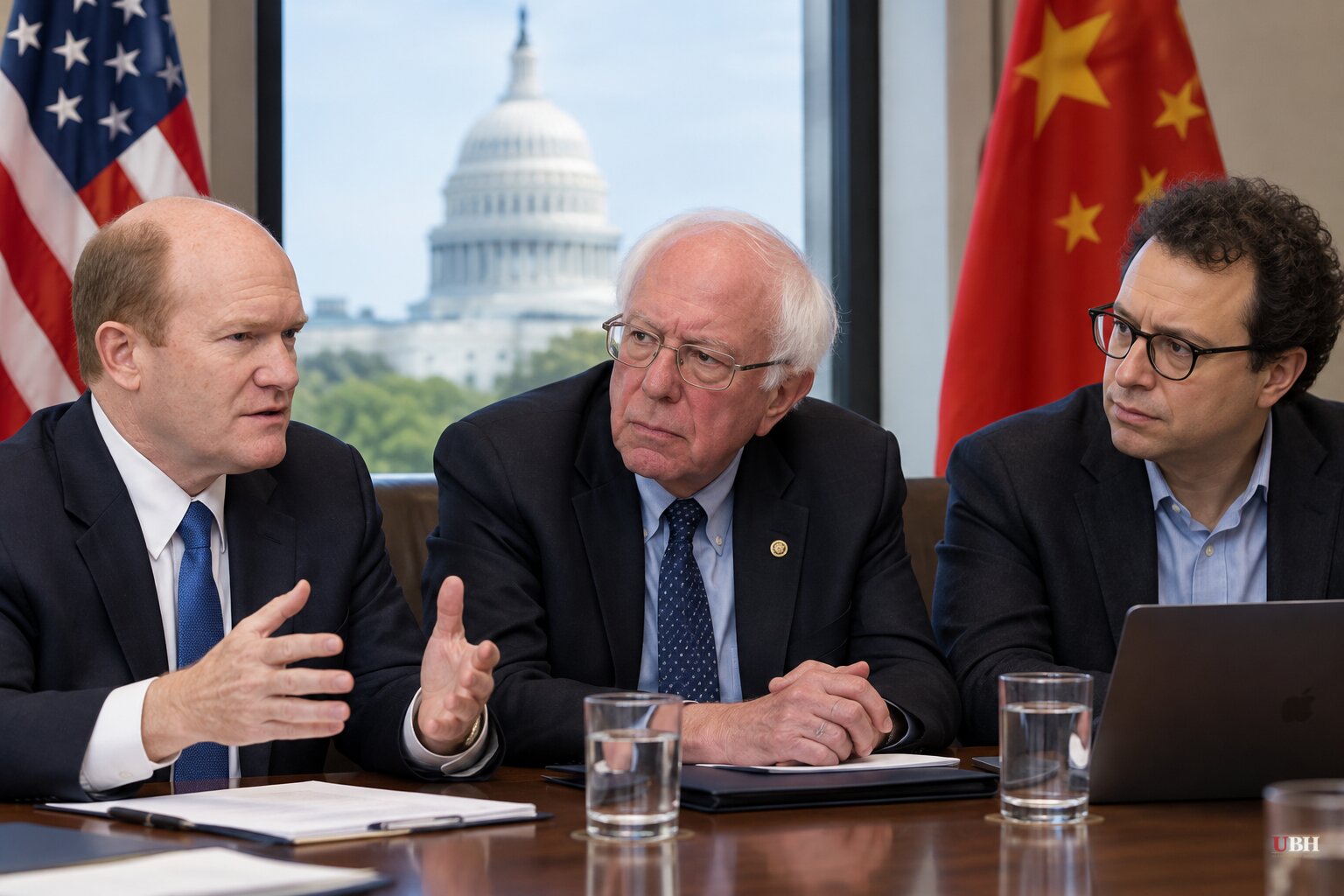
President Trump is heading into a planned Washington summit with Chinese leader Xi Jinping this month facing a chorus of voices, from both parties and from inside the AI industry itself, demanding he put artificial intelligence limits on the table. According to The Straits Times, Trump is sticking with a hands-off approach.
The Nuclear Comparison Everyone Keeps Making
Senator Chris Coons, a Delaware Democrat, told Bloomberg on September 13 that AI cooperation with Beijing needs to happen on the same footing as Cold War nuclear arms talks. Coons argued a unilateral US pause is a fantasy given the competitive dynamics with China, and the only workable path is a framework both countries agree to.
His argument rests on production numbers. Coons says the US manufactures more than 10 million advanced AI chips a year, compared to roughly 200,000 in China, a 50-to-1 gap he wants preserved. He's backing the SAFE Chips Act, which would write existing export controls on high-end processors, including Nvidia's advanced GPUs, into law instead of leaving them as executive orders a future administration could scrap.
Anthropic CEO Dario Amodei made a similar case to CBS in an interview broadcast September 13, telling the network that strategic rivalry with China, not commercial competition, is what "most puts us in a bind," according to Anadolu Agency. Amodei wants advanced chip transfers to authoritarian states restricted to buy time, paired with direct talks with Beijing to set mutual limits. His concrete ask: extend the existing Biological Weapons Convention to cover AI systems that could help someone engineer a pathogen. He said verification is "the most important thing here," but didn't lay out how that verification would actually work against a system built on code, not warheads or missile silos.
Sanders Wants a Full Pause. Trump Doesn't.
Senator Bernie Sanders has gone further than Coons or Amodei, calling for a treaty at the Trump-Xi summit that would pause advanced AI development entirely and permanently ban artificial superintelligence, drawing his own comparison to the Reagan-Gorbachev nuclear talks of the 1980s. Sanders argues that industry calls to merely slow down, from Amodei, Elon Musk and OpenAI's Sam Altman, don't go far enough.
Altman, notably, is on the more modest end of this spectrum. He said this week that even a one-page US-China AI safety treaty could be worthy of a Nobel Peace Prize, according to Crypto Briefing.
Trump himself has shown little appetite for any of this. The Straits Times reports his June 2026 executive order on AI cybersecurity was largely toothless by design, reflecting his administration's reluctance to slow hundreds of billions of dollars in tech investment or hand China an opening. Trump and Xi already discussed AI guardrails and Nvidia H200 chip exports at a May 2026 meeting in Beijing and left without signing anything.
If the US holds a 50-to-1 chip production advantage, as Coons himself states, unilateral restraint hands Beijing exactly the catching-up room it needs. China has publicly stated a goal of AI dominance by 2030. A treaty that can't be verified or enforced against a state with a well-documented history of IP theft and export-control evasion isn't arms control. It's a paper promise.
The Skeptics on Both the Doom and the Decline Narratives
CNN's coverage leans hard into the alarm, built around Jacob Coxon, a former OpenAI and Anthropic researcher who resigned and told Anderson Cooper that people building AI "earnestly believe it could kill us all by the end of the decade." CNN contributor Jacob Ward frames the AI companies themselves as running toward a cliff they can't stop. Those same companies, Anthropic and OpenAI included, are simultaneously racing toward IPOs, a point CNN's own reporting acknowledges but doesn't press further on.
Epoch Times pushes back on a different front. Columnist James Gorrie argues that Xi's warning to Trump about the "Thucydides Trap," the idea that a rising power and a declining one drift toward war, may say more about Beijing's anxiety than American weakness. The US has real problems: a national debt over $40 trillion, high interest rates, a shrinking middle class. But China's headline GDP growth masks a shrinking workforce and slowing productivity, meaning Beijing could be losing ground even as its economy grows on paper.
None of the proposals on the table—Coons' bill, Amodei's treaty framework, Sanders' pause—address how anyone verifies compliance from a government that doesn't allow independent inspectors into its data centers. Defense Secretary Pete Hegseth has said AI isn't making lethal military decisions for now, but the law places no explicit limit on where AI can be used in the targeting chain. Whether Trump raises any of this with Xi, and whether Beijing would even accept outside verification, remains unresolved heading into the summit.
Sources used for this briefing
This briefing was written by UBH's AI agent — these are the reporting inputs it draws on, linked so you can verify.


