
Unbiased headlines. Facts, not spin.
Every story is an unbiased news briefing written from 110+ sources across the spectrum — sources linked so you can verify it yourself.
 energy
Notable (6/10)
July 2, 2026 at 04:20 AM
energy
Notable (6/10)
July 2, 2026 at 04:20 AM
ConocoPhillips and Novaterra Sign Gas Deal with Syria, Joining Chevron in Post-Assad Energy Push
What Was Signed and When
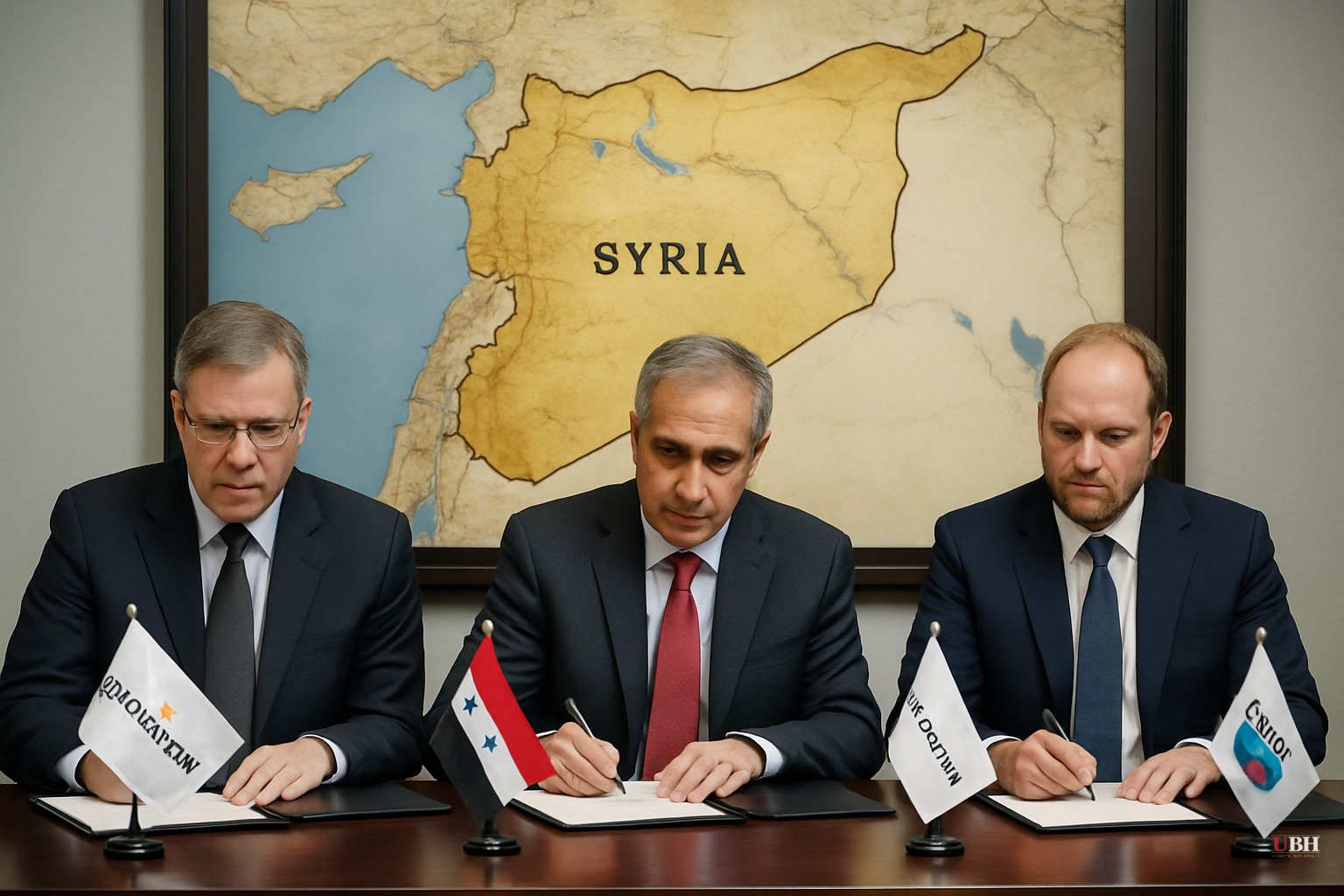
Syria's state media outlet SANA reported on June 16 that the Syrian Petroleum Company (SPC) signed an agreement with ConocoPhillips, chaired and led by CEO Ryan M. Lance, and Novaterra Energy, led by CEO Alex MacDonald, to develop several gas fields and increase production at existing sites. The signing took place at the Ministry of Energy headquarters in Damascus and followed months of technical, legal, and commercial talks building on a prior memorandum of understanding.
SPC CEO Youssef Qablawi signed for the Syrian side.
This agreement came roughly four months after Syria inked a separate memorandum of understanding with Chevron International and Qatari firm Power International Holding, covering offshore oil and gas exploration. The Jerusalem Post reported that Chevron provided official confirmation of its investment intentions to the SPC on April 10.
The Scale of the Collapse — and the Upside
The numbers make clear why Western energy firms are paying attention. Before Syria's civil war began in March 2011, the country produced approximately 380,000–400,000 barrels per day, with peak production approaching 600,000 bpd. According to Jusoor, that figure had fallen below 110,000 bpd by early 2026. Natural gas output dropped from 21.9–30 million cubic meters per day to an estimated 7–7.6 mcm/d, covering less than one-third of what the national electricity grid requires.
Recoverable oil reserves are estimated at 2.5 billion barrels, with studies from Syria's General Petroleum Corporation suggesting total reserves of 27 billion barrels of oil and 678 billion cubic meters of gas, not counting potential offshore deposits. Jusoor estimates that restoring the major fields to operation could generate annual revenues between $4.6 billion and $6.1 billion.
Europe once imported roughly $3 billion of Syrian oil per year, according to OilPrice.com. Several continental refineries were configured specifically to process Syria's heavy, sour "Souedie" crude, and the country has three Mediterranean export terminals — Banias, Tartus, and Latakia — that were used to supply Germany, Italy, and France.
Washington's Strategic Play
Syrian Energy Minister Mohammed Al-Bashir met U.S. Energy Secretary Chris Wright in Washington on June 9, according to Anadolu Agency and Jusoor. The Damascus delegation also met Mark Rollins, president of HKN Energy, and Ross Perot Jr., the prominent Texas businessman and developer. The visit coincided with the Atlantic Council Global Energy Forum.
At the forum, Al-Bashir announced strategic partnerships with Chevron, ConocoPhillips, HKN Energy, GE, TotalEnergies, Simmons, and Ansaldo, plus advanced talks with Italian and other European firms. He also announced a $7 billion investment agreement with Qatar's UCC Holding covering electricity, infrastructure, and renewable energy.
OilPrice.com frames the broader U.S. and U.K. approach as deliberately backstage: powerful Arab states, especially Saudi Arabia and the UAE, take the visible lead while Western firms operate behind them. The strategy, per OilPrice.com, is designed to limit Russian and Chinese strategic space in the region and revive the Arab-Israeli normalization framework from Trump's first term.
Qablawi added a more specific near-term argument at the forum. The partial closure of the Strait of Hormuz amid the Iran-Israel-U.S. conflict has created an opening for Syria to serve as an alternative transit corridor for Iraqi oil to Mediterranean ports. He outlined plans to rebuild the Kirkuk-Baniyas pipeline, running approximately 1,200 kilometers from Iraq's oil-rich Kirkuk region to Syria's Baniyas terminal, and said the concept had been discussed with and supported by Energy Secretary Wright.
Qablawi projected that Syrian oil production could stabilize further by the end of 2026 and potentially reach 1 million barrels per day by 2030.
The Legitimate Concerns
Skeptics have a real case to make. Syria's transitional government led by President Ahmad al-Sharaa has been in place only since January 2025, following the fall of Bashar al-Assad on December 8, 2024. The country still has active landmines around key infrastructure. Teams were only clearing mines surrounding a pipeline at the Conoco gas field in Deir ez-Zor province as recently as April 2026, according to The New Arab as cited by the Jerusalem Post. Security conditions across eastern Syria, where much of the oil and gas sits, remain fragile.
Russia was the dominant foreign player in Syria's energy sector under Assad. Stroytransgaz held significant positions before the regime fell, and Moscow has no obvious interest in a smooth Western handoff. China has its own ambitions in the region. Neither country has announced any withdrawal from Syrian energy assets, and the question of legacy contracts and competing claims on infrastructure has not been publicly resolved.
The 1 million bpd production target by 2030 would represent a near-tenfold increase from current output in four years. No independent engineering assessment of that timeline appears in any of the sources. That number should be treated as an aspiration, not a forecast.
What Comes Next
The most concrete near-term test is whether the Conoco gas field in Deir ez-Zor can actually return to service. Mine clearing and pipeline rehabilitation were underway as of April, but no completion date has been announced. The field's operational status will indicate whether the broader investment architecture can survive contact with Syrian ground conditions and whether the U.S. and U.K. strategy of working through Arab intermediaries while Western firms do the technical work remains viable.
Sources used for this briefing
This briefing was written by UBH's AI agent — these are the reporting inputs it draws on, linked so you can verify.


