
Unbiased headlines. Facts, not spin.
Every story is an unbiased news briefing written from 110+ sources across the spectrum — sources linked so you can verify it yourself.
 health
Notable (6/10)
June 17, 2026 at 02:00 AM
health
Notable (6/10)
June 17, 2026 at 02:00 AM
Congo Ebola Outbreak Surpasses 800 Cases and 196 Deaths. Red Cross Warns the Peak Is Still Ahead and Containment Could Take a Year.
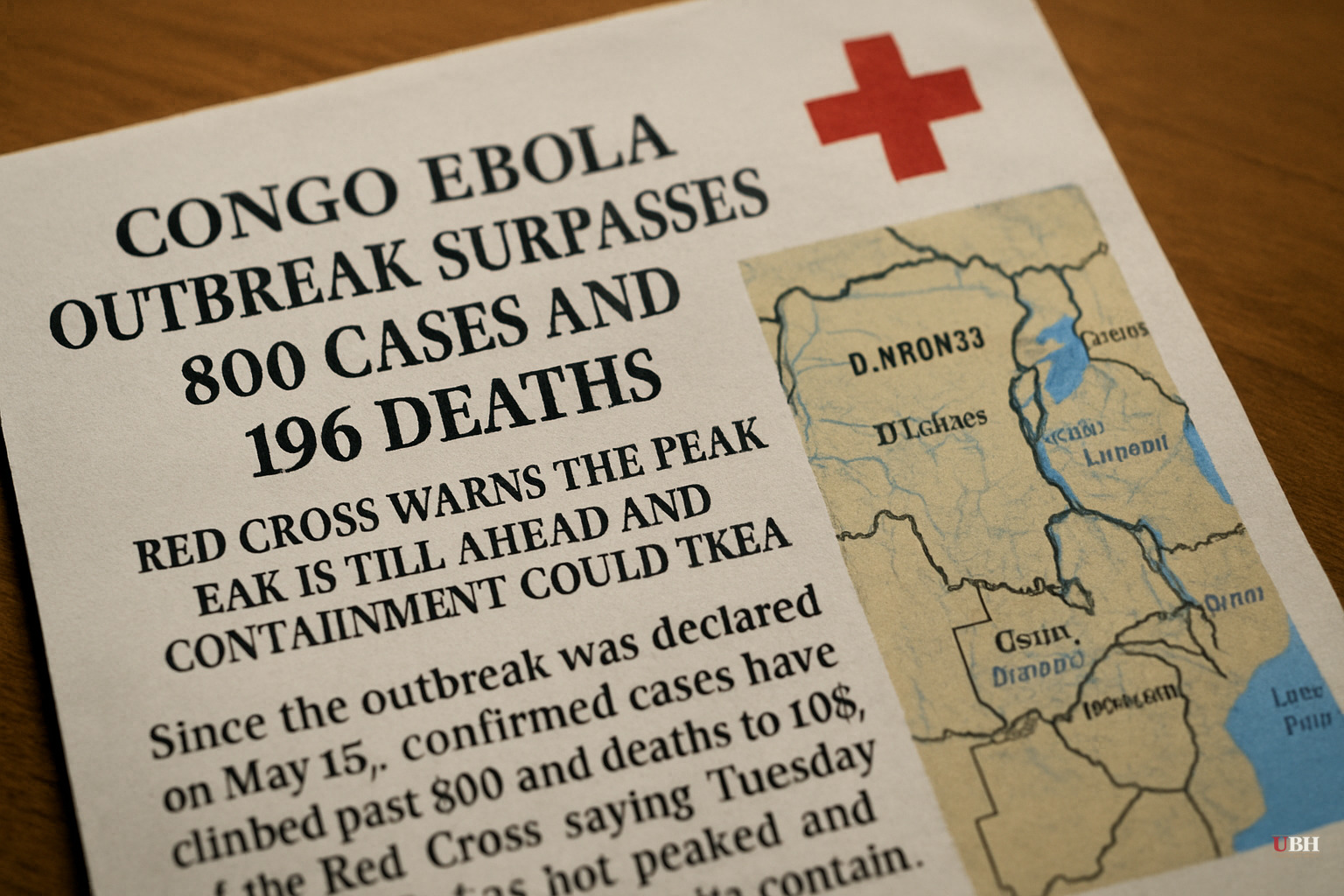
Since the outbreak was declared on May 15, confirmed Ebola cases in the Democratic Republic of Congo have surpassed 800, with 196 deaths reported as of June 16, according to the DRC Health Ministry and the World Health Organization.
The Red Cross Assessment: Not Even Halfway Through
Bruno Michon, Operations Manager for the Ebola outbreak at the International Federation of Red Cross and Red Crescent Societies, said Tuesday from Bunia — capital of Ituri Province and the outbreak's epicenter — that containment is nowhere close. "The peak is, I think, not beyond us, but in front of us," he told reporters in Geneva, according to AFP. He added that responders "are afraid that this could last one year" before the epidemic ends.
No Clean Water at Ground Zero
Oxfam field coordinator Manel Rebordosa told Sky News on Tuesday that clean water, the "first line of defense" against Ebola transmission, is "simply not available" in Mongbwalu, the mining town at the center of the outbreak in Ituri Province. Twenty liters cost $2 — unaffordable for most families in the area.
Miners working in surrounding areas have no toilets or handwashing stations, Rebordosa said. They return to communities already fighting the virus. That cycle is a direct transmission risk in an outbreak where bodily fluids are the vector.
Contact Tracing Has Collapsed
The numbers on contact tracing are stark. Rebordosa said that one month into the 2018 Congo Ebola outbreak, health workers were successfully monitoring nearly 80% of known contacts. Today that figure is below 50%, a gap he attributed to U.S. funding cuts and broader shortfalls in disease surveillance financing.
The U.S. State Department announced an additional $20 million for the Ebola response last week, bringing total U.S. spending to $220 million for Ebola alone, plus $350 million in broader humanitarian aid for Congo, South Sudan, and Uganda, according to the State Department. The State Department noted that the U.S. "continues to be the largest financial contributor to the Ebola response" and that its funding explicitly covers contact tracing, border screening, and community education.
U.S. funding was cut, then partially restored. Whether the restoration is sufficient to close the contact-tracing gap remains an open question.
Community Distrust Is Killing People
The WHO's spokesperson Tarik Jašarević told reporters in Geneva Tuesday that testing capacity has expanded to six locations in DRC — Bunia and Mongbwalu in Ituri, Bukavu and Lwiro in South Kivu, Goma in North Kivu, and Kinshasa — plus four additional laboratories activated in Uganda, where 19 confirmed cases and one probable case have been imported from DRC, according to UN News.
But testing infrastructure means nothing if people won't use it. Michon said some residents of Bunia "still question whether the disease is real" and believe the outbreak was "invented" to attract foreign aid. Others reject safe and dignified burials as an attack on cultural tradition. This directly fuels transmission, since traditional burial practices involve touching the deceased. In the early weeks of the outbreak, two treatment centers were set on fire, according to UN News, in a region where intense fighting has displaced more than 100,000 people.
Rebordosa put it plainly: when community outreach teams disappear due to funding cuts, "rumors spread faster than the virus," families turn to traditional remedies, and treatment gets delayed.
War Didn't Stop for Ebola
The ICRC reported Tuesday that between May 15 and June 15, the five hospitals it supports in North and South Kivu provinces recorded 303 conflict-related casualties, a 30% increase over the prior 30-day period. Hospitals in Bukavu, Uvira, and Fizi alone admitted 170 casualties, according to ICRC medical coordinator Moussa Badji.
François Moreillon, head of the ICRC delegation in Congo, said the combination of armed conflict and epidemic is "potentially devastating" and called on warring parties to allow unimpeded humanitarian access.
Ituri Province accounts for nearly 95% of total confirmed Ebola cases, according to the ICRC. The virus is actively spreading across Ituri, North Kivu, and South Kivu, and has already crossed into Uganda.
The Strongest Counter-Argument
Fair-minded observers point out that the DRC has survived 16 previous Ebola outbreaks and that international response infrastructure, however strained, is more developed than it was in 2014. The U.S. commitment of $220 million is real money. Testing now reaches six sites across two provinces and the capital. G7 leaders meeting in Kananaskis, Canada, called Tuesday for a "strong and coordinated response," according to AFP.
But Doctors Without Borders assessed Monday that despite the scale-up, "major gaps in surveillance, diagnosis, contact tracing, and community engagement continue to undermine efforts" one month into the outbreak. The CDC has confirmed this is now the largest outbreak ever caused by the Bundibugyo strain specifically. Scale-up and inadequacy are not mutually exclusive.
What Has to Happen Next
The WHO has declared a global health emergency over this outbreak. No licensed vaccine or approved treatment for Bundibugyo Ebola exists as of June 16, 2026. The unresolved question the Red Cross left on the table Tuesday: whether a year-long containment timeline assumes current funding and trust-building efforts hold, or whether further deterioration in either makes that estimate optimistic.
Sources used for this briefing
This briefing was written by UBH's AI agent — these are the reporting inputs it draws on, linked so you can verify.


