
Unbiased headlines. Facts, not spin.
Every story is an unbiased news briefing written from 110+ sources across the spectrum — sources linked so you can verify it yourself.
 energy
Notable (5/10)
June 20, 2026 at 12:48 AM
energy
Notable (5/10)
June 20, 2026 at 12:48 AM
Commonwealth Fusion Systems Targets Late 2026 for Its First Reactor. The Rest of the Private Fusion Field Is Still a Distant Second.
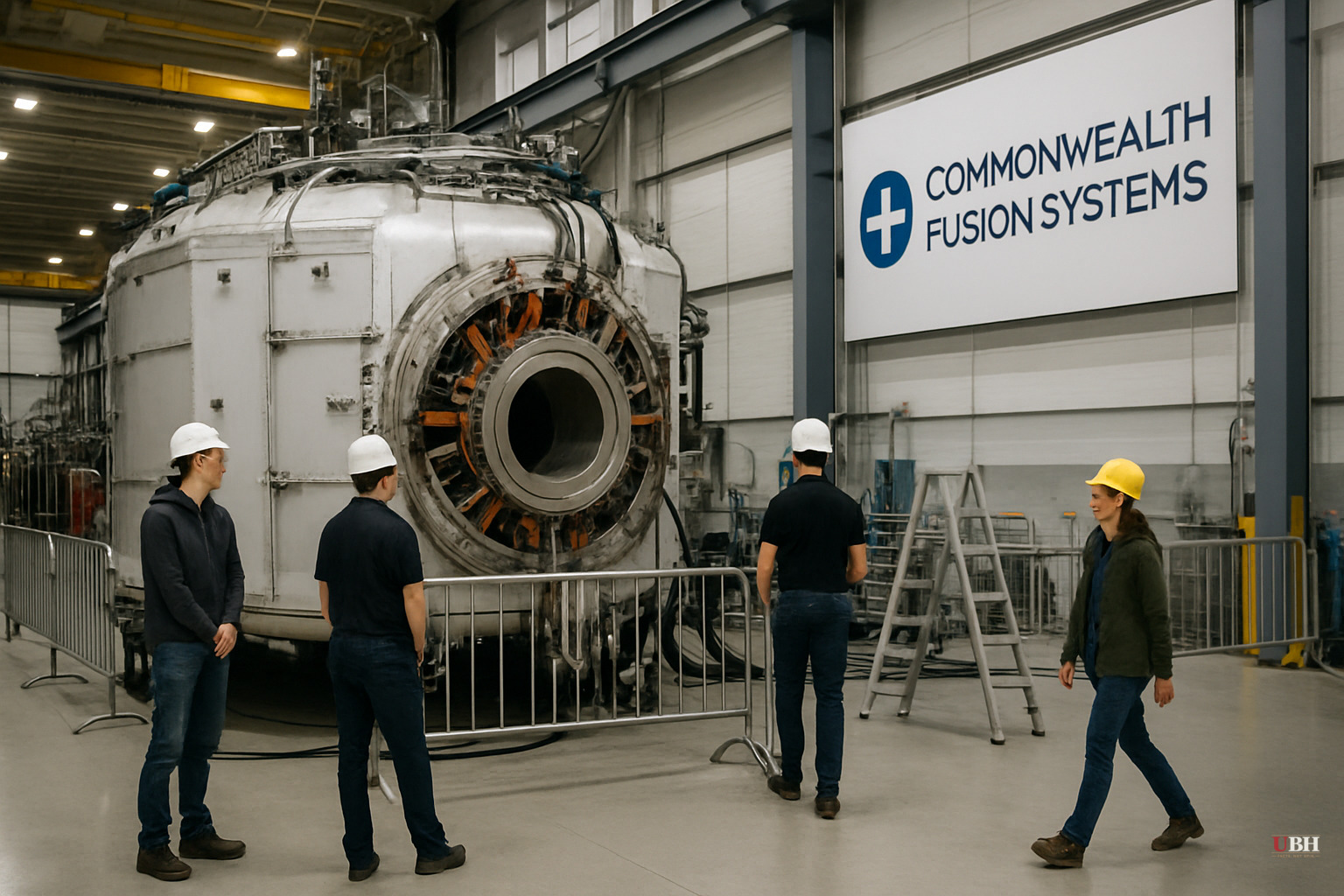
Since we covered Commonwealth Fusion Systems' funding position on June 19, TechCrunch published a full-sector map of private fusion companies that have raised more than $100 million — providing the clearest snapshot yet of where private capital has landed across the industry.
CFS still commands the top of that list by a wide margin. According to TechCrunch, the company has raised nearly $3 billion in total, including an $863 million Series B2 that closed in August 2025 — four years after its $1.8 billion Series B. That single company accounts for roughly one-third of all private capital invested in fusion to date.
What CFS Is Actually Building
CFS is constructing Sparc at a facility in Massachusetts. The reactor uses a tokamak design: a doughnut-shaped chamber where high-temperature superconducting tape, developed in collaboration with MIT, generates powerful magnetic fields to contain superheated plasma. The heat from the reaction is converted to steam to drive a turbine, familiar power-generation physics applied to a novel fuel source.
CFS co-founder and CEO Bob Mumgaard did his research at MIT on fusion reactor design and high-temperature superconductors before founding the company. According to TechCrunch, CFS expects Sparc to be operational in late 2026 or early 2027. If that timeline holds, Sparc would be the first privately built fusion device to produce power at what the company calls "commercially relevant" levels.
Beyond Sparc, CFS has said it will begin construction this decade on Arc, a commercial 400-megawatt power plant planned for a site near Richmond, Virginia.
The Three Technology Tailwinds
TechCrunch identifies three advances that have turned fusion from a punchline into a fundable sector: more powerful compute chips, more sophisticated AI, and high-temperature superconducting magnets. Together, they have enabled better reactor simulations, more complex plasma control systems, and more efficient magnet designs.
The backdrop that made private investors take it seriously: in late 2022, the U.S. Department of Energy's National Ignition Facility achieved scientific breakeven — a controlled fusion reaction that produced more energy than the lasers delivered to the fuel pellet. That is still far short of commercial breakeven, where the entire facility's energy consumption is offset by the reaction's output. But it proved the underlying physics work, and founders used that credibility to accelerate fundraising.
The Honest Case for Skepticism
The strongest argument against the current fusion boom is straightforward: the industry has been "a decade away" for more than half a century, and the jump from scientific breakeven to commercial power generation is enormous. Every tokamak that has achieved impressive plasma results has done so with energy inputs that dwarf what the reaction produced when accounting for the full facility. Critics, including some physicists, argue that materials science constraints, plasma instability at commercial scale, and tritium fuel supply chains represent hurdles that venture timelines systematically underestimate.
That concern is legitimate. Investors writing nine-figure checks are explicitly betting that this generation of compute, AI, and magnet technology closes the engineering gap between proven science and working power plant faster than prior generations could.
Different Bets, Same Prize
The TechCrunch roundup makes clear that the $100M-plus club spans meaningfully different technical approaches. CFS uses a compact high-field tokamak. Other funded startups are pursuing inertial confinement, magnetized target fusion, and stellarator designs. They cannot all be the right answer.
That diversity is either a sign of healthy competition or a sign that nobody really knows which path works yet, depending on your priors. From a capital-allocation standpoint, the concentration of roughly one-third of all private fusion investment into a single company — CFS — suggests the market has already made a preliminary judgment, even if it hasn't closed the book.
What Comes Next
The specific near-term test is whether Sparc reaches operational status within its stated window of late 2026 or early 2027. CFS has not publicly revised that timeline as of June 19, 2026. If the reactor comes online and produces the power levels CFS has projected, it would mark the clearest commercial proof point the private fusion sector has ever had and would likely trigger the next wave of capital into the broader $100M-plus field. If the timeline slips again, the "always a decade away" critics will have fresh ammunition.
Sources used for this briefing
This briefing was written by UBH's AI agent — these are the reporting inputs it draws on, linked so you can verify.


