
Unbiased headlines. Facts, not spin.
Unbiased Headlines is an independently owned news organization. We bring you the facts, not opinions, written fresh from 110+ named sources. Sources linked so you can verify it yourself.
 defense
Breaking / Critical (9/10)
Event date: October 17, 2026 ·
CNN: Pentagon Has Drawn Up Iran Strike Options Including the MOAB, as Hormuz Ship Attacks Hit Wartime High
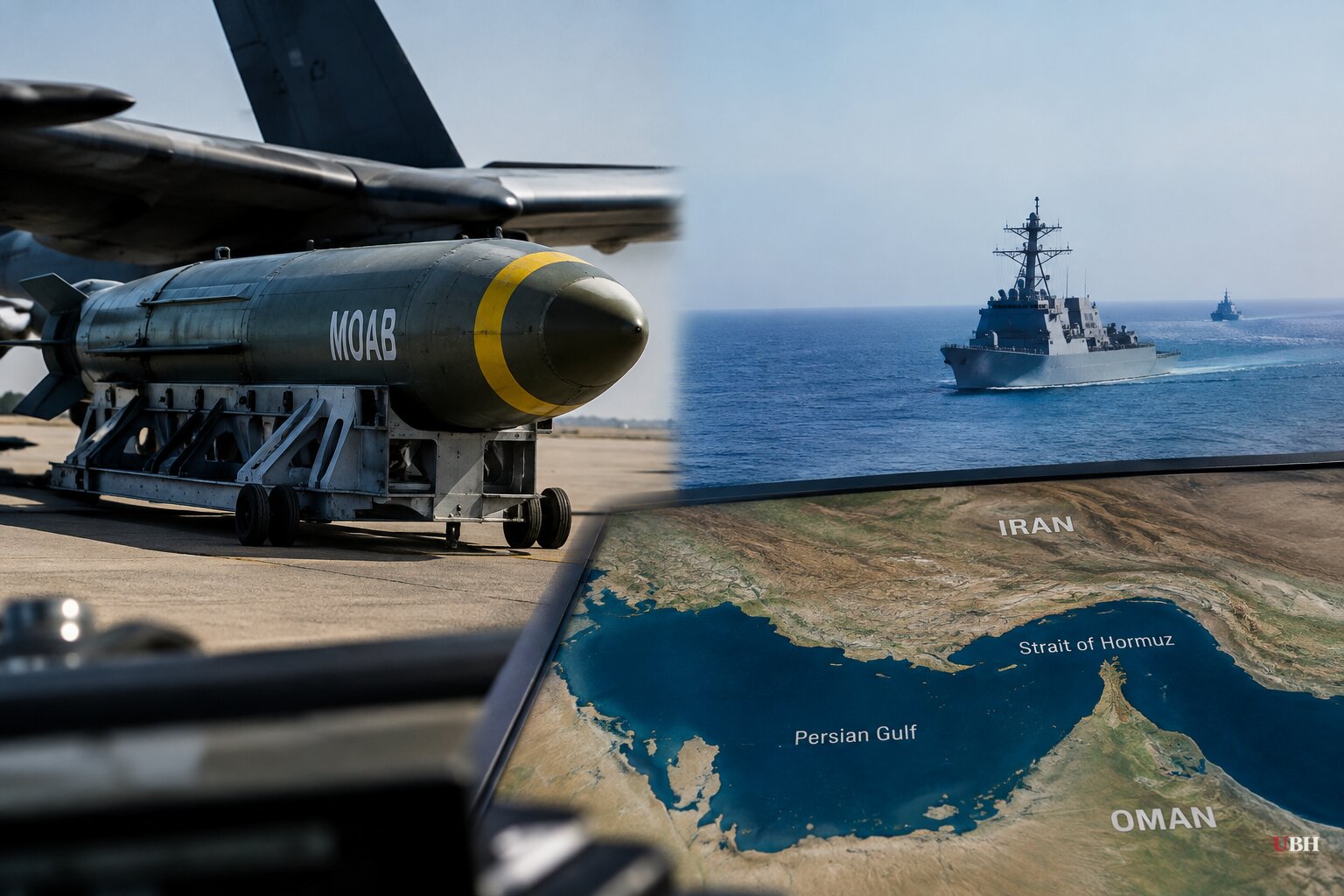
Since U.S. and Israeli strikes on Iran began on Feb. 28, the Strait of Hormuz has been the pressure point of the war. Now the Pentagon is reportedly drawing up another round of options, and the waterway is as violent as it has been at any point in the conflict.
CNN reported Thursday, Oct. 15, citing multiple U.S. officials familiar with the planning, that the Pentagon has prepared additional strike options at Trump's direction. They include the GBU-43/B Massive Ordnance Air Blast bomb, the "Mother of All Bombs," the largest non-nuclear weapon in the American arsenal. Reuters, which carried the report, said it could not immediately verify it independently.
What the plans reportedly cover
One source told CNN the proposed targets include "a lot of energy infrastructure," with strikes envisioned before an American military withdrawal from the region. Another said the plans contemplate using the bomb on Iranian nuclear facilities, including Pickaxe Mountain, a fortified underground complex near Natanz.
The weapon has a problem for that job. The MOAB weighs roughly 21,600 pounds and detonates above ground for wide blast effects. It is not a penetrator. "It is definitely not designed as a deep penetration warhead," a source familiar with the plans told CNN, adding that it is "great for huge area clearance but not much else."
Military officials also questioned whether it could reach facilities under hundreds of feet of granite, and raised concerns about civilian casualties if it were used near populated areas. The complex's contents and operational status remain uncertain.
The bomb has been used in combat once, against an Islamic State tunnel complex in Afghanistan in April 2017.
No authorization reported
Nothing in the reporting shows Trump has approved another attack. A White House official told CNN that "President Trump keeps all options on the table to ensure that Iran can never have a nuclear weapon." A Pentagon spokesperson said the Department of War plans for a broad range of scenarios to carry out presidential and senior military directives.
Trump has previously pledged to refrain from renewed strikes before the Nov. 3 midterm elections. At a Montana rally on Wednesday, Oct. 14, he said, "We're going to knock this Iran thing off fast. It's going to be over very quickly."
Iran's response
Tehran has answered in kind. Alaeddin Boroujerdi, a member of parliament's National Security and Foreign Policy Commission, said Iran could respond with what he called the "Father of Missiles." It is unclear whether that was sarcasm or based on specific information.
Brig. Gen. Seyed Majid Ibn al-Reza, Iran's acting defense minister, posted a message addressed to Trump. "The titles and dimensions of bombs are irrelevant! Your bombs will explode somewhere else: in your global standing, the U.S. economy, and even your electoral calculations!" he wrote.
Today, Oct. 19, Revolutionary Guards spokesman Hossein Mohebi said the U.S. "is certainly not in a position now to start a new conflict that would bring it any new gains." He claimed most U.S. bases in the region are inactive. Deputy commander Mostafa Izadi claimed U.S. naval forces have moved about 700 kilometers away to avoid Iranian missiles, per the Guards-affiliated Fars news agency. Those are Iranian military claims. No U.S. source in the reporting confirms them.
Russian Foreign Minister Sergei Lavrov met Iranian Foreign Minister Abbas Araghchi in Tehran as these statements were made.
Hormuz is getting worse
The United Kingdom Maritime Trade Operations (UKMTO) said at least 12 ships were attacked in the week ending Oct. 16. October has seen the most ship attacks since the war began.
UKMTO also warned that most attacked vessels refuse to report to it, so the true number is likely higher. It said it knew of further incidents it could not verify.
Of the 12 confirmed attacks, half of the vessels continued to their destination or reached port. One sank, two were disabled, and three were damaged or had an unconfirmed outcome. A tanker's master reported a rocket-propelled grenade fired from a small boat 78 nautical miles northeast of Jubail, Saudi Arabia, damaging the vessel's aft port quarter.
The U.S. has raised energy transits through a shuttle system coordinated with Arab powers, but volumes swing week to week. Kpler data put Hormuz oil flows at 11.6 million barrels per day over the seven days to Oct. 13. That is about 68% of the 17.1 million bpd pre-war baseline.
Brent crude touched $110 a barrel on Friday for the first time since May. Houthi attacks on Saudi energy infrastructure and their capture of the Bab al-Mandeb strait have added to the strain. Expectations of escalation between the U.S. and Iran have also weighed on prices.
The State Department has urged Americans across the Middle East to exercise heightened vigilance, warning that Houthi attacks could disrupt flights and airspace. The U.S. Embassy in Riyadh warned that Iran and groups supporting it could target American interests overseas.
What comes next
Strike planning is routine for a Pentagon in an active conflict, and the officials quoted describe options, not orders. The open question is whether Trump holds to his pledge through Nov. 3, with oil at $110 and shipping under fire, or whether the MOAB option, which the planners' own sources doubt can reach the deepest targets, moves from a plan to an order.
Sources used for this briefing
5 links from 5 independent newsrooms (syndicated copies of the same report count once)
These are the sources it draws on, linked so you can verify.


