
Unbiased headlines. Facts, not spin.
Unbiased Headlines is an independently owned news organization. We bring you the facts, not opinions, written fresh from 110+ named sources. Sources linked so you can verify it yourself.
 defense
Major Story (8/10)
State Department Tells Americans Across Middle East to Use 'Heightened Vigilance' as Houthi Strikes Keep Riyadh Airport Closed
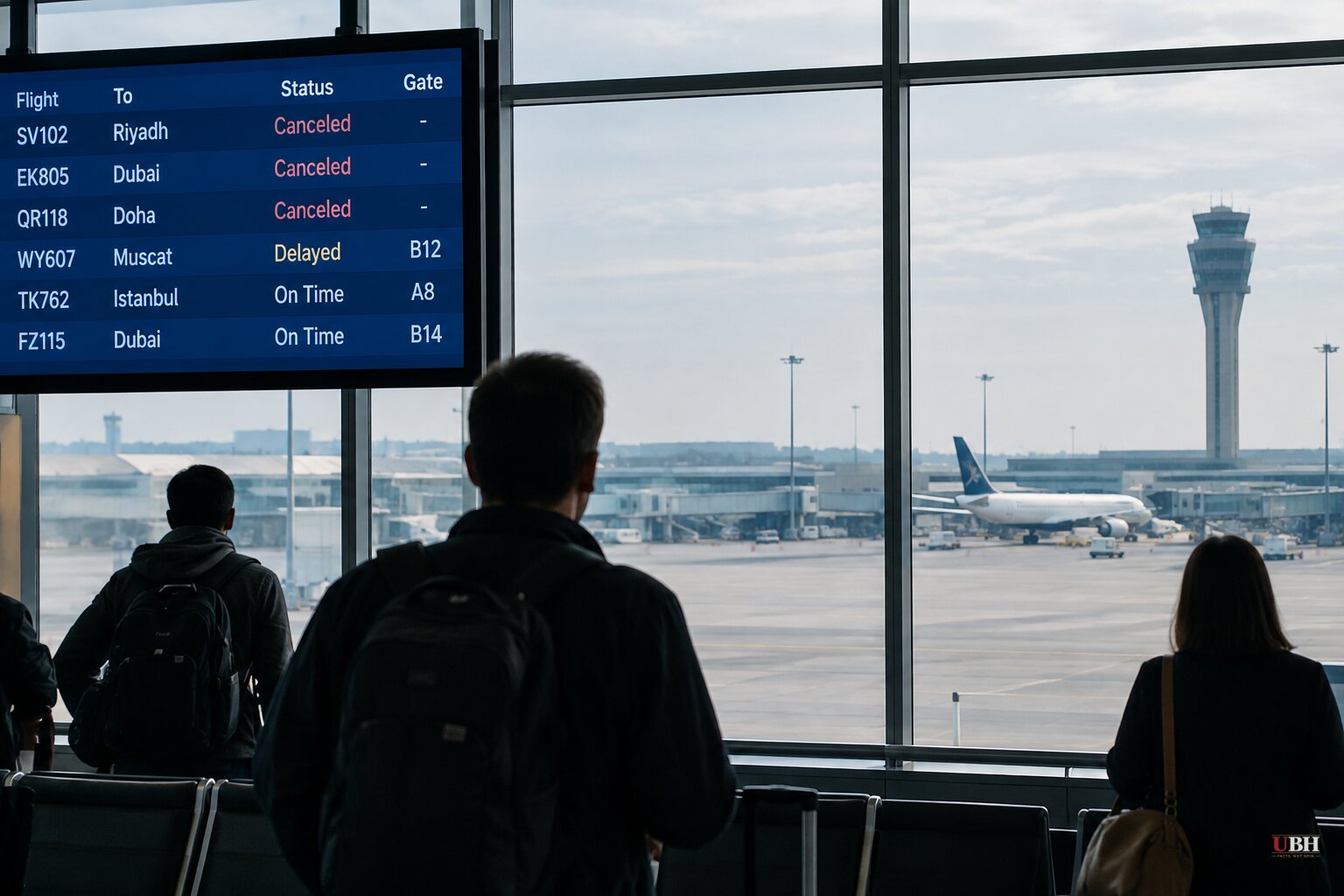
The State Department is telling Americans in the Middle East to be on guard, and it is not limiting the warning to the region.
The Bureau of Consular Affairs and U.S. embassies across the Gulf, Israel, Iraq, Lebanon and Jordan issued the alert, dated Oct. 18 and repeated Monday, Oct. 19. It says Americans in the Middle East "should exercise heightened vigilance due to the complex security environment" and to expect "flight cancellations, airspace closures, and travel disruptions."
What the alert says
The department's stated trigger is the Houthi campaign against Saudi Arabia. "Iranian-supported Houthis have engaged in hostilities against Saudi Arabia, including attacks on civilian airports and other critical infrastructure resulting in civilian casualties and severe travel disruptions," the alert says. "The hostilities have the potential to escalate rapidly beyond that immediate area."
The warning also reaches past the region. The department said Iran and groups supportive of Iran "may target other U.S. interests overseas or at locations associated with the United States and Americans throughout the world, including U.S. businesses and other institutions."
The U.S. Embassy in Jerusalem said its consular sections in Jerusalem and Tel Aviv remain open for routine and emergency services. It urged citizens to enroll in the Smart Traveler Enrollment Program, know where their nearest shelter is, and make contingency plans before traveling.
Saudi airports at the center
The Saudi-specific guidance is more detailed. According to the U.S. diplomatic advisory, missile and drone attacks have disrupted flights across the kingdom. Operations at King Khalid International Airport in Riyadh were reported suspended. Jeddah and Dammam airports kept operating with delays and cancellations.
L'Orient-Le Jour reported that Riyadh's international airport remains closed after 18 people were killed in a string of strikes this month.
U.S. government employees in Saudi Arabia must get special authorization before using airports. The embassy suggested road, rail and bus options where safe. Major roads around Riyadh, Jeddah and Dhahran, along with certain land border crossings, were operating when the notice went out.
The embassy also told Americans not to photograph or share footage of missile interceptions, government facilities, airports or struck sites. Saudi authorities have warned that recording or sharing such material can carry legal consequences.
On the Houthi side, military spokesman Yahya Saree claimed Saudi forces carried out 110 airstrikes and missile attacks across Yemen in 24 hours, causing more than 30 casualties. He put the cumulative total of Saudi-led strikes since the latest escalation at 2,652. Those figures are Houthi claims and have not been independently confirmed.
An eight-month war with no settlement
President Donald Trump announced "major combat operations" against Iran on Feb. 28, with joint U.S.-Israeli strikes on military, government and infrastructure sites. The two countries signed a memorandum of understanding in June meant to end the war. Talks then broke down, and the U.S. and Iran resumed strikes. The Strait of Hormuz is the main flashpoint.
The shipping market shows the strain. TankerTrackers said Monday that daily rates for oil tankers have jumped to $1.4 million from $35,000 to $50,000 before the war. The group said Iran has blacklisted 104 tankers, while the fleet it calls the "Arab Dark Fleet" is nearly four times that size.
Tehran's posture and outside diplomacy
Tehran is projecting defiance. Armed Forces Chief of Staff Ali Abdollahi said Monday that Iran "will not allow any aggressor to encroach on our country." He added: "This America is no longer the powerful America it once was. America has grown old, and we are now witnessing the decline of American power." Defense Minister Mehrdad Akhlaghi said he met the commander of the IRGC Aerospace Force to review the force's requirements.
Other powers are moving in. Russian Foreign Minister Sergei Lavrov met President Masoud Pezeshkian in Tehran on Monday, and the Iranian presidency said they discussed strengthening Tehran-Moscow cooperation. The presidency gave no further details.
In Dushanbe, Chinese Premier Li Qiang urged a return to dialogue and negotiations during a meeting with Iran's First Vice President Mohammad Reza Aref, Xinhua reported. Moscow and Beijing both have senior officials engaging Tehran while Washington warns its citizens about Iranian retaliation.
The Financial Times, citing two unnamed senior Iranian officials, reported that Iran is not currently prioritizing withdrawal from the Nuclear Non-Proliferation Treaty. "Our policy regarding the NPT has not changed yet, but this doesn't mean it won't in the future," one of the officials said.
What comes next
Iran's ISNA news agency reported that Pakistan's senior military commander Asim Munir is likely to visit Tehran this week. The agency said the trip is expected to cover regional developments and Pakistan's role in Iran-US negotiations.
The State Department has not said how long the heightened-vigilance posture will last, and Riyadh's airport has no announced reopening date.
Sources used for this briefing
8 links from 7 independent newsrooms (syndicated copies of the same report count once)
These are the sources it draws on, linked so you can verify.


