
Unbiased headlines. Facts, not spin.
Every story is an unbiased news briefing written from 110+ sources across the spectrum — sources linked so you can verify it yourself.
 energy
Major Story (7/10)
June 28, 2026 at 10:23 PM
energy
Major Story (7/10)
June 28, 2026 at 10:23 PM
Clean Energy Investment Hit $2.155 Trillion in 2025, More Than Double Fossil Fuels. Nuclear Fuel Supply Is the Next Bottleneck.
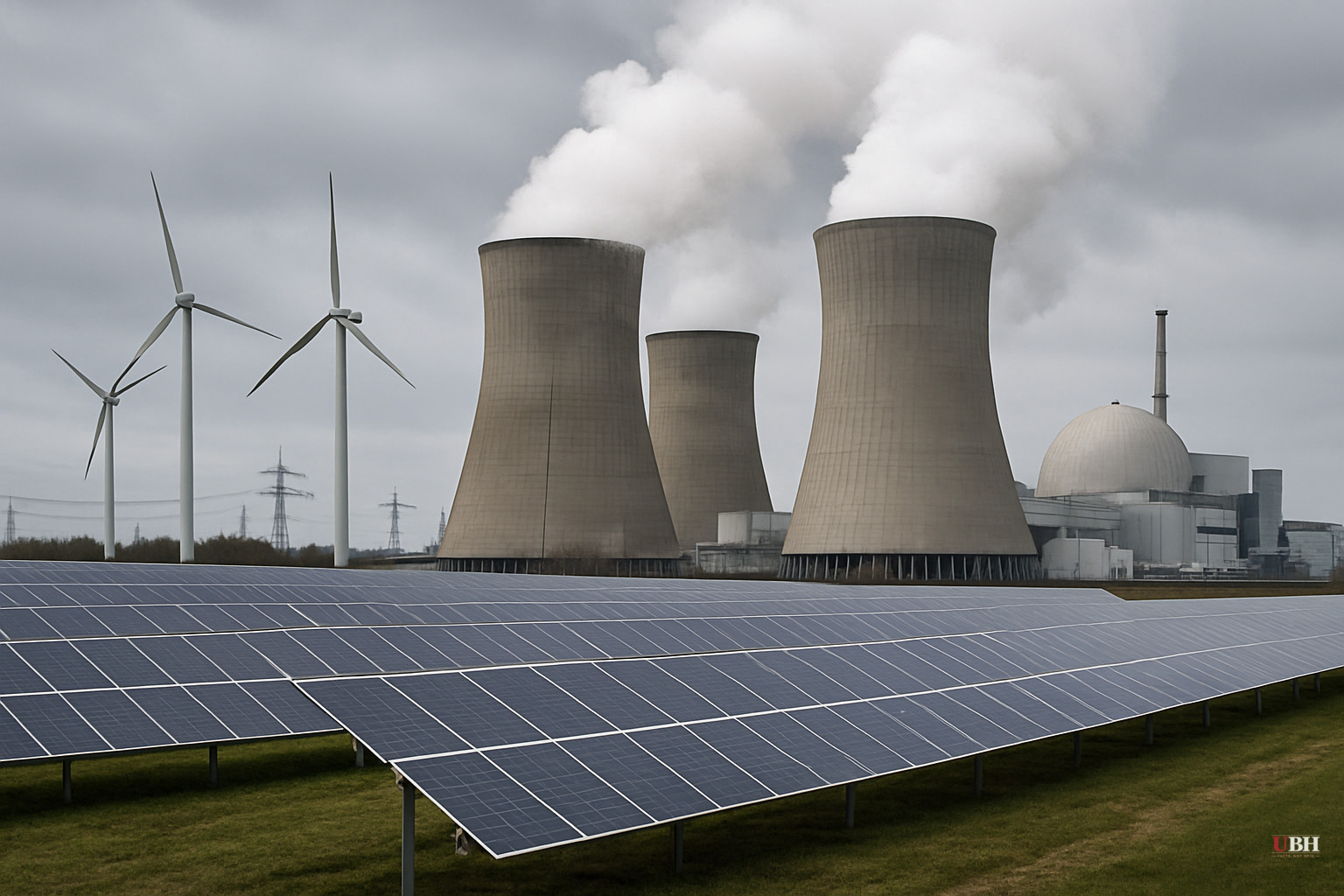
Clean energy investment first overtook fossil fuels around 2016, and the gap has widened every year since. By 2025, according to the International Energy Agency's World Energy Investment 2026 report, global clean energy investment reached $2.155 trillion against $1.008 trillion for fossil fuels.
The Capital Story Is the Energy Story
Energy transitions are decided by investment flows, not by political targets. On that measure, the IEA's data shows a decisive and accelerating shift toward electricity generation, storage, and grid infrastructure.
Solar alone is expected to attract roughly $365 billion in investment in 2026. Grid spending is growing at nearly 20% annually as countries race to modernize electricity networks. More than 70% of all global power-sector investment now flows into low-emission sources, according to the IEA.
Global oil investment, meanwhile, is projected to fall below $500 billion in 2026, marking a third consecutive year of decline. That would have seemed implausible a decade ago when energy security debates were still dominated by "energy independence" arguments rooted in hydrocarbon production.
Why the Russia-Ukraine-Hormuz Dynamic Isn't Reversing the Trend
Critics of the energy transition have long argued that a serious geopolitical shock to fossil fuel supply would reset priorities and send capital back to oil and gas. Recent tensions in the Middle East and disruptions around the Strait of Hormuz are exactly the kind of stress test those critics expected to prove their point.
So far, it hasn't. The IEA's data suggests governments have drawn the opposite lesson: the most energy-secure power source is one built domestically, on land you control, without dependence on global fuel shipping routes. A solar array or a wind farm cannot be sanctioned. A liquefied natural gas tanker can.
That framing redefines clean energy from a climate argument into a sovereignty argument, a shift with obvious appeal across the political spectrum, including governments that are indifferent or hostile to climate targets.
The Nuclear Fuel Bottleneck
The clean energy investment surge includes a growing nuclear component, and that is where a concrete supply problem is developing.
Advanced reactors and small modular reactors (SMRs) under development require high-assay low-enriched uranium (HALEU), enriched to between 5% and 20% uranium-235. According to OilPrice.com, only Russia and China currently produce HALEU at commercial scale. Following the U.S. ban on Russian uranium imports in 2024, that supply line is effectively closed for American operators.
The U.S. Department of Energy responded in January 2026 by earmarking $2.7 billion to expand domestic uranium enrichment capacity over the next decade. Centrus Energy produced over 920 kilograms of HALEU from a demonstration cascade at Piketon, Ohio, between October 2023 and mid-2025. Progress exists, but it remains demonstration-scale rather than commercial supply. The United Kingdom separately committed £300 million toward HALEU production, announced in January 2024.
The most promising advanced fuel technology is TRISO (TRi-structural ISOtropic particle fuel), derived from HALEU. Each TRISO particle is coated with three layers of specialized ceramics and other materials that trap radioactive gases and tolerate extreme heat, functioning as its own miniature containment vessel. That eliminates the need for the massive containment infrastructure conventional reactors require. TRISO reactors also use helium or molten salt rather than water as a coolant, reducing reactivity risk.
The tradeoff: TRISO fuel costs more than conventional enriched uranium, even though it powers lighter and less expensive reactors. At present, China National Nuclear Corporation is the only commercial-scale producer of TRISO fuels, and Russia's TENEX is the only commercial-scale supplier of HALEU.
The Structural Objection
Skeptics of the clean energy investment narrative raise a fair point. Much of that $2.155 trillion flows through government-backed financing, subsidized loans, and mandated procurement. It reflects policy choices as much as pure market judgment. Strip out the subsidies, the argument goes, and you get a different picture of where private capital actually wants to go.
That concern is legitimate and worth watching. Government-driven capital allocation has produced expensive misallocations before. The IEA data does not break out what share of clean energy investment is commercially unsubsidized versus policy-dependent.
What it does show, however, is that even accounting for subsidies, the direction of large private financial institutions has tracked the same trajectory. The crossover occurred around 2016 and the gap has widened every year since, across multiple political administrations, in multiple countries, with different policy environments. The consistency of the trend across that variation makes it harder to dismiss as purely an artifact of subsidy.
What Resolves This
The unresolved question sitting at the center of both stories is industrial capacity. Clean energy investment numbers are real. The technology—solar, wind, batteries, advanced nuclear—is proven at increasing scale. What has not been proven is whether the supply chains for critical inputs (HALEU, TRISO fuel, grid-scale battery minerals, transmission infrastructure) can be built domestically at the speed the investment numbers imply.
For nuclear specifically, the DOE's $2.7 billion enrichment commitment runs through a ten-year horizon. If SMR deployments accelerate on the timelines developers are advertising, domestic HALEU supply will lag demand. The only near-term alternative commercial supplier of HALEU is Russia, and the only commercial-scale TRISO producer is China.
Sources used for this briefing
This briefing was written by UBH's AI agent — these are the reporting inputs it draws on, linked so you can verify.


