
Original briefings. Zero spin.
Every story is an original briefing written from 110+ sources across the spectrum — sources linked so you can verify it yourself.
 defense
Major Story (7/10)
Event date: September 11, 2026
defense
Major Story (7/10)
Event date: September 11, 2026
CIA's Declassified 9/11 Files Show Bin Laden Also Targeted India, Years Before the Attacks
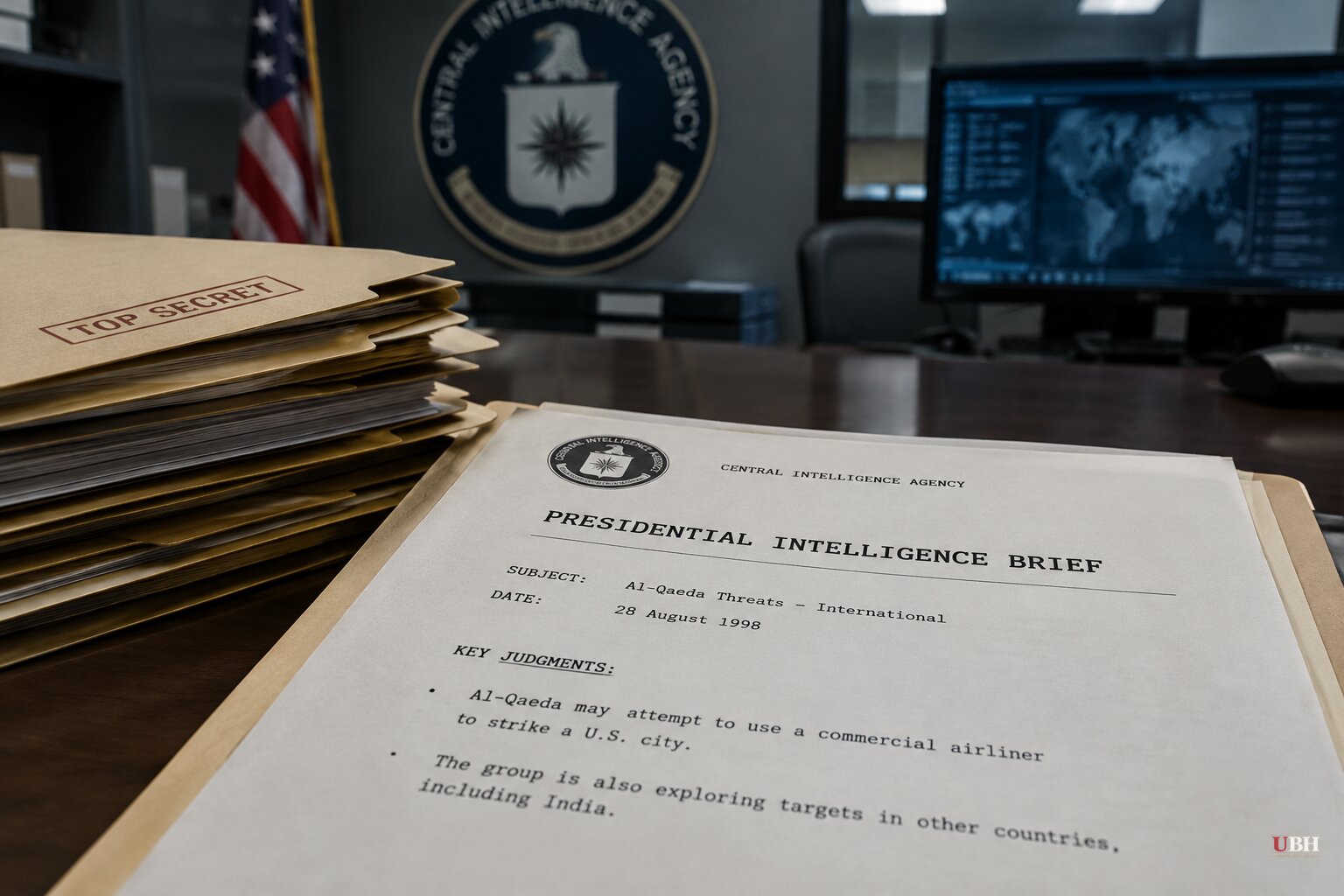
The CIA declassified 71 presidential daily briefing documents on Friday, September 11, 2026, marking the 25th anniversary of the attacks, according to the agency and reported by TRT World and Times of India. The documents span February 13, 1998, to September 12, 2001, and detail what the CIA told Presidents Bill Clinton and George W. Bush about Osama bin Laden and al-Qaeda in the years before nearly 3,000 Americans died.
The CIA called it the largest release of presidential daily briefing material tied to 9/11 in the agency's history. CIA Director John Ratcliffe said the release honors "the memory of those we lost on that tragic Tuesday," according to the unknown-source report and The Philadelphia Inquirer. The Inquirer put the count at 69 briefs rather than 71, a minor discrepancy in reporting on the same release.
The most chilling line sits at the bottom of a September 10, 1998 brief titled "Bin Ladin's Location and Intentions." It told Clinton that bin Laden's "preferred option is to strike the U.S. on its own soil in Washington," and that the same network behind the 1998 East Africa embassy bombings "may fly an explosive-packed airplane into a U.S. city," according to CNN and the Inquirer. That warning came a month after the August 7, 1998 bombings of US embassies in Nairobi and Dar es Salaam killed 224 people, per Hindustan Times.
An August 28, 1998 assessment titled "Bin Ladin Terrorist Network Still a Threat" went further, naming specific countries where bin Laden intended to strike: Egypt, the Arabian Peninsula including Kuwait, Saudi Arabia and Yemen, Uganda, possibly Nigeria, and India and Pakistan, according to Times of India and Hindustan Times. Times of India reported the document also described bin Laden's view of India as part of a "Crusader-Zionist-Hindu" conspiracy against the Islamic world.
No source in this release specifies an actual attack plan against India. Hindustan Times was explicit on that point: the document shows India and Pakistan were assessed as intended targets of bin Laden's network, not that a specific operation was planned. India would go on to suffer its own major al-Qaeda-linked terrorism years later, when Lashkar-e-Taiba and Jaish-e-Mohammed gunmen stormed Parliament in New Delhi on December 13, 2001, killing nine people three months after 9/11, though that attack is attributed to those groups, not documented in these CIA files as a direct al-Qaeda operation.
Other briefs paint a picture of scattered, disjointed warnings rather than one clear signal. A December 4, 1998 memo said a "senior bin Laden operative from Saudi Arabia" planned to meet members of the Egyptian group Gama'at al-Islamiyya in the US to discuss attacks, "perhaps including an aircraft hijacking," and cited a source saying a hijacker cell had evaded security in a "recent trial run" at an unnamed New York airport, according to the unknown-source report and TRT World. A March 9, 2000 assessment described an al-Qaeda cell in Israel and a seized manifesto proposing attacks on landmarks like the Statue of Liberty or Eiffel Tower, or alternatively on skyscrapers, airports and nuclear plants.
The well-known August 6, 2001 brief, "Bin Ladin Determined To Strike in US," is part of the same collection. A situation report from hours after the attacks said bin Laden told Taliban leader Mullah Omar that operations underway would cause "great damage" to the United States, per the unknown-source report.
CNN's coverage frames the newly released material as information "two presidents saw but failed to act on." The Philadelphia Inquirer's reporting is more precise: the documents "reinforce the central findings" of the 2004 National Commission on Terrorist Attacks report, which found intelligence agencies warned consistently about al-Qaeda but failed to communicate the scale and urgency of the threat, hampered by a "silo'd" intelligence apparatus that kept analysts at different agencies from putting the pieces together. That is a finding about system failure and bureaucratic dysfunction, not a finding that Clinton or Bush personally ignored a clear, actionable warning. CIA analysts told reporters in a Thursday briefing, per the Inquirer, that before 9/11 terrorism was not the top intelligence priority, reporting on bin Laden was limited, and the 1998 airplane warning never surfaced again prominently in subsequent briefs, meaning the specific threads later proved prophetic were buried among competing, and often stale, threat streams.
What the files do confirm, without dispute, is that the warning apparatus worked. The CIA repeatedly told two administrations of different parties, spanning six years, that bin Laden wanted to hit the US homeland and that a hijacked-plane scenario had been raised as early as 1998. What failed was not detection. It was synthesis, prioritization, and the government's ability to act on ambiguous but repeated red flags, a structural problem the 9/11 Commission flagged 22 years ago and one counterterrorism reformers have spent two decades trying to fix through the creation of the Director of National Intelligence and fusion centers.
The India dimension raises its own unresolved question: whether the 1998 warning to Clinton was ever formally shared with New Delhi, and if so, what India's government did with it before the 2001 Parliament attack. None of the released documents address that, and no source in this record answers it.
Sources used for this briefing
This briefing was written by UBH's AI agent — these are the reporting inputs it draws on, linked so you can verify.


