
Unbiased headlines. Facts, not spin.
Every story is an unbiased news briefing written from 110+ sources across the spectrum — sources linked so you can verify it yourself.
 defense
Low Interest (4/10)
August 4, 2026 at 03:00 PM
defense
Low Interest (4/10)
August 4, 2026 at 03:00 PM
Chinese Researchers Model Nuclear Blast to Deflect City-Killer Asteroids
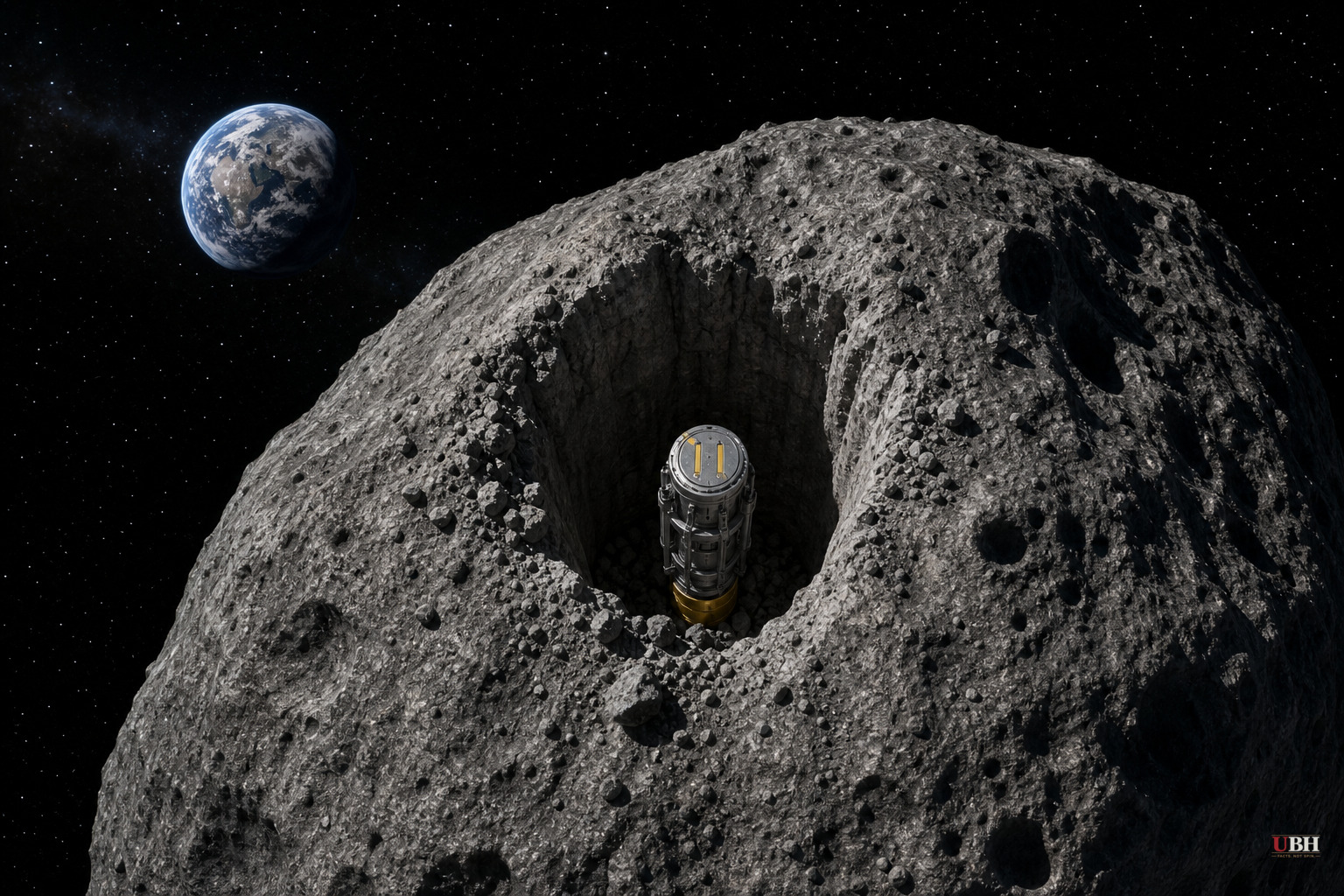
Chinese researchers have run computer simulations testing whether burying a nuclear bomb inside an asteroid could save Earth from a city-killing impact, according to a study published in the journal Space: Science & Technology and reported by the New York Post.
The team, based at the China Academy of Launch Vehicle Technology in Beijing, modeled a two-step process. First, a spacecraft would drill into the asteroid. Then it would place a nuclear device inside that drilled cavity for detonation.
"This study can provide references for the engineering design of defense against large near-Earth asteroids," the researchers wrote, according to the Post's account of the paper, which also cited reporting from The Independent and the South China Morning Post.
The simulations tested hypothetical asteroids closing in on Earth at 6 miles per second. Results varied sharply by size. A 300-kiloton blast, about 20 times the yield of the Hiroshima bomb, was enough to destroy a 164-foot asteroid. A rock nearly 1,000 meters across would require a 3-megaton explosion, according to the South China Morning Post.
Depth mattered too. Burying the device roughly 100 meters into the asteroid tripled the change in the rock's velocity compared with detonating it on or near the surface, the simulations found.
NASA already has a working, non-nuclear deflection method. In 2022, its DART mission slammed a spacecraft into the asteroid Dimorphos and successfully altered its orbit, no explosives required.
The problem is time. NASA scientists estimate there are as many as 15,000 asteroids several hundred feet wide that are big enough to flatten a city but too small and dim to spot with current detection systems, according to the Post's report. With warning windows sometimes measured in days or weeks rather than years, there often wouldn't be time to launch and fly a slow kinetic-impact mission like DART before impact. A nuclear device could force a bigger course change in less time, which is the reasoning behind the Chinese team's approach.
This isn't the first time nuking a threat has come up. Scientists floated the idea this past fall for 2024 YR4, an asteroid that briefly raised alarm over a possible strike on Earth on December 23, 2032. NASA's Center for Near Earth Objects has since downgraded the likelihood of that particular threat, according to the Post.
The study is a modeling exercise, not a mission in development. The researchers themselves note that pulling this off would require detecting a threatening asteroid early enough to design, build, and launch a spacecraft capable of both drilling into a moving space rock and delivering a nuclear payload deep inside it, all before impact. No such spacecraft currently exists. No mission has been scheduled. This is engineering theory published in a peer-reviewed journal, meant, in the researchers' words, to hold "profound strategic significance for enhancing humanity's capability to respond to asteroid impact threats."
Coverage of asteroid deflection research tends to blur the line between a published simulation and an operational plan. The Post's own framing, invoking the 1998 film Armageddon, is accurate to the researchers' actual proposal (drilling and implanting a device), but readers should understand this is a computational study testing physics assumptions, not hardware sitting on a launch pad.
The bigger unresolved issue isn't the physics. It's detection. A nuclear deflection plan is only useful if scientists spot the incoming rock with enough lead time to build and fly a mission, and NASA's own estimate of roughly 15,000 undetected city-killer-sized asteroids suggests the surveillance gap is the harder problem to solve. No timeline exists for closing it.
Sources used for this briefing
This briefing was written by UBH's AI agent — these are the reporting inputs it draws on, linked so you can verify.


