
Original briefings. Zero spin.
Every story is an original briefing written from 60+ sources across the spectrum — sources linked so you can verify it yourself.
 defense
Notable (6/10)
August 14, 2026 at 12:26 AM
defense
Notable (6/10)
August 14, 2026 at 12:26 AM
Chinese Ex-Intelligence Official Buys D.C. Building 650 Feet From White House, and Harvard's China Ties Draw New Scrutiny
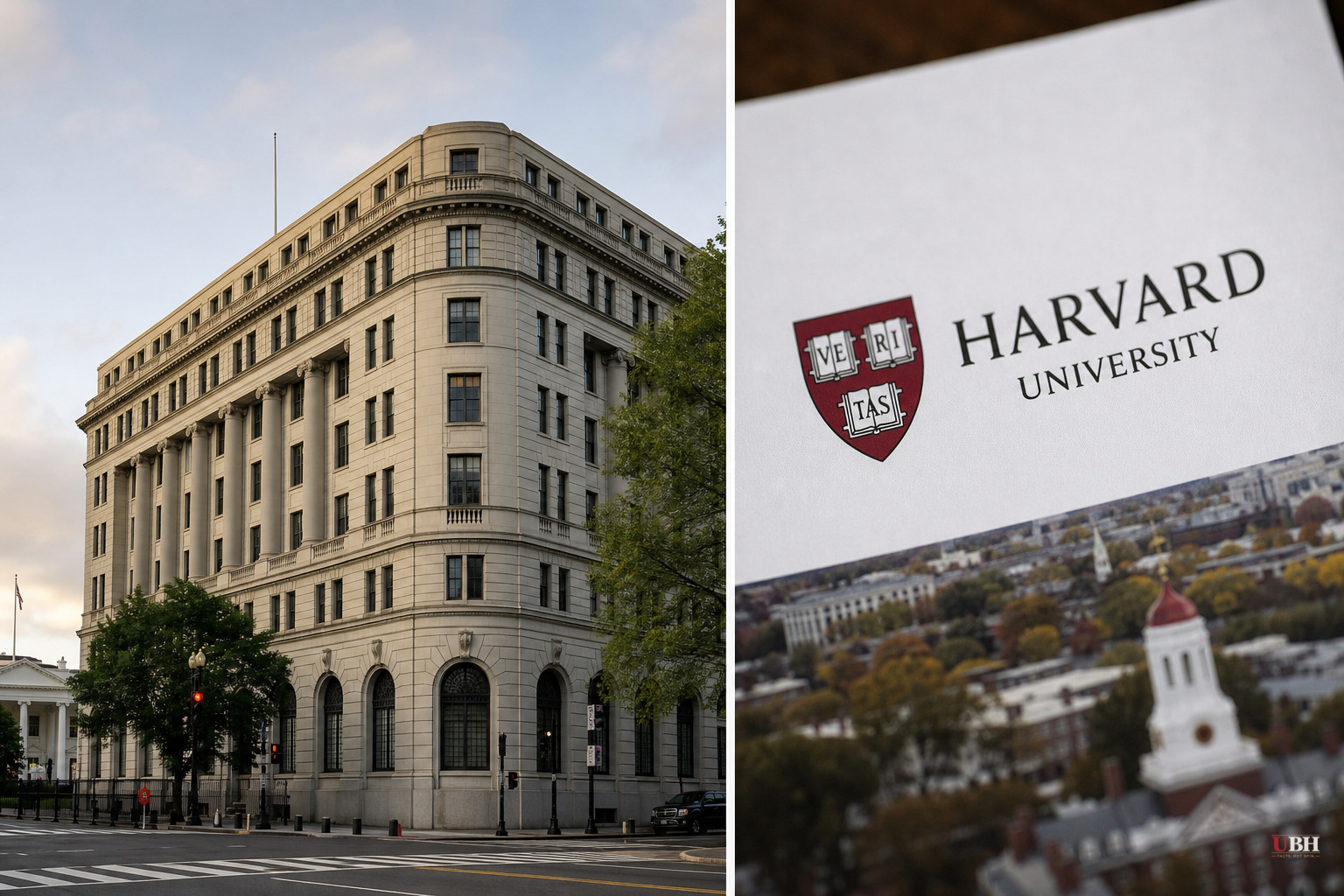
A former Chinese state security official now owns a 100-year-old building 650 feet from the White House. Harvard, meanwhile, spent years publishing joint research with universities the Pentagon considers pillars of China's military buildup. Neither situation is illegal on its face. Both are drawing bipartisan alarm bells for the same reason: proximity and access.
The building near the White House
Philip Qiu, also known as Qiu Feili, purchased the Securities Building at 729 15th Street NW on July 21, 2026, for $8.4 million through the Philip Qiu and Family Foundation, according to a Daily Caller News Foundation investigation cited by Radar Online, Ground News, and Heartlander News. The building sits roughly 650 feet northeast of the White House grounds.
Qiu's résumé, based on university records and DCNF translations of Chinese government announcements, includes a stint as a detective on Shanghai's Criminal Investigation Team, a unit inside Shanghai's Public Security Bureau, which DCNF describes as the local arm of China's Ministry of Public Security, the rough equivalent of the FBI. He has also held roles tied to the United Front Work Department and the Ministry of State Security, according to the same reporting.
A 2024 University of New Haven Instagram post cited by Heartlander News says Qiu began his career as a Shanghai detective. Photos from Shanghai Jiao Tong University, where Qiu enrolled in a master's program in October 2011, reportedly show students in camouflage carrying rifles during a team-building exercise, according to DCNF's translations.
Qiu did not respond to multiple requests for comment, per DCNF's reporting. In 2021, according to a DCNF translation of a Chinese intelligence-arm announcement, Qiu said: "The CCP is like a kind, but firm parent. It has guided our people out of hardship, led China's sons and daughters to build a new country and is steering us toward great national rejuvenation."
Qiu's foundation reportedly also controls a nearby property that hosts the Chinese American Museum, which Ground News says has hosted events co-sponsored by Chinese government agencies.
Former CIA operations officer Bryan Dean Wright told DCNF the building's location makes it a potential platform for surveillance. "This property allows access for big splashy intel ops as well as for more classic ops, like a listening post or Stingray-like systems to collect phone calls, text messages, and digital exhaust," Wright said. He added that it could also enable "hidden drone swarms or shipping container missiles," calling the property a place "where the next 9/11 will come from."
No charges have been filed against Qiu. No investigation into this specific purchase has been publicly announced by the FBI, DHS, or any other federal agency, based on the available reporting. Wright's assessment concerns theoretical capability, not evidence that any surveillance or operation is actually underway at the property.
Gordon Chang, the China analyst, told DCNF the ownership itself is the problem regardless of intent. "No Chinese citizen should be permitted to own, lease, or occupy any real estate that gives him or her the ability to surveil any sensitive federal installation," Chang said. "No ifs, ands, or buts."
Current U.S. law does not bar foreign nationals, including those with past government service in adversary nations, from buying commercial real estate near federal buildings, unless the property falls under specific restricted zones or CFIUS review triggers tied to critical infrastructure. Whether that gap should be closed is a legitimate policy debate.
Harvard's $600 million China problem
Separately, the House Select Committee on the Chinese Communist Party, chaired by Rep. John Moolenaar (R-MI), found that Harvard researchers co-authored more than 140 papers with China's so-called Seven Sons of National Defense universities, according to Fox News. The Pentagon and other U.S. officials have identified those schools as central to Beijing's military modernization effort.
Education Department data cited in the committee's report show Harvard received more than $600 million from China under Section 117 foreign gift disclosure rules, more than any other American university, according to Daily Wire's account of the report.
One example: a 2023 paper on bio-inspired underwater robots co-authored with a researcher at Beihang University, which has been on the Commerce Department's Entity List since 2001 over ties to China's aerospace and defense sector. Harvard's research compliance office called the project nonmilitary. The committee countered that soft-robotics work could still feed into underwater detection applications with military use.
Another paper involved a researcher from China's National University of Defense Technology, itself on a U.S. restricted list, examining magnetic materials, partly funded by the U.S. Army Research Office. Engineering was the most common subject area across the flagged collaborations, the committee found.
Harvard responded that it "shares the Committees' concern about geopolitical risks, including threats posed by the Chinese Communist Party," and said it follows federal national security standards for international collaboration.
What's actually unresolved
Neither story has produced criminal charges, sanctions, or a formal federal investigation as of this writing. The real estate purchase operates within current law. The Harvard research partnerships were disclosed, at least in part, under Section 117. The concern in both cases is structural: existing disclosure and property law wasn't built with an adversarial great-power rival in mind, and critics on the right and in national security circles argue that gap needs closing before, not after, something goes wrong.
The open questions are concrete. Will the Treasury Department's CFIUS process, or Congress, move to restrict foreign nationals with intelligence-agency backgrounds from buying property near federal buildings? Will Harvard face any funding consequences from the Education Department over the Section 117 findings? So far, based on available reporting, neither has happened.
Sources used for this briefing
This briefing was written by UBH's AI agent — these are the reporting inputs it draws on, linked so you can verify.

