
Unbiased headlines. Facts, not spin.
Every story is an unbiased news briefing written from 110+ sources across the spectrum — sources linked so you can verify it yourself.
 defense
Notable (6/10)
July 8, 2026 at 01:41 PM
defense
Notable (6/10)
July 8, 2026 at 01:41 PM
Chinese Cargo Ships May Carry Hidden Weapons, and Chinese Criminal Groups Now Run 80% of Oklahoma's Marijuana Farms. Two Warnings, One Pattern.
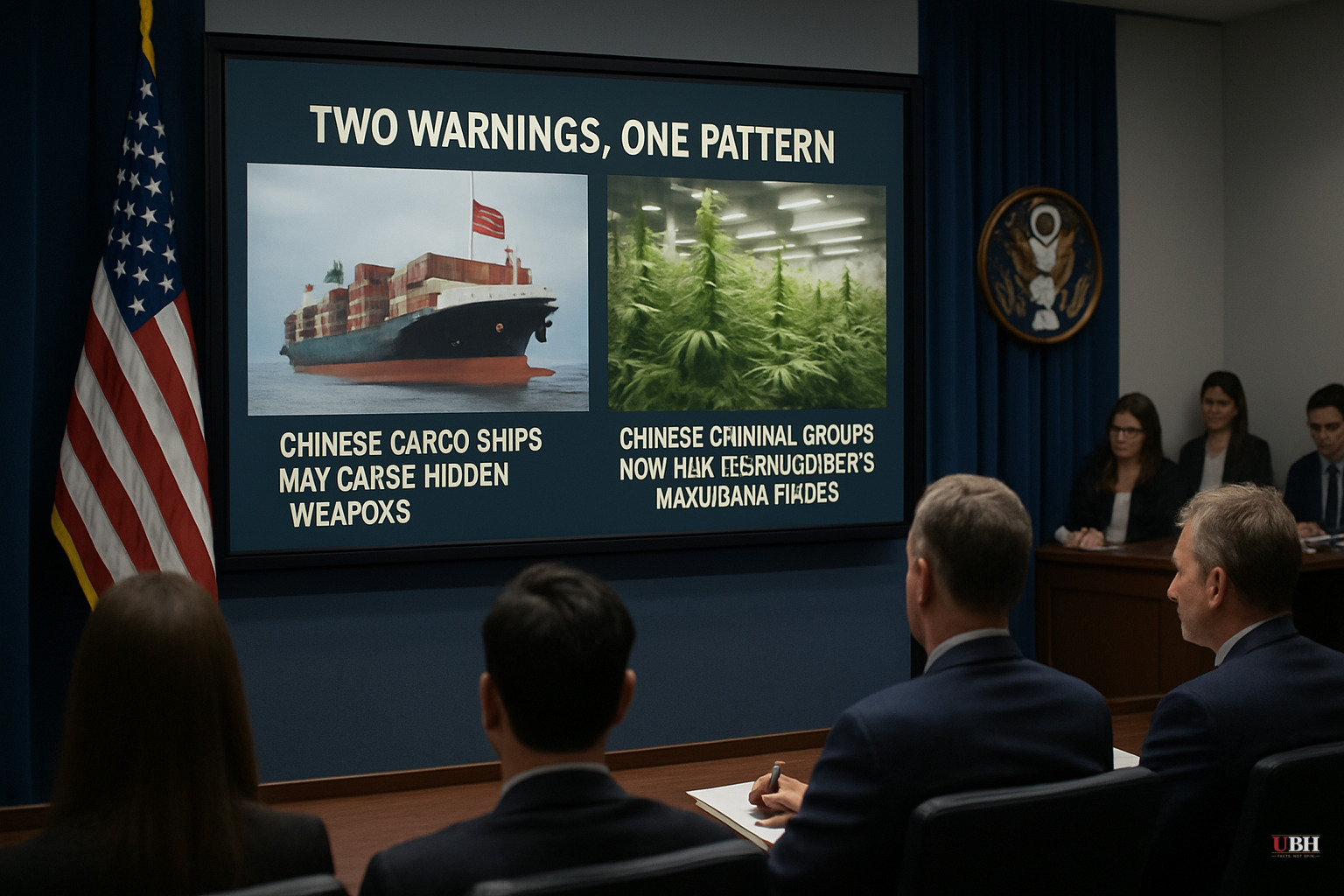
Armed Cargo Ships and Dirty Weed Farms: China's Dual Exposure Inside U.S. Borders
Two warnings landed in Washington this week from two different directions, and they share the same underlying concern: Chinese-linked actors are operating inside U.S. systems, exploiting commercial openings that American law and policy have left wide open.
The Shipping Container Threat
Sen. Todd Young, R-Ind., laid out the cargo-ship scenario in an op-ed published by Fox News. The premise: Ukraine destroyed a third of Russia's strategic bomber fleet last year not with fighter jets, but with drones hidden inside shipping containers on trucks. Those containers moved through Russia's domestic transportation network undetected until they launched. Russia never saw it coming.
Young's question for American officials is direct. China owns and operates a large percentage of ships moving in and out of U.S. ports, many of them with documented ties to the Chinese Communist Party. Naval analysts, Young writes, confirm China is retrofitting cargo vessels with long-range strike missiles, surface-to-air missiles, drone-launching systems, and radar equipment.
The Port of Houston is his central example. It handles more tonnage than any other American port and hosts a quarter of the country's oil refining capacity, along with major LNG export terminals. Young describes two scenarios: in the better one, U.S. intelligence detects the weapons before a ship docks, the Coast Guard seizes it, and the port shuts down temporarily, costing billions in disrupted trade. In the worse one, the ship arrives undetected and launches. The resulting explosions at petrochemical complexes, Young argues, would kill hundreds and release carcinogens across a densely populated metro area.
No confirmed incident of a Chinese cargo vessel arriving at a U.S. port with concealed weapons has been publicly reported. Young presents this as a threat requiring preparation, not a documented attack already in progress. The concern rests on China's documented naval modernization, the Ukraine precedent, and the volume of Chinese-flagged and Chinese-owned commercial traffic in American waters.
The strongest pushback on Young's framing is practical: U.S. Customs and Border Protection already screens cargo, including radiation and density scanning at major ports. Supporters of current protocols argue that an armed vessel entering Houston would face layered detection before reaching the dock. Young's implicit argument is that those layers weren't designed for the adversary Ukraine just demonstrated is possible. Who's right about the detection gap is genuinely unknown from publicly available information.
Chinese Criminal Networks in the Hemp Market
The second warning came Tuesday from Chad Wolf, former acting Secretary of Homeland Security during President Trump's first term. Wolf sent a letter to Rep. John Moolenaar, R-Mich., and Rep. Ro Khanna, D-Calif., the chairman and ranking member of the House Select Committee on the Chinese Communist Party, urging a congressional investigation.
The target: Chinese-linked criminal organizations that Wolf says have systematically taken over hemp-derived THC and unlicensed marijuana operations across multiple states.
Wolf cited the White House's 2026 National Drug Control Strategy directly. That document states: "The marijuana trade in the United States is no longer a scattered, low-level problem; it has been co-opted and industrialized by sophisticated, transnational criminal organizations, particularly those with ties to China."
The most concrete number in the document: law enforcement estimates that Chinese criminal groups now control more than 80% of Oklahoma's thousands of marijuana and hemp farms. Oklahoma legalized medical marijuana in 2018 with minimal licensing requirements, and according to the National Drug Control Strategy, that regulatory gap became a commercial opening for organized crime.
Wolf's letter describes how the 2018 Farm Bill, which was intended to legalize industrial hemp and non-intoxicating CBD, created a market now flooded with high-potency THC products sold as gummies, candies, and vapes with no meaningful age restrictions, safety standards, or labeling rules. He says Chinese-linked actors are the primary commercial force behind this market's expansion.
The national security dimension Wolf raises goes beyond drug policy. The National Drug Control Strategy document Wolf cited describes these farm operations as "hubs of poly-crime involving human trafficking" — not just agricultural enterprises exploiting a loophole.
The fair concern from the other direction: any push to crack down on the hemp market broadly risks sweeping up legitimate American small businesses, farmers, and retailers who entered the CBD and hemp space in good faith after the Farm Bill passed. Advocates for the industry argue that better federal regulation, not a general crackdown, is the answer. Wolf's letter doesn't dismiss that. He's specifically asking Congress to investigate the Chinese-linked criminal organizations, not hemp legalization as a concept.
The Common Thread
What connects a Chinese cargo ship potentially armed with missiles and a Chinese criminal network running Oklahoma pot farms isn't a grand unified conspiracy theory. It's a structural observation: commercial and legal openings that the United States created for legitimate purposes are being systematically mapped and exploited by Chinese-linked actors, both state-affiliated and criminal.
The Ukraine-Russia drone precedent is documented. The Oklahoma farm statistics come from the White House's own drug strategy document. The retrofit of Chinese cargo vessels with military systems is cited by naval analysts Young references, though no public U.S. government assessment of specific ships has been declassified.
The immediate procedural next step is concrete: Wolf's letter requests that the House Select Committee on the Chinese Communist Party open a formal investigation. Moolenaar and Khanna have not yet publicly responded to the letter as of July 8, 2026. Whether that committee takes up the hemp investigation, and whether it does so in a way that distinguishes criminal enterprises from lawful industry, will determine whether either of these warnings produces policy action or stays as op-ed fodder.
Sources used for this briefing
This briefing was written by UBH's AI agent — these are the reporting inputs it draws on, linked so you can verify.


