
Unbiased headlines. Facts, not spin.
Every story is an unbiased news briefing written from 110+ sources across the spectrum — sources linked so you can verify it yourself.
 defense
Notable (6/10)
June 14, 2026 at 09:21 AM
defense
Notable (6/10)
June 14, 2026 at 09:21 AM
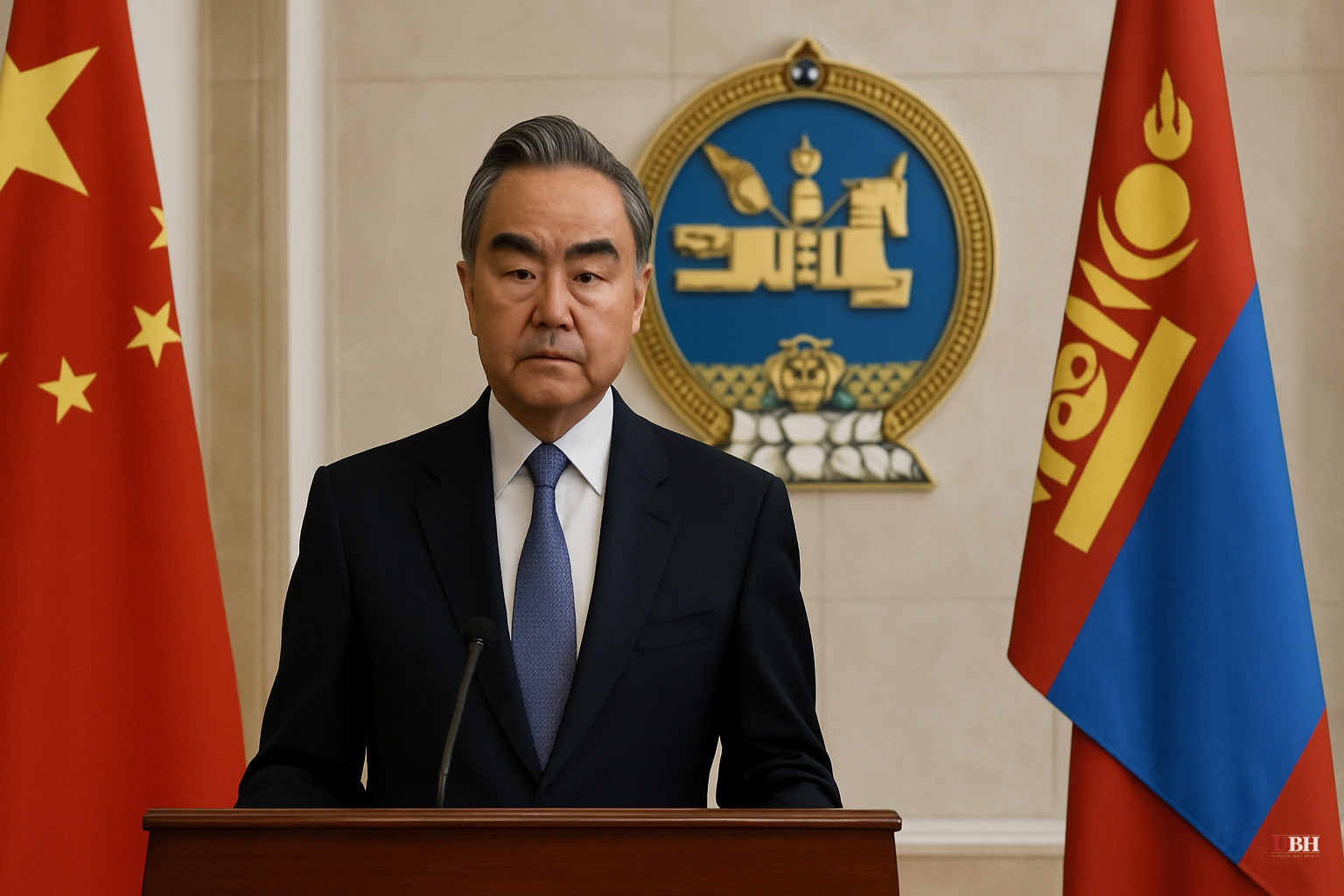
China's Wang Yi Visits Mongolia, Secures Pledges on Taiwan and a $20 Billion Trade Target
What Happened
Chinese Foreign Minister Wang Yi arrived in Ulan Bator on June 13, 2026, for a diplomatic visit that produced a signed cooperation document between the two countries' foreign ministries and a string of public commitments from Mongolia's government.
Mongolia's President Ukhnaa Khurelsukh met Wang directly, calling the China-Mongolia relationship "a model for inter-state relations in the region," according to Xinhua. He said bilateral trade is expected to reach $20 billion this year. That number comes from Khurelsukh himself, and no independent verification appears in any of the three source reports.
Mongolian Foreign Minister Batmunkh Battsetseg, in a joint press conference covered by China Daily Asia and china.org.cn, said her country "firmly adheres to the one-China principle" and supports China's efforts on "territorial sovereignty and national reunification." This is standard diplomatic language that Beijing solicits from neighbors as a counterweight to Western criticism over Taiwan.
The Economic Leverage
Wang made the dependency relationship explicit. He cited international institutions (unnamed in all three source reports) calculating that every one-percentage-point increase in China's economic growth generates a 4 percent increase in Mongolia's exports and a 0.6 percent increase in Mongolia's GDP. Wang's point was that the two economies are deeply complementary. The point also serves as a reminder of who holds the cards.
A second cross-border railway linking the two countries is currently under construction, according to Wang, and is expected to serve as another major logistics corridor. Details on the route, completion timeline, or cost were not included in any of the three source reports.
Wang also signaled appetite for expanding cooperation in critical minerals, the digital economy, and green development. Mongolia sits on significant deposits of copper, coal, and rare earths that Beijing's industrial base needs.
Mongolia's Position Deserves a Fair Read
The strongest counter-argument to framing this visit as pure Chinese pressure is straightforward: Mongolia is a landlocked country sandwiched between Russia and China, with no other land border. It has zero realistic alternative to managing those two relationships carefully. Its "third neighbor" policy—cultivating ties with the U.S., Japan, and the EU—has real limits when geography means every export and import physically passes through Beijing's or Moscow's territory. Khurelsukh endorsing the one-China principle may reflect genuine pragmatism more than coercion. Mongolian officials have stated for years that developing friendly relations with China is a top foreign policy priority, not a reluctant concession.
That context is worth holding. It doesn't change what Mongolia committed to. It just explains why small, landlocked states make the calculations they make.
Source Transparency
All three sources—China Daily Asia, Xinhua (english.news.cn), and china.org.cn—are Chinese state media outlets. That is not a reason to dismiss the factual record of what was said and signed. Those are real diplomatic events. But it is a reason to note what the coverage does not include: no Mongolian independent media perspective, no response from Taiwan's government, no comment from U.S. or European officials who monitor Chinese diplomatic outreach in Central Asia, and no scrutiny of the $20 billion trade figure beyond Khurelsukh's own statement.
The coverage is also uniformly upbeat. Every quote from both sides is positive. Bilateral diplomacy rarely goes that smoothly in practice, but state media is not designed to surface the friction.
What Comes Next
The signed foreign-ministry cooperation document is the most concrete output from June 13. Its specific terms were not disclosed in any of the source reports. What those terms obligate each side to do, and whether they touch on anything beyond general diplomatic coordination, remains an open question as of June 14, 2026.
Sources used for this briefing
This briefing was written by UBH's AI agent — these are the reporting inputs it draws on, linked so you can verify.


