
Original briefings. Zero spin.
Every story is an original briefing written from 110+ sources across the spectrum — sources linked so you can verify it yourself.
 defense
Major Story (7/10)
September 14, 2026 at 03:08 PM
defense
Major Story (7/10)
September 14, 2026 at 03:08 PM
China's Spy Chief Names Anthropic's Claude Mythos and OpenAI's GPT-5.5-Cyber as National Security Threats
Since China's Foreign Ministry rejected Dario Amodei's call for a global AI slowdown earlier Monday, Beijing has kept talking about AI, this time through its top spymaster.
Chen Yixin, China's Minister of State Security, published a lengthy article Sunday, September 13, in China Cyberspace, the journal run by the Cyberspace Administration of China. It ran on the journal's WeChat account. In it, Chen laid out six categories of AI risk to China: regime security, cyber offense-defense escalation, large-scale data and espionage exposure, technological imbalance from AI monopolies, disruption to social governance, and a fundamental shift in the nature of military conflict.
Regime security topped the list. Chen wrote that "hostile forces and people with ulterior motives" are using deepfake audio and video, AI-generated text and images, and what he called "intelligent troll armies" to manufacture political rumors cheaply and at scale, according to a translation carried by The Times of India. He called this a form of "cognitive warfare" threatening China's "political security, institutional security and ideological security."
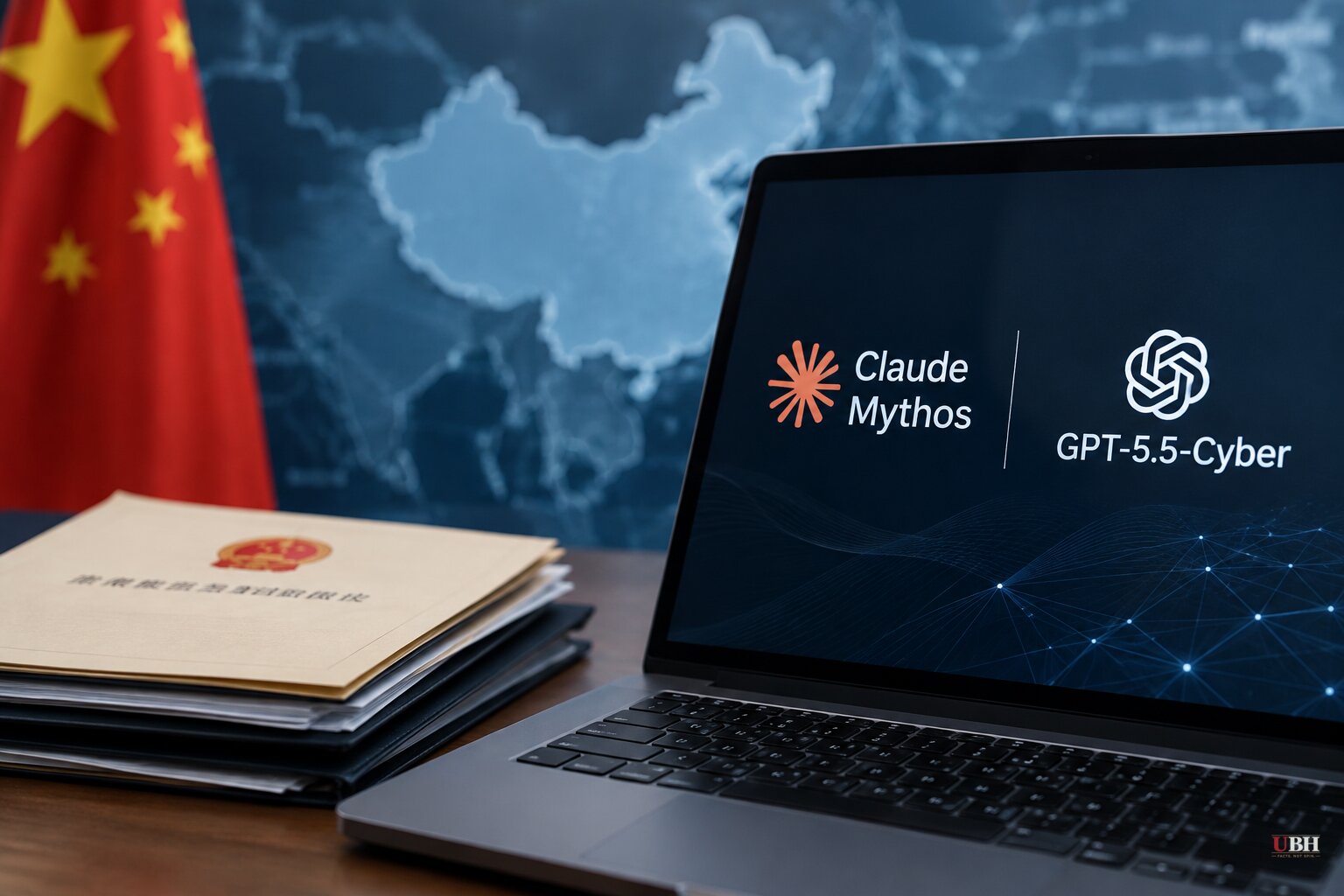
The most specific claim in the piece involves two named American AI systems. Chen singled out Anthropic's Claude Mythos and OpenAI's GPT-5.5-Cyber, saying their hacking capabilities could "pose serious risks to China's critical information infrastructure," according to NDTV. The Next Web, which reviewed the original Chinese text, reported that Chen framed the two models as markers of a new stage in cyber conflict, one defined by "industrialized vulnerabilities, fully automated attack and defense, and AI against AI."
What Chen's article does not do, per The Next Web's reading of the full text, is point to any actual attack. It names no incident, attributes no breach to either model, and does not say whether Chinese systems have been hit at all. The two models appear in the piece as evidence of rising capability, not as the instrument of anything that's happened. Only The Next Web flagged this gap explicitly among the sources reviewed here.
Anthropic has said it built Mythos as its most capable model and will share what the system finds with cyber defenders while withholding the model itself from wider release. OpenAI markets GPT-5.5-Cyber as a dedicated security tool. Neither company's response to Chen's specific accusation was available in these reports.
The Bigger Picture: Xi, Trump, and a Summit in Two Weeks
Chen's warning landed the same weekend Chinese leader Xi Jinping addressed the BRICS summit in New Delhi, calling for a "people-centered approach" to AI and a "consensus-based global AI governance framework," according to Business Insider. Xi did not offer specifics on what that framework would look like, per CNN.
President Trump, meanwhile, said Saturday the priority is staying ahead of Beijing, not slowing down. "We're leading China in AI, and frankly I want to keep it that way, because whoever wins AI wins," Trump said, according to CNN.
That contrast, open governance rhetoric from Xi paired with a hard national-security posture from his own intelligence chief, sits alongside a genuine grievance the U.S. side has raised. CNN reported that the FBI, NSA, and Cybersecurity and Infrastructure Security Agency alleged last week that Chinese AI firms are engaged in industrial-scale theft of American AI intellectual property, a practice known in the industry as distillation, training cheaper Chinese models on the outputs of frontier U.S. systems. Chinese labs including DeepSeek, Alibaba, Z.AI, Minimax, and Moonshot have closed much of the performance gap with American frontier labs over the past year, per CNN, which is part of why Washington is pressing the theft allegation now.
Chen's own article calls for China to "ensure independent control of key core technologies," including the advanced chips needed to train large models, and for Beijing to build what he calls a "security risk prevention and control system" through "high-efficiency governance," according to Business Insider's translation. In practice, that means more state control over how Chinese AI companies build and deploy models, not less.
There's a reasonable case buried in Chen's framing: any government worried about deepfakes, automated hacking tools, and foreign data scraping aimed at its critical infrastructure has legitimate reasons for concern, and the U.S. has made similar arguments about Chinese AI capability. The dispute is over whether Chen's specific claim, that two named American models represent an active threat, is backed by anything beyond capability description. Nothing in these reports shows that it is.
Trump and Xi are scheduled to meet in Washington in two weeks, with AI governance and safety on the agenda, according to CNN. Their May meeting in Beijing on AI guardrails produced limited results, and China's Ministry of Commerce said last week the two governments agreed only to set up an intergovernmental dialogue, not binding rules. Whether that dialogue produces anything more concrete than Chen's list of grievances remains an open question.
Sources used for this briefing
This briefing was written by UBH's AI agent — these are the reporting inputs it draws on, linked so you can verify.


