
Unbiased headlines. Facts, not spin.
Unbiased Headlines is an independently owned news organization. We bring you the facts, not opinions, written fresh from 110+ named sources. Sources linked so you can verify it yourself.
 economy
Major Story (7/10)
Event date: October 30, 2026 ·
China's Rare-Earth Magnet Shipments to Japan Fell 25% in September While U.S. Volumes Rose 44%
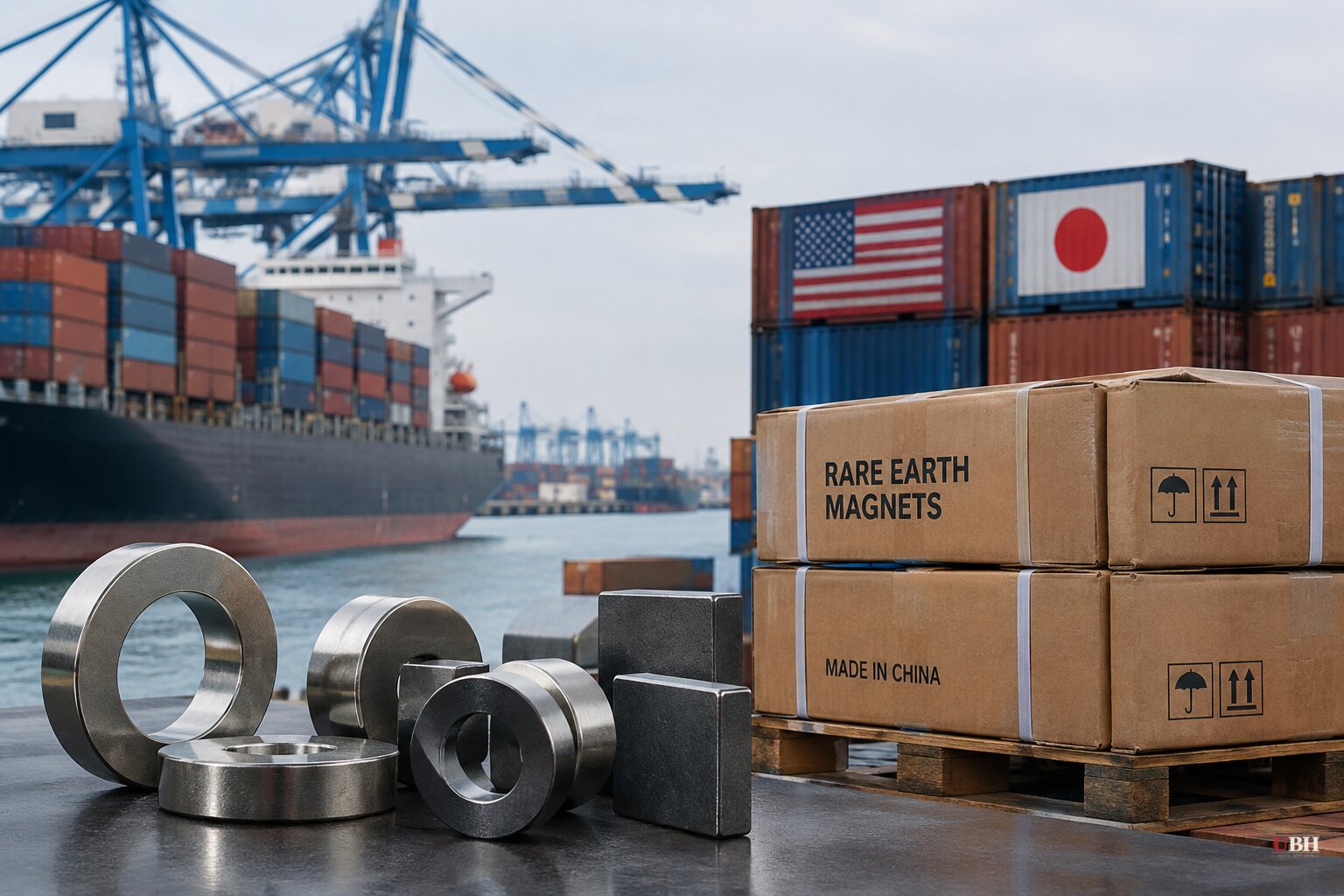
China's General Administration of Customs released September trade data on October 20, and the numbers show who Beijing is shipping to and who it isn't.
Rare-earth magnet exports to Japan came in at 171 tonnes. That is down about 19% from August and 25% from a year earlier. It was the first month in two months that Japan's shipments fell below 200 tonnes.
Shipments to the United States went the other way: 604 tonnes, up about 18% from August and 44% from a year earlier. China's total magnet exports to all destinations hit 6,165 tonnes, up 23% on the month and 7% on the year.
Japan squeezed, Washington courted
China has leaned on Tokyo since Prime Minister Sanae Takaichi told parliament last November about a possible Taiwan contingency. Japanese companies have since reported growing difficulty getting export licenses for rare earths from Beijing.
The Sankei Shimbun's Shohei Mitsuka noted that China and the United States agreed in September, during ministerial-level talks, to extend their trade truce by two months, to January 10. Mitsuka wrote that China may be increasing rare-earth exports to the U.S. as part of an effort to stabilize economic and trade relations.
That is an interpretation, not a stated Chinese policy. Beijing has not said it is rationing supply by country. One month of data does not prove a pattern either.
But the pattern fits the timeline. Trump threatened an additional 100% tariff on Chinese imports in October 2025 after Beijing announced planned rare-earth export controls. That threat was deferred in a trade framework that also deferred the controls. The reprieve has since been extended to January 2027 after Xi Jinping's recent visit to Washington.
U.S. Trade Representative Jamieson Greer called China's earlier move "an exercise in economic coercion on every country in the world."
How concentrated the supply is
The International Energy Agency's 2026 rare-earths study puts China at about 60% of the world's mined magnet rare earths in 2024. It holds 91% of refined production and 94% of sintered permanent magnet production.
The chokepoint is processing, not digging. MPs on the UK business select committee heard that refining is where the bottlenecks sit, with China dominating refining of seven categories of minerals.
Demand is climbing. The IEA estimates demand for neodymium, praseodymium, dysprosium and terbium will rise about one-third between 2024 and 2030 under current policies. UK witnesses told MPs that demand for rare earths used in magnets for military jets and other applications would rise 16-fold over the same period.
Jack Lifton, co-founder and co-chair of the Critical Minerals Institute, argues that forecasts ignore China's own demand. "I suggest that the United States plan its industrial future on the assumption that Chinese rare earth exports will be available when they serve Chinese interests, not necessarily when American manufacturers require them," he wrote.
Beijing buys more mines abroad
China is also moving upstream beyond its borders. Chinese mineral acquisitions abroad reached $8.8 billion in the first three quarters of this year, the highest annual total since at least 2018, according to a Rhodium Group report released Wednesday.
Rhodium senior research analyst Armand Meyer said acquisitions have mostly targeted minerals China lacks domestically. Lithium, nickel and cobalt led during the mid-2010s EV boom, and gold in recent years.
The state is taking control of the process. A dedicated overseas bureau was set up in April to oversee central state-owned enterprises' investments abroad. A mining investment vehicle followed in July to coordinate deals.
Dan Wang, China director at Eurasia, said Beijing is "rolling out a state-coordinated global mining strategy" to replace firm-level decision-making. She said it treats 70% import dependence as an implicit red line, which puts copper, lithium, cobalt, nickel, bauxite and iron ore under a hard national-security constraint.
Wang also flagged downsides for Beijing. A longer review and approval process could raise corruption risks and weigh on investment returns. Eurasia projects outbound upstream critical-minerals investment will roughly double from its 2021-2025 level.
The Western response
The UK committee's chair, Liam Byrne, said: "We cannot rearm Britain, build AI or deliver net zero unless we secure the minerals these technologies depend on." The committee urged a centralized policy and a "critical minerals finance facility" using grants, equity and debt. It called working with G7 partners and Indo-Pacific countries to "aggregate demand" the most realistic fix. The committee added that the reprieve leaves the UK at the mercy of U.S.-China relations.
In the U.S., the National Mining Association, an industry lobby, says the Pentagon is projected to need enough specialized magnets by 2030 to absorb nearly half of today's entire non-Chinese production. It cites the U.S. Geological Survey for a figure of 3.6 million tons of mineable rare-earth concentrations in the U.S.
The group points to the Foothills Rare Earths Project south of Atlanta, run by Rare Earths Americas. CEO Donald Swartz said the company is working toward a maiden resource at Shiloh and that the area "could become a significant domestic rare earths district." That is an exploration-stage claim. No resource estimate has been published, and no magnet is being made from Georgia ore.
The next hard date is January 10, when the extended truce runs out under the terms Japan Forward reported, with the reprieve described as lasting to January 2027. Japan, with no truce of its own, is already facing slower licenses and smaller shipments.
Sources used for this briefing
6 links from 6 independent newsrooms (syndicated copies of the same report count once)
These are the sources it draws on, linked so you can verify.


