
Unbiased headlines. Facts, not spin.
Unbiased Headlines is an independently owned news organization. We bring you the facts, not opinions, written fresh from 110+ named sources. Sources linked so you can verify it yourself.
 economy
Breaking / Critical (9/10)
Event date: November 5, 2026 ·
S&P 500 Drops 4.4% Thursday, Two Days After Democrats Win Congress, as AI Stocks Sell Off
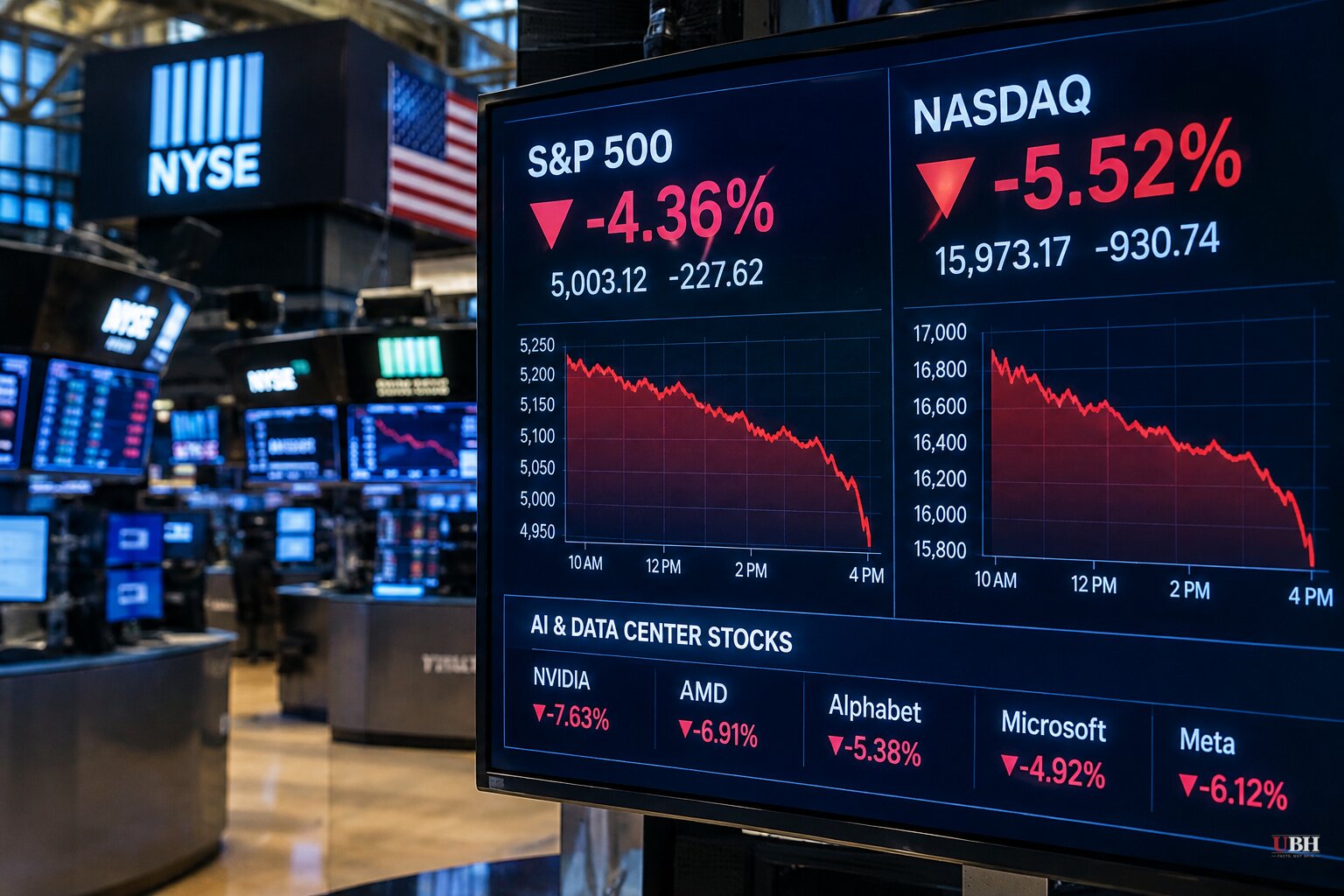
Wall Street gave back its post-election gains in one session.
The S&P 500 closed down 4.36% at 7,353.73 on Thursday, Nov. 5. The Nasdaq fell 5.52% to 24,315. The Dow dropped 1,833 points, or 3.44%, to 51,523.06, which erased all of Wednesday's roughly 1,500-point gain. By Daily Wire's tally, S&P 500 companies lost a record $2.9 trillion in market value and the Nasdaq lost $2.5 trillion.
That followed a relief rally. After Democrats took both the House and Senate in the Nov. 3 midterms, the Dow rose about 3% on Wednesday, the S&P 500 gained 1.6% and the Nasdaq added 1.4%.
Where the selling hit
The damage was concentrated in AI. Nvidia shares slid 9%, a loss of about $374 billion in market value. Tesla and Microsoft lost $161 billion and $117 billion. Broadcom fell 10% and Oracle fell 7%.
Qualcomm dropped 9% on a gloomy forecast, even though it beat earnings estimates. Nebius, which rents out AI computing power, fell 15%, and CoreWeave fell 10%.
One money manager estimated that 401(k) accounts shed about 4% in a day. That is an estimate, not a measured figure.
Asian markets showed the same pattern. Japan's Nikkei fell around 3%, yet roughly 95 of its 225 members closed higher. Korea's Kospi dropped as much as 4% before finishing 0.6% higher. Memory makers, chip-equipment suppliers and server builders were sold. Banks and consumer names were barely touched.
Why data centers are in the crosshairs
The political backdrop is real. Sen. Bernie Sanders is demanding a "national data center moratorium now." Rep. Greg Casar (D-TX) wants to halt new construction. Rep. Ted Lieu (D-CA) has promised public hearings and new AI "guardrails."
In Texas, which holds roughly a quarter of the nation's planned data-center capacity, Gina Hinojosa ousted Gov. Greg Abbott after campaigning on a pause for new projects, according to Daily Wire. Asia Times reports that more than half of American voters said data centers weighed heavily on their vote, mostly because of rising power bills.
Tech analyst Dan Ives has warned the buildout will slow sharply through 2028. Daily Wire says UBS estimated about 30% of planned capacity could be affected.
There is a competing read. In a Nov. 2 note, before the vote, UBS said it did not expect a change in congressional control to derail data-center expansion, because many of the decisions are made at state and local levels. The firm also noted that narrow majorities and the president's veto power limit the odds of sweeping legislation.
Stephen Brown of Capital Economics made a similar point after the results. The size of the Democratic gains "does not change too much for the near-term policy outlook," he said, since the party lacks a filibuster-proof Senate majority and President Trump can veto bills.
An Asia Times analysis called the concern behind the selling "legitimate, even if the panic was overdone." It noted that orders already placed are not going away.
Trump's response
Trump called the slide "a sad thing to watch" on Thursday evening and blamed Democrats. "Your 401(k)s have, therefore, dropped. Remember, it wasn't Republicans, it was Dumocrats," he said.
Vice President JD Vance took a different line. His lengthy statement blamed Republican election losses on the Iran war. Dan Coatsworth, head of markets at AJ Bell, read that as "an admission from the Republican camp that the Iran war cost them a clean sweep."
Oil and rates
The Iran war is the other big market variable. ICE Brent crude fell 8.7% on Wednesday and closed below $100 a barrel for the first time since September. Traders took the result as raising the odds that Trump seeks a deal to end the war, which would help restore Gulf refinery capacity.
Bond markets moved too. The 10-year Treasury yield fell six basis points to around 4.9%, and the dollar slid. Gold recovered above $4,000 an ounce.
The Federal Reserve, Bank of England, European Central Bank and Bank of Japan have all raised rates in recent months, in part because of war-driven energy prices. Andrew Slimmon of Morgan Stanley said a resolution that brings oil down would ease what has been "an issue for the Fed and inflation."
Ralph Axel, rates strategist at Bank of America, wrote Thursday that oil and global rates are tightly correlated. If crude rises over the next three to six months, he expects "significantly higher interest rates," especially in the U.K. and Germany.
Crude ticked up Thursday and has been choppy Friday, per CNBC. Futures on the Nasdaq and S&P 500 were slightly higher this morning and Dow futures were lower, according to Daily Wire. Those are pre-market indications. The regular session opens at 9:30 a.m. ET.
Whether Trump moves toward a deal with Iran is now the key uncertainty for oil, and through oil for the rate path that markets are trying to price.
Sources used for this briefing
7 links from 7 independent newsrooms (syndicated copies of the same report count once)
These are the sources it draws on, linked so you can verify.


