
Unbiased headlines. Facts, not spin.
Unbiased Headlines is an independently owned news organization. We bring you the facts, not opinions, written fresh from 110+ named sources. Sources linked so you can verify it yourself.
 economy
Notable (6/10)
Event date: November 4, 2026 ·
India vows to fight EU carbon border tax at COP31 as Brussels moves to widen it
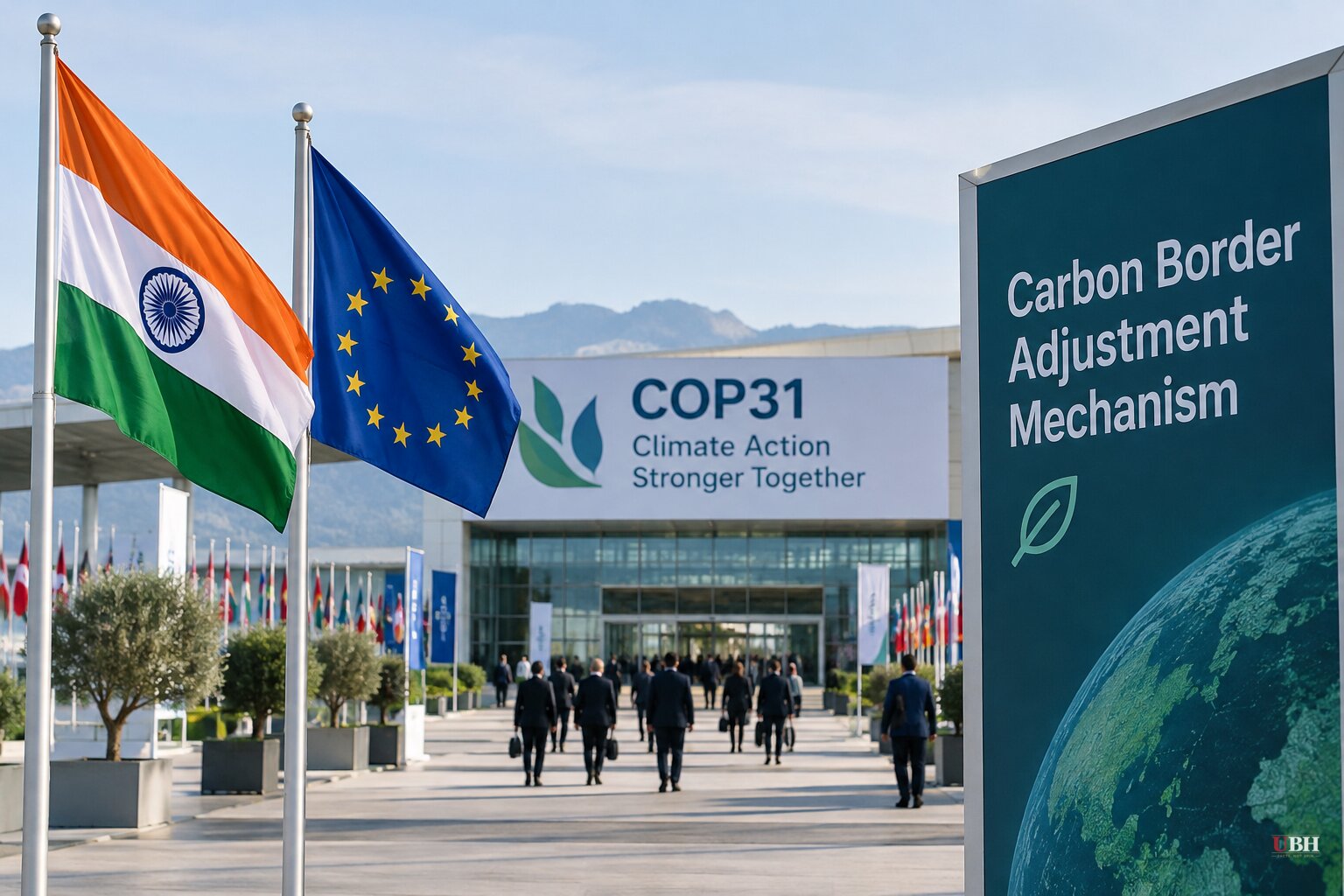
India is heading into the COP31 climate summit in Turkey with a clear message for Brussels: the EU's carbon border tax is a trade barrier, and New Delhi will say so.
Environment Minister Bhupender Yadav said Tuesday, Nov. 3, that India will stay committed to protecting its domestic industry against "unilateral trade barriers" such as the EU's Carbon Border Adjustment Mechanism, or CBAM. "On CBAM, we will stand by our position," he told Indian media. "When it comes to protecting India's interests, that is what we speak about most strongly."
Yadav will lead India's negotiators to Antalya. The summit runs Nov. 9 to 20, with a leaders' segment scheduled for Nov. 11-12. Turkey's presidency has invited Prime Minister Narendra Modi. Whether he will attend is not yet clear.
What CBAM does
CBAM entered its operational phase on Jan. 1, 2026. It covers imports of aluminum, cement, fertilisers, hydrogen, iron and steel, and effectively obliges operators to pay for the CO2 emissions linked to their production.
Brussels argues the mechanism prevents EU manufacturers from being undercut by imports produced under weaker climate rules. Developing economies counter that it is an unfair, unilateral measure that could penalise their industries and restrict their development. Foreign players do not need to pay for their emissions, but they must comply with monitoring and reporting, which they argue is too burdensome.
Shortly after launch, several EU countries sought temporary exemptions for fertilisers, warning that the tax would push up prices and could undermine food security. The European Commission did not concede the request.
India has opposed CBAM from the time it was conceived, arguing that such a unilateral move places an additional burden on businesses in developing economies because of the emissions embedded in their products. The BRICS nations, including China, Russia, South Africa and Brazil, formally opposed it at their September summit under India's chairship, calling such measures "unilateral, punitive, discriminatory and protectionist."
Asked whether the India-EU Free Trade Agreement would change India's position, Yadav said: "We have cleared our stand again and again. And we are committed to India's interests and protection." Down to Earth reports that although India-EU FTA negotiations concluded in January 2026, the agreement does not give India a blanket exemption from CBAM.
Goyal's cost-of-living argument
India's Commerce Minister Piyush Goyal has made the sharper economic case. Speaking at the Berlin Global Dialogue, he said: "If you have put a CBAM on yourself, you put a 50% import duty to bring steel into your country, you are inviting disaster. Your cost of living will go up. Your people will be unhappy. Your industry will be out-priced."
The 50% figure is Goyal's characterization of the tax's effect on steel.
The EU's own member states raised the price concern first, when they asked for the fertiliser carve-out. Brussels argues the tax levels the field for European producers. Both claims are now live in the same negotiation.
Brussels is expanding, not retreating
The timing is awkward for the EU. Negotiators are working on extending CBAM to more products, including washing machines and car parts. They are also tightening rules meant to stop companies from circumventing the tax.
The next round of political talks among the EU co-legislators, the European Council and the European Parliament, is slated for Nov. 20. That is the last scheduled day of COP31.
Resistance is also growing beyond India. Canada is trying to negotiate a CBAM exemption with the EU. The United Kingdom is in talks with EU officials to link its carbon market to the EU's Emissions Trading System, which a UK Treasury minister said would create the conditions for mutual CBAM exemptions. Russia has an open dispute against CBAM at the World Trade Organisation, and Russia and China announced on Nov. 3 that they will join forces at COP31 against unilateral trade barriers.
Fossil fuels and the electrification pledge
CBAM is not India's only sticking point. Yadav said India will not support any move to phase out fossil fuels, citing the country's energy requirements for its development goals. He also said India will play a "constructive and bridge-building role" and wants an outcome that moves from commitments to implementation and support.
The Turkish presidency is pushing a "35-by-35" goal. It would raise electricity's share of global final energy demand from about 23% today to 35% by 2035. Down to Earth reports that Yadav told reporters on Nov. 3: "We are not going to sign any pledge. This is their agenda." He said India's official position would be communicated at COP31.
The Times of India reports that Yadav preferred not to comment on the goal itself. He said voluntary initiatives under the presidency's Action Agenda should remain separate from negotiations, and that uniform global targets must respect national circumstances.
Yadav also said climate finance will be a key priority, with India seeking a COP31 decision to commence the Climate Finance Work Programme. He said finance is an obligation of developed countries under the Paris Agreement and must be "predictable, largely public and concessional."
The summit also comes alongside a voluntary roadmap on transitioning away from fossil fuels, released by Brazil's COP30 Presidency under President André Aranha Corrêa do Lago. It says countries must develop national plans to reduce dependence on coal, oil and gas. The document sets no new commitments or national targets. It draws on 267 submissions, including from countries or groups representing 115 nations.
The roadmap says fossil fuels account for about 73% of global greenhouse gas emissions, which reached 57.7 billion tonnes of CO2 equivalent in 2024. It faces questions over financing, implementation timelines and accountability.
The host's own energy mix
Turkey's credibility as host is also under scrutiny. Its Energy Ministry says coal remained the country's largest source of electricity last year at 33% of generation. Solar and wind together supplied nearly 23%.
Duygu Kutluay of the advocacy group Beyond Fossil Fuels said Turkey's renewable plans contain "neither a roadmap for a coal phase-out, nor any planning for a phase-out of other fossil fuels, including gas." She said that is not compatible with Turkey's pledge to reach net zero by 2053.
Australia will chair the formal negotiations under a compromise reached at COP30 in Belém. Amnesty International has said both countries must show credible climate leadership. It points to Turkey's continuing reliance on coal and Australia's continued support for fossil fuel extraction.
The backdrop is rough. The Iran war has driven up gas and oil prices and sharpened energy-security worries. In September, according to Amnesty, the United Nations acknowledged for the first time that the world is set to overshoot its 1.5°C warming target within the next few years.
What to watch
India's position puts a trade dispute inside a climate conference. CBAM is an EU law, and COP31 has no mechanism to repeal it. The open question is whether Brussels will adjust the scope or pace of its expansion when EU negotiators sit down on Nov. 20, or push ahead as planned.
Sources used for this briefing
7 links from 7 independent newsrooms (syndicated copies of the same report count once)
These are the sources it draws on, linked so you can verify.


