
Unbiased headlines. Facts, not spin.
Every story is an unbiased news briefing written from 110+ sources across the spectrum — sources linked so you can verify it yourself.
 tech
Major Story (7/10)
Event date: September 16, 2026
tech
Major Story (7/10)
Event date: September 16, 2026
China's Open-Weight AI Models Sit Four Months Behind US Rivals, and Tesla Still Can't Get a Robotaxi Permit There
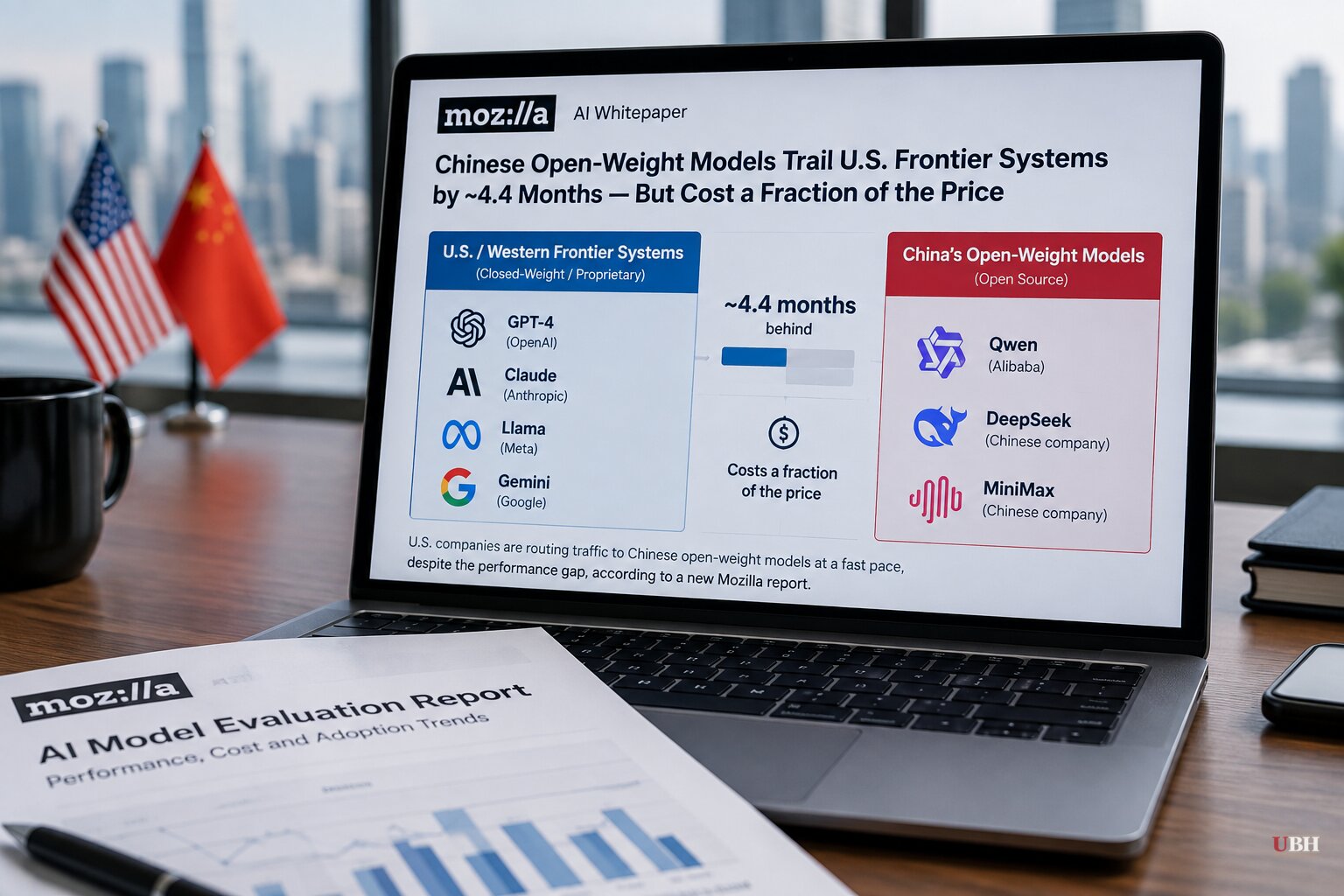
The gap is shrinking, and it's cheap
Mozilla published version 1.1 of its State of Open Source AI report on September 15, using data current through September 1. The headline number: leading Chinese open-weight AI models now trail the best closed American systems by roughly 4.4 months on a fitted measure of METR's task-horizon data, according to Ars Technica, which reviewed the report ahead of publication.
Mozilla CTO Raffi Krikorian told Ars that closed models still "earn their premium" on expert professional work, high-intensity retrieval, and long-context tasks, jobs that take a human expert eight to twelve hours. Below that threshold, Krikorian said, either category can usually get the job done.
The price gap is where things get stark. Moonshot AI's Kimi K3 scored three points behind Anthropic's Claude Opus 4.5 on the Artificial Analysis Intelligence Index while costing 30 percent as much, per Ars Technica. Z.ai's GLM-5.2 landed within one point of Claude Opus 4.7 on Vals AI's Terminal-Bench 2.1 benchmark, about four points behind Opus 4.8, at roughly one-fifth the cost per completed task, according to both Tom's Hardware and Ars.
Mozilla counted eight of the top ten models by August token volume on OpenRouter as open-weight, seven of them Chinese-built, Tom's Hardware reported. Yet closed providers still captured 96 percent of model-layer revenue on that same marketplace between May and September 2025, according to the Linux Foundation's figures cited in the report. Traffic share and revenue share are not the same thing.
Companies are already routing around the expensive stuff
Ars Technica reported that DoorDash uses Kimi for routine work and reserves Claude for harder tasks. Separately, reporting aggregated by daily.dev cited Uber cutting its cost per AI session by 52 percent through model routing, Pinterest getting cost per transaction under 8 percent of comparable closed-model pricing, and AT&T reporting up to 80 percent savings routing through open-weight alternatives via LiteLLM, with only about a 2 percent quality drop. Proprietary models' share of routed OpenRouter queries reportedly fell from roughly 60 percent to 25 percent within a few months, per that same aggregation.
Why Wall Street is watching
Anthropic and OpenAI are both working toward IPOs that analysts have pegged in the $1.5 trillion to $2 trillion range, according to 24/7 Wall St, which reported Anthropic's 2026 revenue run rate at roughly $65 billion, about seven times its 2025 revenue. 24/7 Wall St argues that if the market concludes Chinese open-weight models are close enough to American frontier systems, those valuations could take a hit, alongside separate concerns about the hundreds of billions of dollars committed to AI data centers and Bloomberg reporting on a wave of blocked US data-center projects. That's 24/7 Wall St's own analysis, not a fact established by regulators or company filings, and it should be read as one outlet's projection rather than a settled outcome.
Nvidia CEO Jensen Huang has said Chinese models are "excellent" and shouldn't be pushed out of the US market, according to 24/7 Wall St. On the other side, US politicians have moved to restrict Chinese AI tools like DeepSeek and Kimi over concerns the models could be used to gather intelligence on American users or systems. Those are stated concerns from named lawmakers, not findings from a completed investigation, and no charges or formal enforcement actions were cited in that reporting. The security worry is legitimate to raise given China's state-directed tech policy; it remains, for now, an allegation rather than a proven case.
Tesla's Cybercab: look, don't touch
Tesla's driverless Cybercab opened for public viewing today, September 17, at the Huamao Tesla Experience Center in Beijing and at HKRI Taikoo Hui in Shanghai, according to Tech Times. The Beijing display runs through September 27, Shanghai's through September 21. Both are static exhibits with no passengers and no commercial service planned in China.
The car itself has no steering wheel, pedals, or rearview mirrors, running entirely on eight cameras and Tesla's AI4 chip rather than the LiDAR-radar-camera combination used by Waymo, Baidu's Apollo Go, Pony.ai and WeRide. Tesla projects an operating cost around $0.20 per mile, about half what the company cited at its 2024 "We, Robot" event.
The camera-only approach is Tesla's biggest selling point and its most debated weakness. Rivals argue LiDAR provides redundancy cameras alone can't match in poor visibility or edge cases, a concern that remains unresolved in public testing data cited across these reports.
Baidu, Pony.ai and WeRide already run driverless fleets in more than 20 Chinese cities, per Tech Times. Tesla can't carry a single paying passenger there. Tesla's self-imposed Q3 2026 deadline to win full regulatory approval for commercial Full Self-Driving deployment in China expires September 30, thirteen days from today. Whether Beijing grants that approval, extends the runway, or leaves Tesla locked out of its own robotaxi ambitions in the world's largest EV market remains an open question.
Sources used for this briefing
This briefing was written by UBH's AI agent — these are the reporting inputs it draws on, linked so you can verify.


