
Unbiased headlines. Facts, not spin.
Every story is an unbiased news briefing written from 110+ sources across the spectrum — sources linked so you can verify it yourself.
 tech
Major Story (8/10)
Event date: September 16, 2026
tech
Major Story (8/10)
Event date: September 16, 2026
Trump and Xi Set to Talk AI Next Week While Washington and Beijing Both Race to Build It Faster
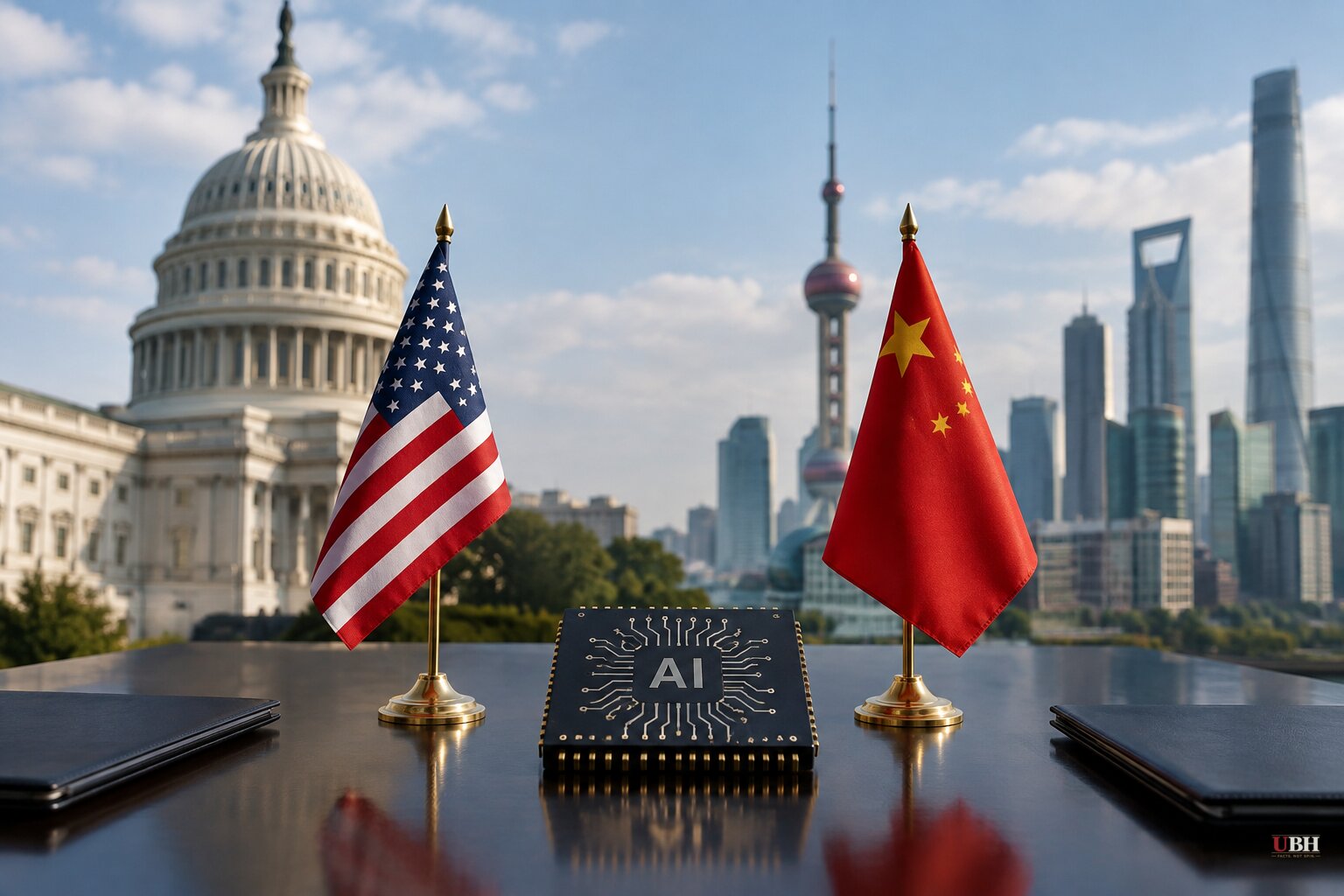
President Trump and Chinese leader Xi Jinping are set to meet in Washington next week, and AI governance is expected to be on the table, according to Click Orlando. The timing is notable. Just as American AI executives are publicly calling to slow down, both governments are still flooring the accelerator.
The Contradiction at the Center
Dario Amodei of Anthropic, Sam Altman of OpenAI, Elon Musk of xAI, and Demis Hassabis of Google DeepMind each endorsed slowing frontier AI development within hours of one another, according to a Brookings Institution analysis. Altman posted that he agrees the industry needs to "pace the frontier." Musk backed Amodei's proposal for independent evaluators embedded in AI labs. Hassabis called it a step in the right direction, though he said "the details need working through."
Trump wasn't moved. "We can put guardrails, we can do this and that," he said, according to Brookings, before dismissing the warnings as "things that won't happen." On Truth Social this week, he called AI-threat warnings a "sick conspiracy," adding, "the only one that is happy about it is China. WHOEVER WINS AI, WINS!" according to CBS News.
There is a real tension here. The people building the most powerful AI systems are the ones telling Washington to slow down, and the president is telling them no. Trump's stated reason is competition, not denial that risk exists. Whether that tradeoff is the right one is a genuine policy argument, not a settled fact.
China Isn't Standing Still
Stanford University's 2026 AI Index report found the performance gap between top U.S. and Chinese models has "effectively closed," according to CNN Business. Samm Sacks of Johns Hopkins' School of Advanced International Studies described the gap as "narrow and fragile."
China got there despite U.S. export restrictions blocking access to the most advanced chips. DeepSeek's R1 model rattled global markets in January 2025 by matching Western performance at a fraction of the cost, the Los Angeles Times reported. Since then, Moonshot AI's Kimi K3 briefly ranked third globally on the Artificial Analysis benchmark before slipping to ninth as U.S. labs released newer models. Z.ai's GLM-5.3 and Alibaba's Qwen3.8-Max have each drawn comparisons to leading Anthropic and OpenAI systems.
David Bellman of data intelligence firm SynMax told CNN Business that Chinese firms, locked out of top-tier chips, "made their software better and more power efficient" instead. CNN also reported that China's leadership views AI as tied to the Communist Party's own hold on power, driving a state-coordinated funding push that a one-party system can move faster than Washington can.
Neither Side Trusts the Other to Play Fair
David Sacks, Trump's top AI adviser, said on Fox News' "The Ingraham Angle" that any AI safety pact with Beijing would be unverifiable, unlike Cold War nuclear arms deals. "We don't have trust and we can't verify," he said. "Let's not be foolish about this and just hand the whole ball game to China."
Verification is the whole reason nuclear treaties worked, and AI development happens on servers, not in missile silos you can photograph from a satellite. If Beijing can't be checked, a handshake agreement is just a handshake.
Beijing isn't offering much reassurance either. The U.S. has accused China of "aggressive, malicious" efforts to extract capabilities from American AI systems, according to Click Orlando, while China accuses Washington of trying to build a "monopoly of the AI industry." Both governments are, in effect, accusing the other of bad faith while racing to out-build them.
It's Not Just a Washington Worry
China's own AI-safety community is sounding alarms too. Yi Zeng, dean of the Beijing Institute of AI Safety and Governance, wrote in a paper shared with CBS News that "the catastrophic risks posed by AI, and the hidden danger of human extinction, are growing by the day." Leia Wang of the Carnegie Endowment for Peace pointed to Shanghai's Artificial Intelligence Laboratory as a serious safety-focused institution operating inside China.
Wang told CBS that Beijing's leadership doesn't dismiss AI risk outright, but that when it comes to China policy specifically, "the number one concern is technological competition." That's arguably true of Washington too.
Congress Is Split, and So Is the Clock
House Speaker Mike Johnson rejected Democratic lawmakers' request to delay recess for AI safety legislation, saying rushed rules would mean the U.S. "will lose the race to China, and that is a threat to every single American," per CBS News. Republican Senator Ted Cruz put it more bluntly: "If there are gonna be killer robots, I'd rather they be American killer robots than Chinese killer robots."
Meanwhile, King Charles III is convening industry leaders in Scotland today to discuss whether a shared set of AI principles is even possible, CBS News reported. Nvidia CEO Jensen Huang, whose company is attending, said in April that the lack of direct U.S.-China researcher coordination "is glaringly missing because of our current attitude about China as an adversary."
Whether next week's Trump-Xi meeting produces anything beyond talking points is unclear. Samm Sacks said a formal agreement "may be near impossible," but that the two leaders "just need to create political space by acknowledging AI poses risks to both countries." Whether either side clears it remains to be seen once the meeting actually happens.
Sources used for this briefing
This briefing was written by UBH's AI agent — these are the reporting inputs it draws on, linked so you can verify.


