
Unbiased headlines. Facts, not spin.
Unbiased Headlines is an independently owned news organization. We bring you the facts, not opinions, written fresh from 110+ named sources. Sources linked so you can verify it yourself.
 economy
Major Story (7/10)
Event date: November 6, 2026 ·
China's October Factory Output Slows to 4.8%, Property Investment Down 21.6%, as Exports Drive 40% of Third-Quarter Growth
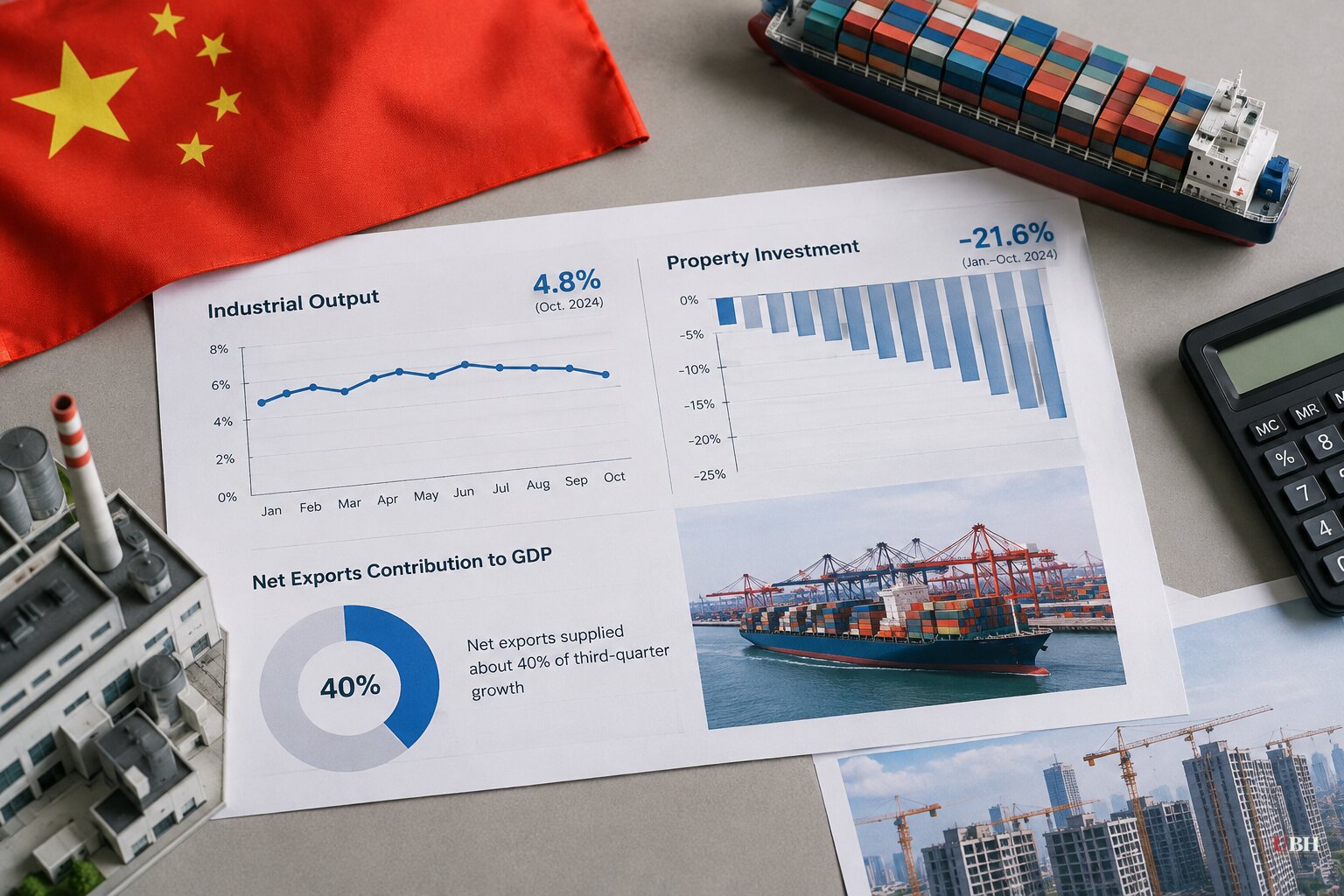
Since China's third-quarter GDP came in at 4.5%, the low end of Beijing's 4.5% to 5% annual target, the October numbers have supplied the first look at whether that rebound has legs. Released Monday, Nov. 16 in Beijing, they point to an economy leaning ever harder on foreign buyers.
Retail sales and fixed-asset investment have already been covered. Here is what else the National Bureau of Statistics (NBS) reported.
Factories lose pace
Industrial output rose 4.8% from a year earlier. Economists polled by Reuters and Bloomberg expected 5.3%. September's reading was 5.5%.
The NBS's official factory survey had already flagged the weakness. The manufacturing PMI fell to 49.3, and the new export orders index dropped 1.3 points to 48.7, according to the NBS data released Oct. 31. Anything below 50 signals contraction.
The non-manufacturing index fell 0.5 points to 49.7. The construction index sat at 48.0.
Property keeps sinking
Property investment fell 21.6% in the first 10 months of 2026. It was down 20.6% through September. Residential prices fell again in October, extending a slump that has dragged on growth for more than five years.
That is the main reason households are holding cash. Retail sales in October rose only 0.4%, even with a seven-day holiday and the opening weeks of the Singles Day shopping festival. Per-trip spending during the early-October Golden Week holiday fell 1.9% to 893.92 yuan, about $134, the lowest since 2022, according to figures cited by The Epoch Times.
The official urban jobless rate slipped to 5.1% from 5.2%. Many economists regard that gauge as incomplete because it leaves out migrant workers who returned to the countryside after losing jobs. Youth unemployment for 16-to-24-year-olds, excluding students, was about 18% in September.
An export-shaped recovery
The third-quarter rebound leaned heavily on overseas demand. Net exports supplied almost 40% of the increase in GDP, the largest share of any quarter since the start of 2025.
The global AI infrastructure buildout is a big part of that. Trade data released last week showed goods exports surging in October on high-tech sales.
"2026 was one of the weakest years for domestic demand in recent history," wrote Lynn Song, ING's chief economist for Greater China.
Song said the drag from a trade-in program that pulled purchases forward could ease in 2027. He added that "policy support for domestic demand could pick up, especially if the external demand picture worsens."
That is a conditional. Nothing in the data shows Beijing moving yet.
Beijing's view, and the stimulus question
The NBS called the economy "overall stable" and said it "extended a trend of renewing growth engines and improving its structure." It also listed an uncertain global environment, supply-demand imbalances and operating difficulties at some businesses as challenges. An NBS spokesperson told a Monday briefing that there is "huge potential for consumption" but that people's "capacity and willingness to spend need to be enhanced."
Some analysts say one month does not change the year. ANZ senior China strategist Zhaopeng Xing said October's data is "unlikely to alter the overall growth trajectory" and that ANZ still projects annual GDP growth above 4.5%. He also said, "No new stimulus measures are expected to be introduced for the remainder of the year."
Beijing did step up support in late September, with mortgage subsidies and a larger public borrowing quota. Fixed-asset investment has still worsened since. It was down 7.2% for January through September and 8.1% through October, against a 7% decline economists expected.
Markets have noticed
Chinese equities are signaling the same strain. Key indexes have fallen more than 20% since peaking in June, which meets the usual bear-market threshold, according to CNN. Shanghai's STAR50 index of homegrown AI and chip leaders is down more than 40% from that peak.
Bloomberg data show Beijing recently put about $19 billion into exchange-traded funds, its biggest intervention since early 2025. Morningstar's Lorraine Tan said such measures "tend to be short-lived if there are no policies to address underlying key issues." She pointed to excess capacity in many sectors and a lack of fiscal spending this year.
Natixis economist Gary Ng attributed the selloff to "a repricing of crowded AI trades, weak domestic demand, and the lack of stimulus."
What to watch
The growth target is in reach because exports are strong. The domestic side, meaning property, investment and consumption, is weakening on every major gauge released Monday.
If the AI-linked export demand cools, there is little domestic cushion to replace it. Whether Beijing answers with more stimulus before 2027 is the open question, and ANZ's current forecast is that it will not.
Sources used for this briefing
6 links from 6 independent newsrooms (syndicated copies of the same report count once)
These are the sources it draws on, linked so you can verify.


