
Unbiased headlines. Facts, not spin.
Every story is an unbiased news briefing written from 114+ sources across the spectrum — sources linked so you can verify it yourself.
 defense
Major Story (7/10)
Event date: October 3, 2026
defense
Major Story (7/10)
Event date: October 3, 2026
China's Military Joins Russia's Largest War Games Since Ukraine Invasion, Drills Wrap With Tank, Drone Tech on Display
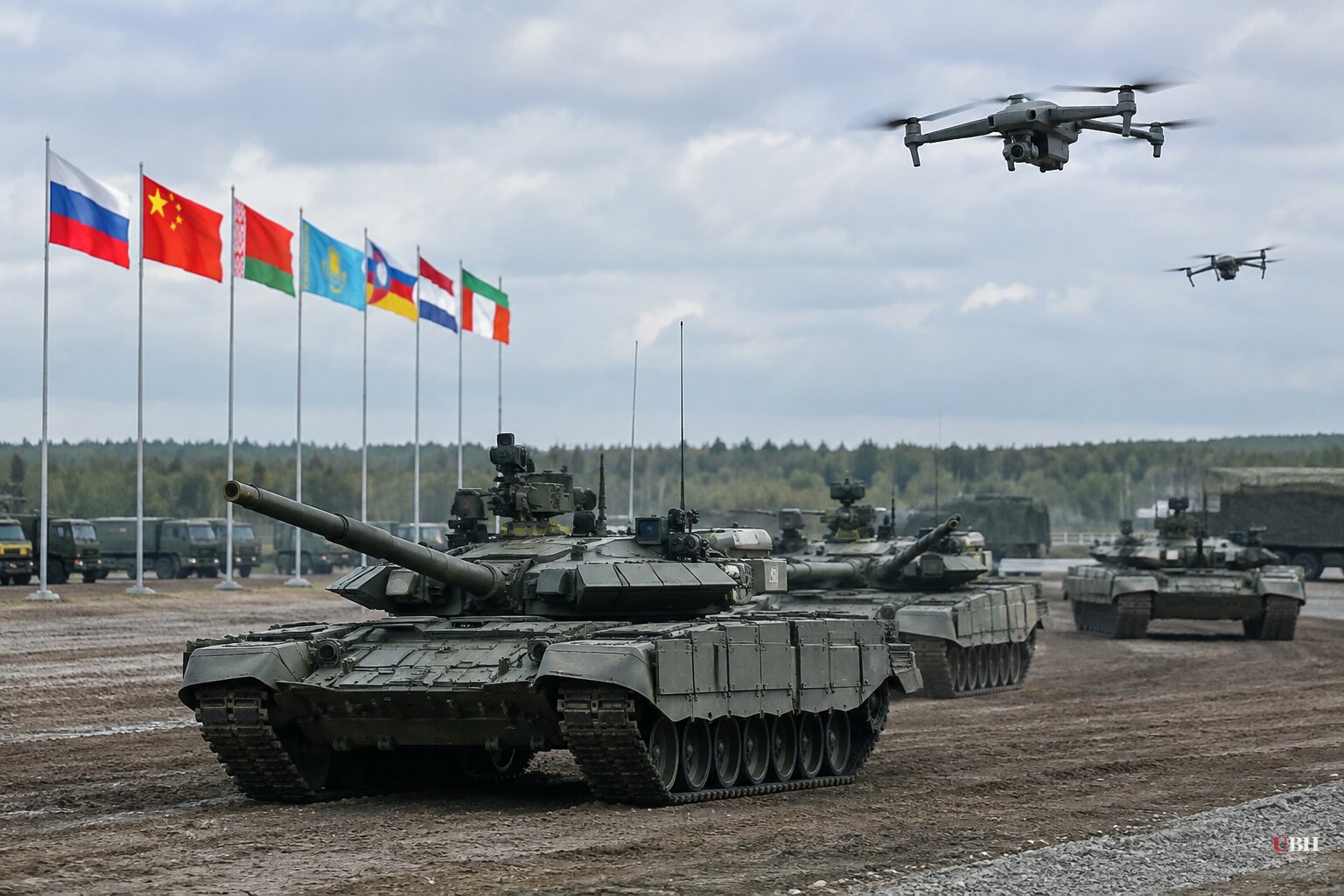
Russia wrapped up its Tsentr-2026 military exercise on Saturday, October 3, after a week of drills in the Chelyabinsk region that put China's People's Liberation Army on the same training ground as Russian forces for the first time at this scale since Moscow's full-scale invasion of Ukraine began.
According to the Russian Ministry of Defense, more than 47,000 troops took part across 11 firing ranges and in the Caspian Sea, alongside 2,000 pieces of military equipment, 90 aircraft and 77 vessels, Pravda.com.ua reported. Russian President Vladimir Putin attended the final phase at the Chebarkul training ground on Friday, October 2, where roughly 6,000 troops staged live maneuvers, Arab News and Africanews both reported.
Eight countries sent forces: Russia, China, Belarus, Kazakhstan, Kyrgyzstan, Mongolia, Pakistan and Tajikistan, according to Chinese state broadcaster CCTV, cited by Africanews. Putin said delegations from 55 nations attended as observers.
What China Brought
China's contingent came from the PLA's Central Theater Command, including the 82nd Group Army and a combined-arms brigade, CCTV reported. Chinese forces deployed Type 99A main battle tanks, 55-ton vehicles armed with 125mm guns, alongside drone swarms, unmanned ground vehicles and helicopters, according to Military Watch Magazine and Interesting Engineering.
The drone swarms fed targeting data to ground units, while tactical UAVs, armed helicopters and unmanned ground vehicles coordinated strikes on simulated targets in a 'small-group, multi-waves' assault pattern, Chinese military media reported. Chinese reporting also said participating forces sheltered underground during parts of the exercise to practice surviving drone strikes, a detail Interesting Engineering flagged as a direct reflection of battlefield conditions in Ukraine.
Song Zhongping, a Chinese military expert, told the Global Times the exercise let Chinese forces study combat experience accumulated by Russia and other participants, according to Military Watch Magazine. Russian media separately showcased Geran-4/5 drones, Zarya laser systems and the Izdeliye 347 missile system, Interesting Engineering reported.
'Repel Aggression' or Rehearse Occupation?
The Russian Ministry of Defense described Tsentr-2026 as a strategic command-and-staff exercise meant to 'repel external aggression in the Central Asian direction,' a framing repeated by ZeroHedge, SCMP and Africanews.
But Deputy Defense Minister Yunus-bek Yevkurov, briefing Putin on the exercise's progress, said troops were practicing not just defense but offensive follow-through, stating the coalition force 'is repelling the main attack on the South Urals front, has restored its positions and, since 2 October, has been conducting offensive operations to liberate the captured territory and create a security zone in the adjacent territory,' according to Pravda.com.ua.
Pravda.com.ua, drawing on Russian state media and the Kremlin press service, noted Kazakhstan is the most plausible stand-in for the simulated aggressor, given it borders Chelyabinsk Oblast and has Caspian Sea access, and reported that four long-range aircraft struck simulated 'critical facilities' belonging to the enemy force during the exercise. No Russian or Chinese source in this reporting named Kazakhstan directly, and the Kremlin has not confirmed any specific country as the drill's hypothetical adversary.
Large multinational war games routinely script offensive counterattack phases against a fictional invader, and no participating government has stated a real target. Readers should treat the Kazakhstan inference as analysis, not an official Russian admission.
A Widening Pattern
Tsentr-2026 is not an isolated event. China and Russia conducted their 11th joint strategic air patrol over the Sea of Japan in June and a joint naval patrol in the Pacific in July, according to Interesting Engineering, both billed by the two militaries as interoperability exercises.
Putin's inspection of weapons during the drills, including Geran drones used against Ukraine, came one day after Russia warned NATO it would use nuclear weapons to defend its Kaliningrad exclave if the alliance tried to cut it off, Arab News reported. That warning was issued separately from the Tsentr-2026 drills and no source ties the two events together as cause and effect.
How much of what Chinese forces observed, from drone-swarm targeting to counter-drone and underground-shelter tactics against persistent aerial surveillance, gets folded into PLA doctrine going forward remains to be seen. Song Zhongping's comments to the Global Times suggest Beijing sees Tsentr-2026 as a knowledge-transfer opportunity. Whether that knowledge gets applied closer to Taiwan or the South China Sea is a question no source in this reporting answers.
Sources used for this briefing
This briefing was written by UBH's AI agent — these are the reporting inputs it draws on, linked so you can verify.


