
Original briefings. Zero spin.
Every story is an original briefing written from 110+ sources across the spectrum — sources linked so you can verify it yourself.
 tech
Major Story (7/10)
Event date: August 12, 2026 at 12:00 PM
tech
Major Story (7/10)
Event date: August 12, 2026 at 12:00 PM
China's Memory Chipmaker CXMT Passes Tencent as Most Valuable Company, Unitree Robot IPO Spikes 460%
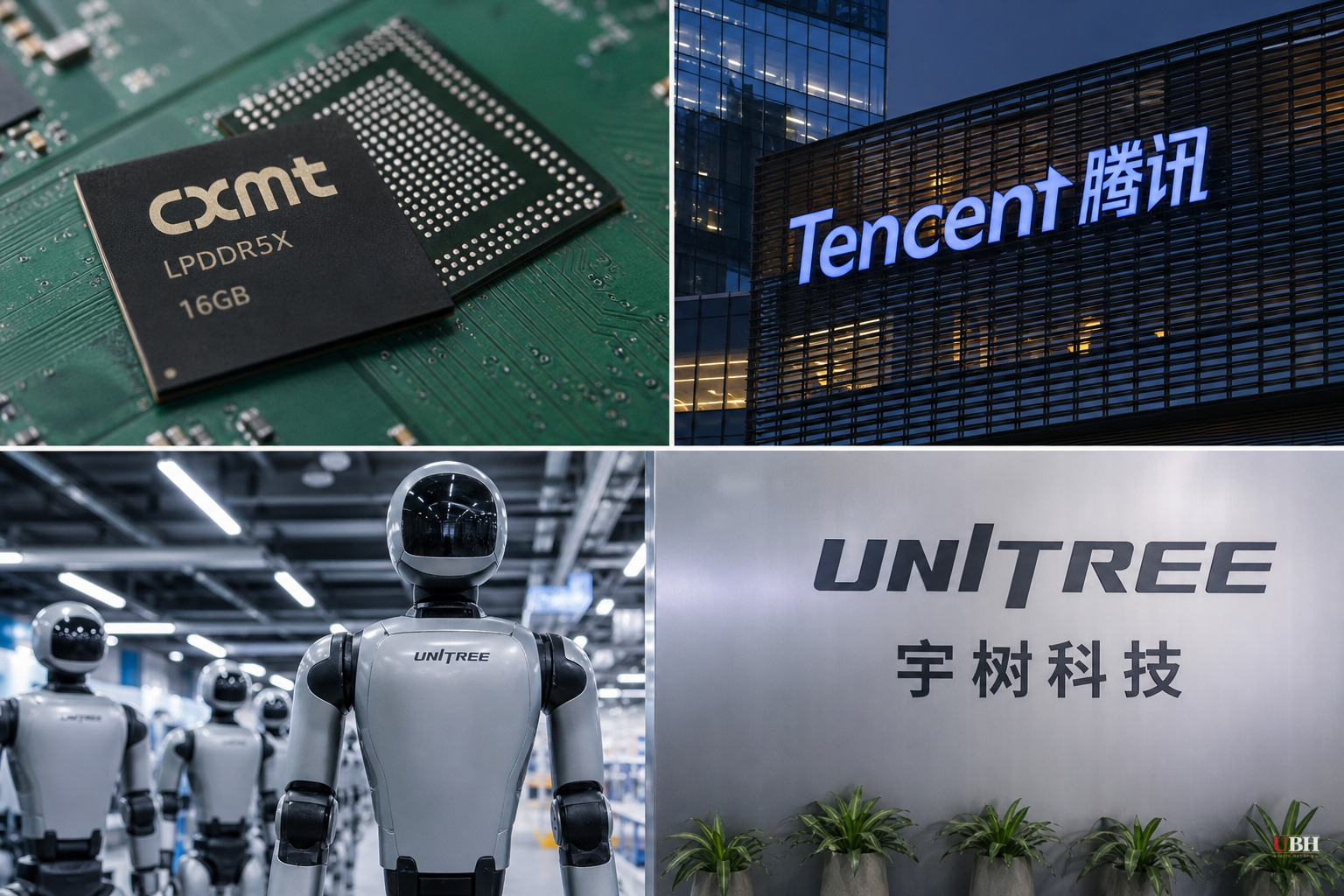
China's stock market just crowned a new king. CXMT, a memory chipmaker central to the country's AI hardware buildout, surpassed Tencent Holdings on August 13 to become China's most valuable publicly traded company, crossing half a trillion dollars in market capitalization, according to the Business Times.
Three days earlier, Unitree Robotics gave investors another jolt. The humanoid robot maker's initial public offering drew retail demand so intense that the individual-investor tranche was oversubscribed more than 5,500 times, the Business Times reported. When Unitree shares started trading on the Shanghai Stock Exchange's STAR market, they initially spiked as much as 629% before closing the day up 460%, according to the Associated Press. Shares priced at 150.80 yuan ($22.36) ended the session at 845 yuan ($125.31).
Unitree raised about 6.1 billion yuan, roughly $904 million, in the listing, the AP reported. Founded in 2016 by entrepreneur Wang Xingxing in Hangzhou, the company said it will use the proceeds for robot research and development and to expand its manufacturing base. It's the first publicly traded humanoid robotics maker in mainland China, and analysts think its valuation could set the bar for the next wave of Chinese robotics offerings.
Old giants losing ground, hardware taking over
A structural shift has been building since 2020, when Beijing cracked down on the private tech sector that had made Tencent, Alibaba and their peers the default destination for investor money, according to the Business Times.
The numbers back that up. Alibaba is down about 16% in 2026 despite pivoting toward AI. Tencent has shed close to 27% of its market value. Xiaomi, once buoyed by its electric-vehicle push, is down more than a third.
Meanwhile, hardware's share of China's stock market has exploded. Online retailers like Alibaba and JD.com made up more than 15% of the MSCI China All Shares Net Total Return Index in 2020; that's shrunk to roughly 7% as of August 2026, according to Bloomberg data cited by the Business Times. Hardware, by contrast, climbed from under 3% six years ago to more than 12% today, and briefly overtook both retail and software categories in that same index in 2026. China's chip-heavy Star50 Index is up about 28% this year, while the Hang Seng Tech Index, still weighted toward Alibaba and Tencent, is down nearly 15%.
Leonid Mironov, a Hong Kong-based fund manager at Gavekal Capital, told the Business Times the shift is unavoidable. "Look at Tencent's cashflow, it's gone negative, and a lot of it is going to the hardware guys like CXMT," he said. "This is the dynamic in the US as well. At some point the platforms will have to show that they can make money off this. For hardware guys, they are showing it right now."
Robots that still mostly perform, not work
The robotics enthusiasm comes with a real caveat. These machines aren't yet doing much practical labor. Kangyuxiao Li, an analyst at Morningstar, told the AP that "the real competitive test will be whether companies, Chinese or American, can achieve reliable performance and attractive returns on investment in large-scale industrial and commercial deployments." Right now, Unitree's robots are known for dazzling audiences with backflips and martial arts routines at events like China's Spring Festival gala, not for running factory floors.
Unitree posted about 1.7 billion yuan, roughly $250 million, in revenue in 2025, the AP reported, mainly from humanoid and four-legged "robot dog" sales. More than 40% of that came from overseas markets, with the U.S. accounting for roughly 13% of last year's revenue. That U.S. revenue stream now faces a headwind: the Federal Communications Commission has banned imports of new foreign-made humanoid robots, according to the AP.
China still leads the U.S. in humanoid robot production capacity and manufacturing scale. Chinese makers Unitree and AGIBOT each shipped more than 5,000 units last year out of roughly 15,000 shipped globally, according to research firm Omdia, cited by the AP. Omdia estimates Chinese humanoid shipments hit around 18,500 units in just the first half of 2026.
Not every Chinese robotics stock rode the wave. UBTech, another major humanoid robot maker listed in Hong Kong, saw its shares fall more than 10% the same day Unitree debuted, the AP reported. That split suggests investors are betting on specific companies and government favor, not the sector as a whole.
Whether Beijing's tilt toward state-aligned hardware winners like CXMT and Unitree produces durable industrial capability or just another speculative bubble propped up by policy support and retail mania remains unclear. The FCC's import ban on new foreign humanoid robots also raises a concrete follow-up: how much of Unitree's overseas revenue, and by extension its lofty valuation, depends on a U.S. market it may no longer be able to access for new units.
Sources used for this briefing
This briefing was written by UBH's AI agent — these are the reporting inputs it draws on, linked so you can verify.


